
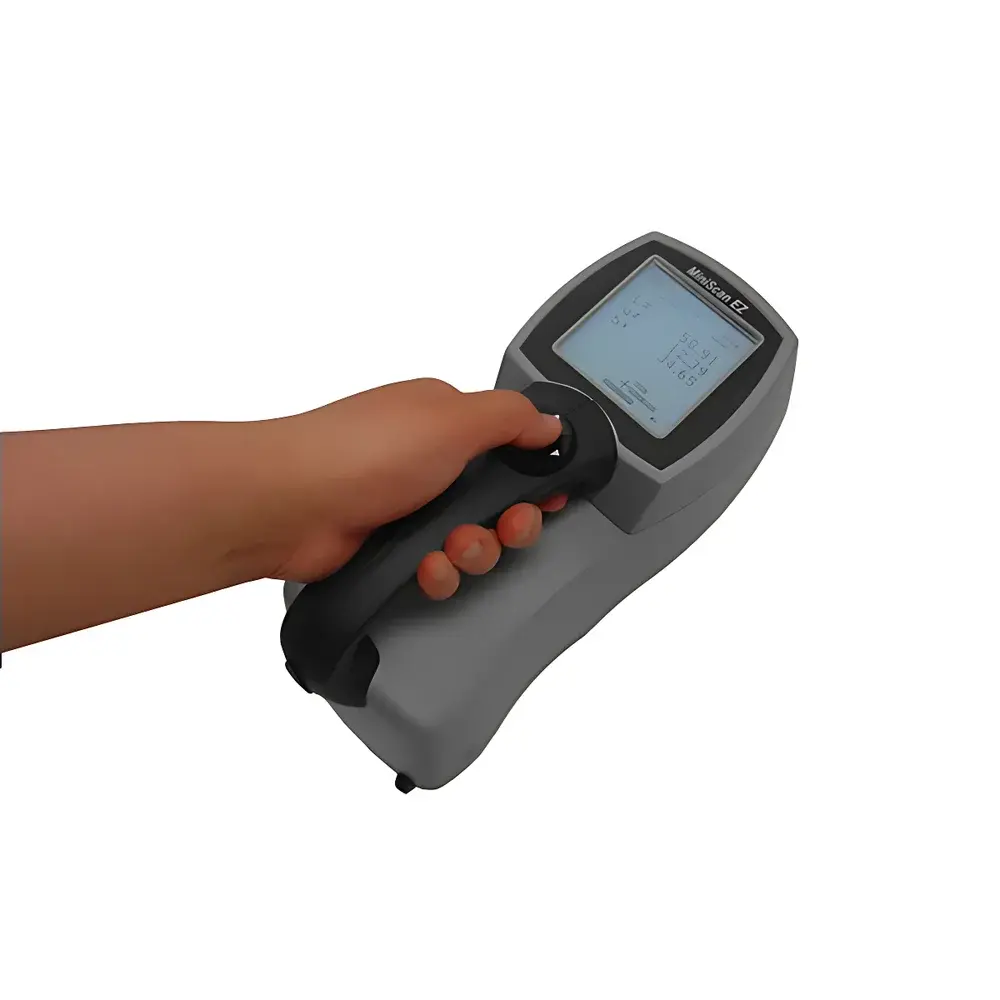
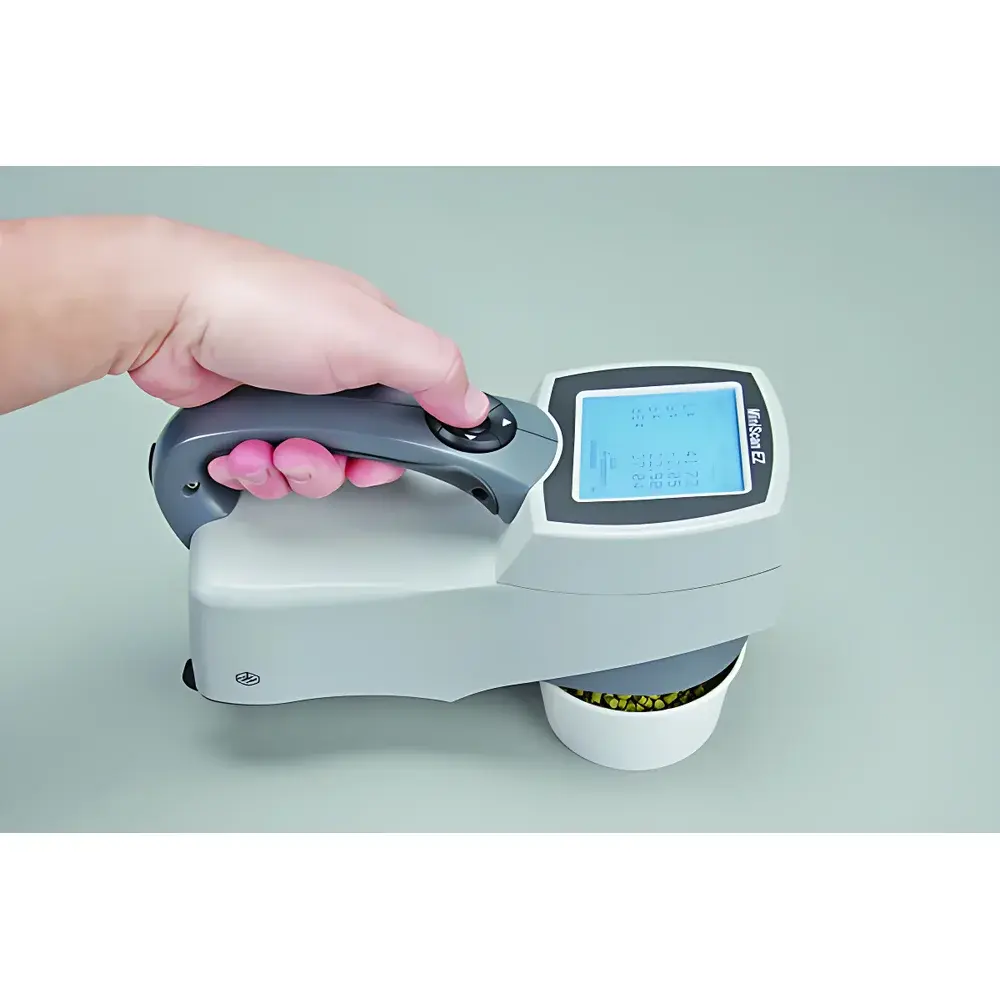
HunterLab MiniScan EZ Portable Colorimeter & Yellowness Index Analyzer
| Brand | HunterLab |
|---|---|
| Origin | USA |
| Manufacturer Type | Authorized Distributor |
| Product Category | Imported Instrument |
| Model | HunterLab MiniScan EZ |
| Price Range | USD 13,500–20,500 (FOB) |
| Product Type | Portable Color Difference Meter |
| Optical Geometry | 0/45° Integrating Sphere |
| Light Source | Pulsed Xenon Lamp |
| Spectral Range | 400–700 nm |
| Repeatability | ΔE*ab ≤ 0.05 (mean, CIE Lab, 10 readings on white tile) |
Overview
The HunterLab MiniScan EZ is a high-precision portable colorimeter engineered for rigorous color measurement across industrial and laboratory environments. Based on the proven 0/45° optical geometry with an integrating sphere detector, it delivers spectrophotometric accuracy without requiring benchtop infrastructure. Unlike conventional d/8° instruments that average diffuse reflectance, the 0/45° configuration replicates human visual perception under standardized viewing conditions—making it ideal for evaluating surface appearance, gloss-sensitive samples, and directional color effects in coatings, plastics, textiles, and packaging. The instrument measures full spectral reflectance at 10 nm intervals across the visible spectrum (400–700 nm), enabling calculation of CIE L*a*b*, CIE XYZ, Yellowness Index (ASTM E313, ASTM D1925), Whiteness Index (CIE, Ganz, Berger), and other industry-standard metrics. Its pulsed xenon light source ensures stable, flash-based illumination with >500,000 flashes lifetime—eliminating thermal drift and lamp aging artifacts common in tungsten-halogen or LED-based systems.
Key Features
- Industry-exclusive dual calibration capability: certified white tile + green tile calibration—significantly improving long-term photometric stability and reducing inter-instrument agreement error.
- Modular aperture system supporting five measurement configurations: 45°/0° LAV (31.8 mm port), 45°/0° SAV (6.0 mm), d/8° LAV (25.0 mm), d/8° SAV (14.3 mm), and d/8° VSAV (6.0 mm)—enabling precise adaptation to heterogeneous, textured, or small-area samples.
- High-resolution 6.4 cm × 6.4 cm LCD display with four-axis rotation (0°/90°/180°/270°), optimized for ergonomic single-hand operation in production-line or field settings.
- Flexible power architecture: rechargeable NiCd battery pack or optional AC adapter (120/220 VAC); eliminates proprietary battery dependency and reduces total cost of ownership versus legacy MiniScan XE Plus units.
- Ruggedized housing (10.2 × 12.7 × 25.4 cm; 1.3 kg) with IP54-rated ingress protection against dust and incidental water exposure—validated for use in manufacturing floors, QC labs, and warehouse inspection zones.
Sample Compatibility & Compliance
The MiniScan EZ accommodates opaque solids, powders, pastes, gels, and transparent/semi-transparent liquids via optional liquid cell holders. Its 0/45° geometry avoids specular component exclusion errors inherent in d/8° systems when measuring glossy or structured surfaces. All measurements comply with CIE Publication No. 15:2018, ISO 7724-1:2022 (Colorimetry – Part 1: CIE standard colorimetric observers), ASTM D2244 (Standard Practice for Calculation of Color Tolerances), and ASTM E313 (Standard Test Method for Calculating Yellowness and Whiteness Indices). Instrument firmware supports audit-ready data logging aligned with GLP and FDA 21 CFR Part 11 requirements—including user authentication, electronic signatures, and immutable timestamped measurement records.
Software & Data Management
Data acquisition and analysis are managed through HunterLab’s EasyMatch QC software (Windows-based), which provides real-time pass/fail tolerancing, statistical process control (SPC) charting, multi-instrument fleet synchronization, and automated report generation in PDF, CSV, or Excel formats. The software enforces role-based access control and maintains full traceability from raw spectral data to final index values (e.g., YI E313, WI CIE). Optional API integration enables direct linkage to MES, LIMS, and ERP platforms via TCP/IP or OPC UA protocols—supporting Industry 4.0-ready quality workflows.
Applications
The MiniScan EZ serves as a primary color verification tool in regulated and non-regulated sectors including polymer compounding (color masterbatch consistency), pharmaceutical tablet coating uniformity (USP compliance), food ingredient batch release (yellowness monitoring in starches, sugars, dairy powders), architectural glass tint evaluation, textile dye lot matching, and solar panel anti-reflective coating homogeneity assessment. Its portability and dual-calibration architecture make it especially valuable for supplier audits, incoming raw material inspection, and cross-site method transfer validation.
FAQ
Does the MiniScan EZ support ASTM D1925 Yellowness Index calculations?
Yes—preconfigured algorithms compute YI per ASTM D1925 and ASTM E313, with selectable illuminants (C, D65) and observers (2° or 10°).
Can the instrument measure translucent or liquid samples?
Yes—with optional liquid transmission cells or backlit sample holders; spectral transmittance data is acquired across the same 400–700 nm range.
Is firmware upgradable in the field?
Yes—via USB connection and EasyMatch QC; all updates maintain backward compatibility with existing calibration files and measurement databases.
What is the spectral bandwidth specification?
Effective optical bandwidth is <12 nm (triangular shape), with wavelength resolution <3 nm—meeting ISO 7724-3:2022 requirements for Class I colorimeters.
How is measurement repeatability verified?
Instrument performance is validated using NIST-traceable ceramic tiles; repeatability of ΔE*ab ≤ 0.05 is specified per CIE 117:1995 and confirmed during factory certification.



