
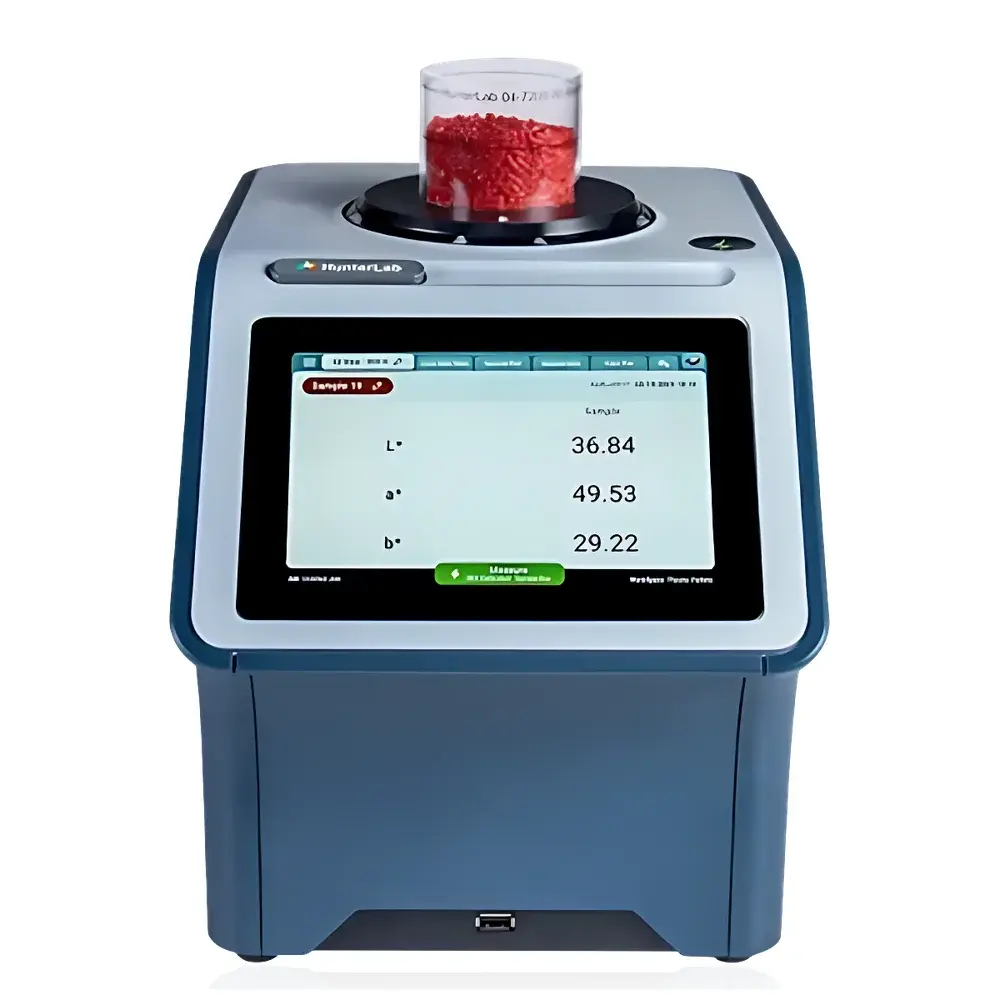
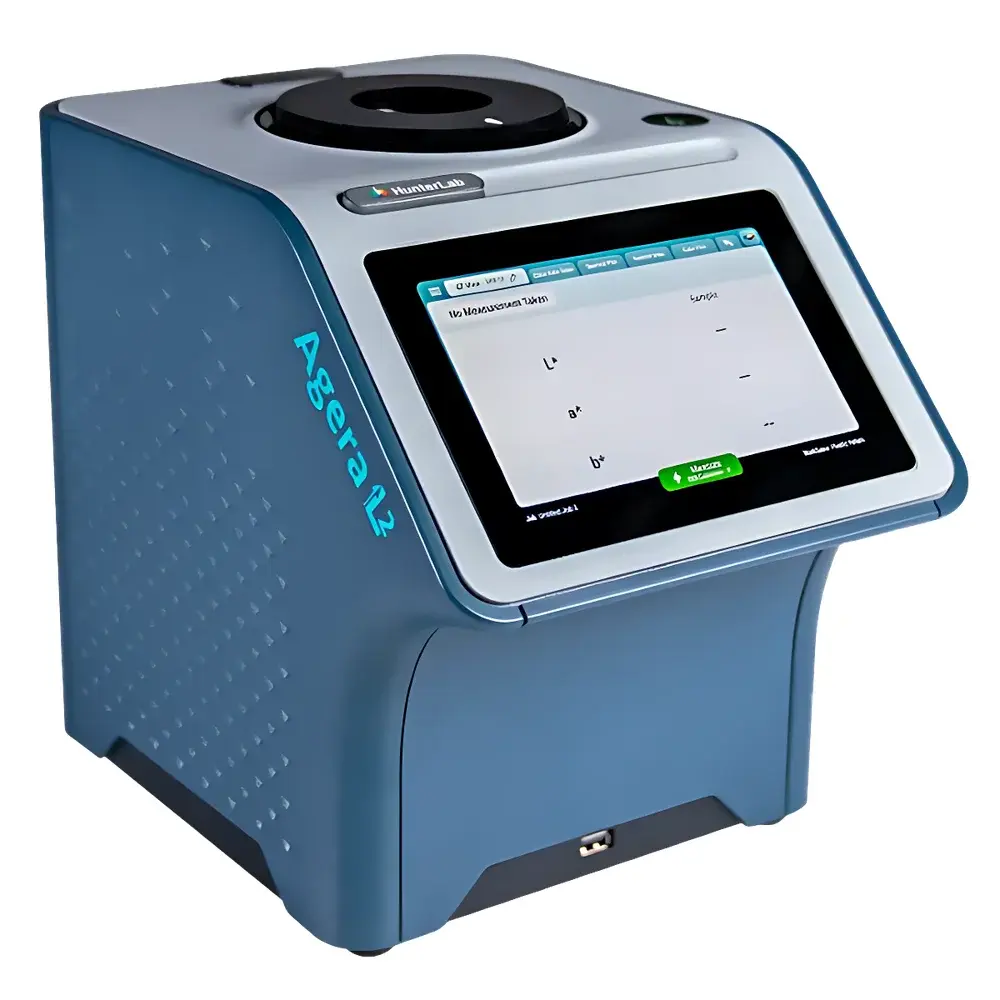
HunterLab Agera L2 Benchtop Spectrophotometer
| Brand | HunterLab |
|---|---|
| Origin | USA |
| Model | Agera-L2 |
| Product Type | Colorimeter |
| Instrument Type | Benchtop |
| Optical Geometry | 45/0° |
| Light Source | Full-spectrum balanced LED array |
| Spectral Range | 400 nm – 700 nm |
| Repeatability | ΔE* ≤ 0.03 |
| Measurement Aperture | Large-area (up to 16× standard) |
| Integrated Capabilities | Simultaneous color + 60° gloss measurement |
| Built-in Imaging | High-resolution sample alignment camera with image capture and metadata embedding |
Overview
The HunterLab Agera L2 is a high-precision benchtop spectrophotometer engineered for rigorous color measurement in industrial quality control and R&D environments where visual consistency, long-term stability, and regulatory traceability are mission-critical. Operating on the 45/0° optical geometry—defined by ISO 7724-1 and CIE 15:2004—the instrument eliminates directional bias from surface texture or gloss by illuminating the sample at 45° and collecting reflected light perpendicularly (0°), ensuring robustness across structured, directional, or low-reflectance substrates. Its full-spectrum balanced LED array replicates the spectral power distribution of D65 daylight illumination with exceptional stability and minimal thermal drift, enabling measurement fidelity that aligns closely with human visual perception under standardized viewing conditions—even in non-controlled ambient lighting. This “Visual Truth” technology is not a marketing term but a metrological framework grounded in CIELAB color space computation, chromatic adaptation transforms (CAT02), and observer functions compliant with the CIE 1931 2° standard observer.
Key Features
- Large-Area Measurement Aperture: Delivers up to 16× the sampling area of conventional 45/0° instruments (e.g., 30 mm Ø vs. typical 7.5–15 mm), significantly reducing spatial variance caused by surface texture, weave directionality, or pigment dispersion heterogeneity—particularly critical for recycled plastics, embossed films, and coarse textiles.
- Integrated Sample Imaging System: A high-resolution coaxial camera captures real-time, geometrically registered images during every measurement. Images are embedded directly into data files with timestamp, instrument ID, aperture selection, and illumination status—supporting GLP-compliant audit trails, operator training validation, and remote measurement verification.
- Simultaneous Color & Gloss Measurement: Measures CIE L*a*b*, ΔE*00, Yellowness Index (YI E313, ASTM D1925 & ASTM E313-20), whiteness, opacity, and 60° gloss (per ASTM D2457 and ISO 2813) in a single acquisition cycle—eliminating repositioning, inter-instrument calibration drift, and workflow fragmentation.
- D65-Centric Illumination Architecture: LED spectral output is actively stabilized via onboard photodiode feedback, maintaining <±0.2% spectral deviation over 10,000 hours—ensuring compliance with ASTM E308 and ISO/CIE colorimetric computation standards without periodic lamp replacement or recalibration.
- Robust Mechanical Design: Precision-machined aluminum housing, motorized aperture selection, and sealed optical path minimize particulate ingress and thermal expansion effects—validated for continuous operation in QC labs meeting ISO/IEC 17025 environmental class 2 (20 ± 2°C, 50 ± 10% RH).
Sample Compatibility & Compliance
The Agera L2 is validated for use with opaque and translucent materials exhibiting reflectance values as low as 20%—including post-consumer recycled (PCR) polymers, metallized packaging foils, retroreflective sheeting, pharmaceutical film coatings, and pigment-dispersed elastomers. It meets essential regulatory and industry requirements: ASTM D1925 (Yellowness Index), ASTM E313 (YI and Whiteness), ISO 11475 (paper color), ISO 12048 (plastic color), and USP <1061> (color uniformity of solid dosage forms). Data integrity features—including user-level access controls, electronic signatures, and immutable audit logs—align with FDA 21 CFR Part 11 and EU Annex 11 expectations for computerized systems in GMP environments.
Software & Data Management
Controlled via HunterLab’s EasyMatch QC software (v5.0+), the Agera L2 supports automated pass/fail evaluation against multi-parameter tolerances (e.g., L* ±0.2, a* ±0.15, gloss ±0.5 GU), SPC charting with X̄/R and Cpk calculation, and export to LIMS via ASTM E1384-compliant XML or CSV. All measurement records include embedded EXIF metadata (camera exposure, focus status, LED intensity history), enabling forensic reconstruction of measurement context. Software validation packages (IQ/OQ/PQ documentation, test scripts) are available for regulated industries.
Applications
Primary application domains include: color release testing of injection-molded automotive interior components; yellowness index trending in UV-stabilized polyolefins; batch-to-batch consistency verification of pigment masterbatches; gloss-color correlation analysis in high-barrier food packaging; whiteness qualification of medical-grade PVC tubing; and stability monitoring of light-sensitive pharmaceutical excipients under ICH Q1B photo-stability protocols. The instrument is routinely deployed in laboratories accredited to ISO/IEC 17025 for color measurement.
FAQ
Does the Agera L2 comply with ASTM D1925 for Yellowness Index calculation?
Yes—it implements the exact tristimulus integration method specified in ASTM D1925-22 using CIE 1931 2° observer data and D65 illuminant, with spectral bandwidth correction applied per ASTM E308-23.
Can measurement images be exported independently of color data?
Yes—images are stored in lossless PNG format within the native .hqd file and can be extracted programmatically or via batch export in EasyMatch QC.
Is 60° gloss measurement traceable to NIST standards?
Gloss optics are factory-calibrated using NIST-traceable ceramic standards (certified 10 GU and 90 GU), with calibration verification documented in the instrument’s Certificate of Conformance.
What is the minimum sample size required for reliable large-aperture measurement?
For optimal repeatability, samples should exceed 35 mm in diameter or linear dimension; smaller specimens may be measured using optional mask inserts to prevent edge diffraction artifacts.
Does the system support multi-instrument network synchronization?
Yes—via Ethernet-connected EasyMatch QC servers with centralized database architecture, enabling cross-site color harmonization and global tolerance management.



