
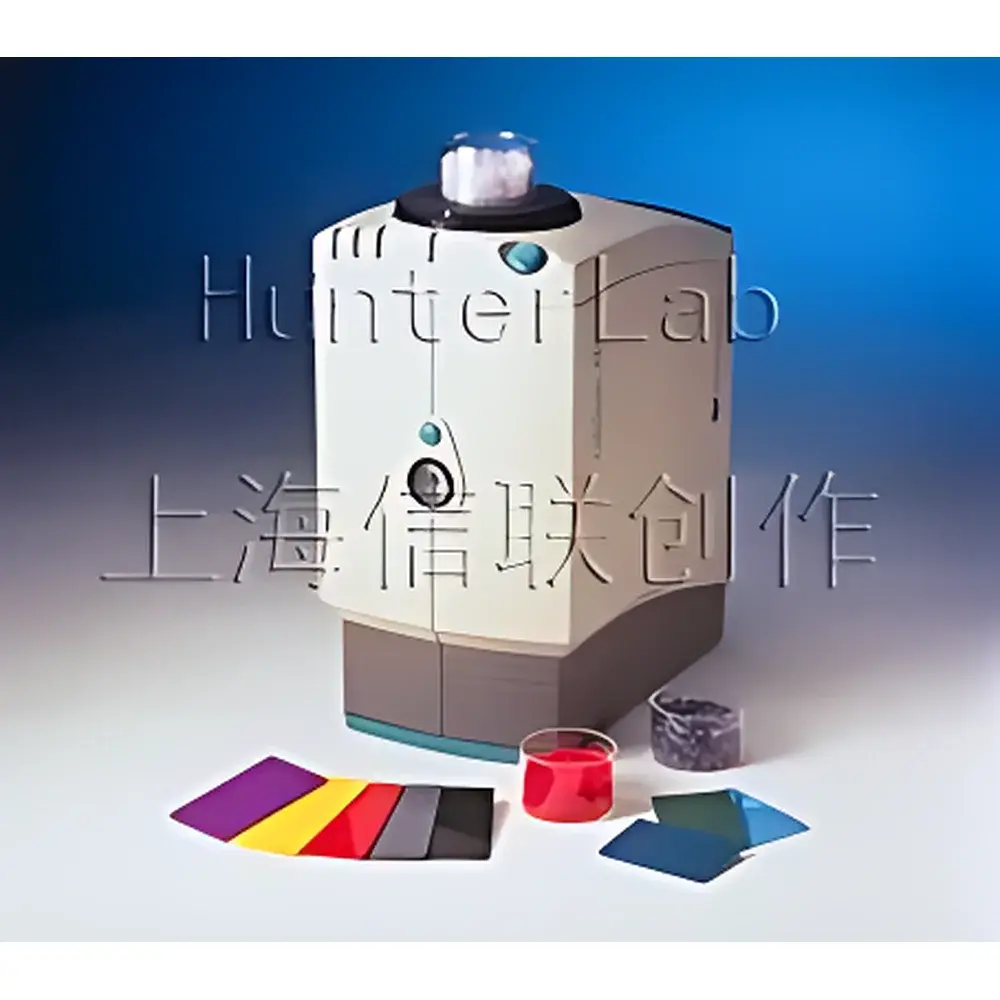
HunterLab LabScan XE Desktop Spectrophotometer for Yellowness Index (YI) and Color Measurement of Epoxy Resins
| Brand | HunterLab |
|---|---|
| Origin | USA |
| Model | LabScan XE |
| Product Type | Spectrophotometer |
| Instrument Type | Benchtop |
| Optical Geometry | 0°/45° |
| Light Source | Pulsed Xenon Lamp |
| Spectral Range | 400–700 nm |
| Wavelength Interval | 10 nm |
| Detector | 256-element silicon photodiode array with diffraction grating |
| Aperture Options | 44 mm, 25 mm, 13 mm, 6 mm, 3 mm (motorized variable aperture) |
| Repeatability (ΔE*ab) | ≤ 0.09 |
| Measurement Time | ≤ 3 s |
| Reflectance Range | 0–150% |
| UV Filtering | Optional 420 nm cut-off filter |
| Compliance | CIE No. 15, ASTM E308, ASTM D1925 (Yellowness Index), ASTM E2698 (Plastics), ISO 7724, ISO 11664, USP <631>, FDA 21 CFR Part 11 (with EasyMatch-QC software enabled) |
Overview
The HunterLab LabScan XE is a high-precision benchtop spectrophotometer engineered for quantitative color and yellowness assessment of transparent, translucent, and opaque materials—including epoxy resins, cured polymer films, coatings, pharmaceutical excipients, and plastic formulations. It operates on a dual-beam 0°/45° optical geometry, which replicates the human visual response to surface texture and gloss while eliminating directional bias inherent in integrating sphere systems. This configuration ensures metrological traceability to CIE standards and delivers measurement stability critical for monitoring yellowing (YI) in thermosetting resins during thermal aging, UV exposure, or long-term storage. The instrument employs a pulsed xenon lamp with spectral output closely matching CIE Illuminant D65—enabling accurate evaluation of fluorescent whitening agents and UV-reactive additives commonly found in epoxy systems. Its 400–700 nm spectral range, sampled at 10 nm intervals across 256 detection channels, supports full-spectrum analysis required for calculating ASTM D1925 Yellowness Index, CIE L*a*b*, ΔE*ab, K/S values, whiteness, opacity, and spectral absorbance.
Key Features
- Dual-beam 0°/45° optical path with motorized, five-position variable aperture (3 mm to 44 mm) for flexible sample coverage—from micro-domains on cured resin chips to large-area cast films.
- Pulsed xenon light source with >1 million flash lifetime; integrated 420 nm UV cut-off filter option for controlled UV energy delivery—essential for distinguishing photo-oxidative yellowing from thermal degradation mechanisms.
- High signal-to-noise ratio achieved via ring-shaped photodetector array and anti-stray-light variable-focus optics, minimizing interferences from surface scattering in textured or filled epoxy composites.
- Automated calibration validation with built-in ceramic tile reference and real-time drift compensation—ensuring long-term repeatability of ≤0.09 ΔE*ab under GLP-compliant operation.
- Benchtop architecture with front-panel tactile measurement trigger and status LED indicators—designed for integration into QC laboratories with ISO/IEC 17025-controlled workflows.
Sample Compatibility & Compliance
The LabScan XE accommodates solid, powdered, granular, and paste-like specimens without requiring liquid cuvettes or destructive preparation—ideal for monitoring yellowing in uncured epoxy prepolymers, B-staged films, or post-cure molded parts. Optional accessories include polarization-compensating holders for birefringent cured resins and custom sample cups for viscous amine-hardened systems. The system complies with ASTM D1925 (Yellowness Index), ASTM E308 (standard practice for computing color tolerances), ISO 7724-1 (colorimetry fundamentals), and USP (color measurement of pharmaceuticals). When paired with EasyMatch-QC software configured for audit trail and electronic signatures, it meets FDA 21 CFR Part 11 requirements for regulated environments.
Software & Data Management
Controlled via HunterLab’s EasyMatch-QC platform, the LabScan XE supports automated method-driven workflows—including multi-point YI trending, pass/fail limits per batch, and statistical process control (SPC) charting. Raw spectral data (36 points per nm interval) is exportable in CSV or XML format for secondary analysis in MATLAB or Python-based aging models. Software modules support ASTM D1925 YI calculation with both CIE 1931 2° and 10° observer weighting, as well as custom index development for proprietary resin formulations. All measurement events—including operator ID, timestamp, calibration history, and environmental metadata (temperature/humidity)—are logged with immutable audit trails compliant with GLP/GMP documentation standards.
Applications
- Quantifying yellowing kinetics in bisphenol-A and novolac epoxy systems exposed to accelerated thermal cycling (e.g., 85°C/85% RH per IPC-TM-650 2.6.25).
- Validating UV stabilizer efficacy in optically clear encapsulants for LED packaging and aerospace composites.
- Monitoring batch-to-batch consistency of amine-cured resins across production lots using YI tolerance bands defined per internal QMS.
- Correlating spectral shift (e.g., 420–450 nm absorbance rise) with FTIR carbonyl index in degradation studies.
- Supporting ICH Q5C stability protocols for polymer-based drug delivery devices where color change signals hydrolytic breakdown.
FAQ
Does the LabScan XE comply with ASTM D1925 for Yellowness Index reporting?
Yes—the instrument calculates YI per ASTM D1925 using CIE tristimulus values derived from its calibrated 400–700 nm spectrum, with selectable 2° or 10° standard observer functions.
Can it measure yellowing in liquid epoxy resins before curing?
Yes, using optional liquid cell holders and the 3 mm or 6 mm aperture setting to minimize path-length variability and fluorescence saturation.
Is UV filtering mandatory for epoxy yellowing studies?
Not mandatory, but strongly recommended when evaluating UV-induced degradation; the 420 nm cut-off filter isolates visible-region chromophore formation from UV-excited artifacts.
How does the 0°/45° geometry improve reproducibility over sphere-based instruments for textured epoxy surfaces?
It eliminates inter-reflection errors caused by diffuse scattering in rough or pigmented cured surfaces—yielding higher correlation with visual assessment under standardized viewing conditions.
What software validation documentation is available for regulated labs?
HunterLab provides IQ/OQ/PQ protocols, 21 CFR Part 11 configuration guides, and raw data integrity verification reports upon request—fully aligned with Annex 11 and ALCOA+ principles.





