
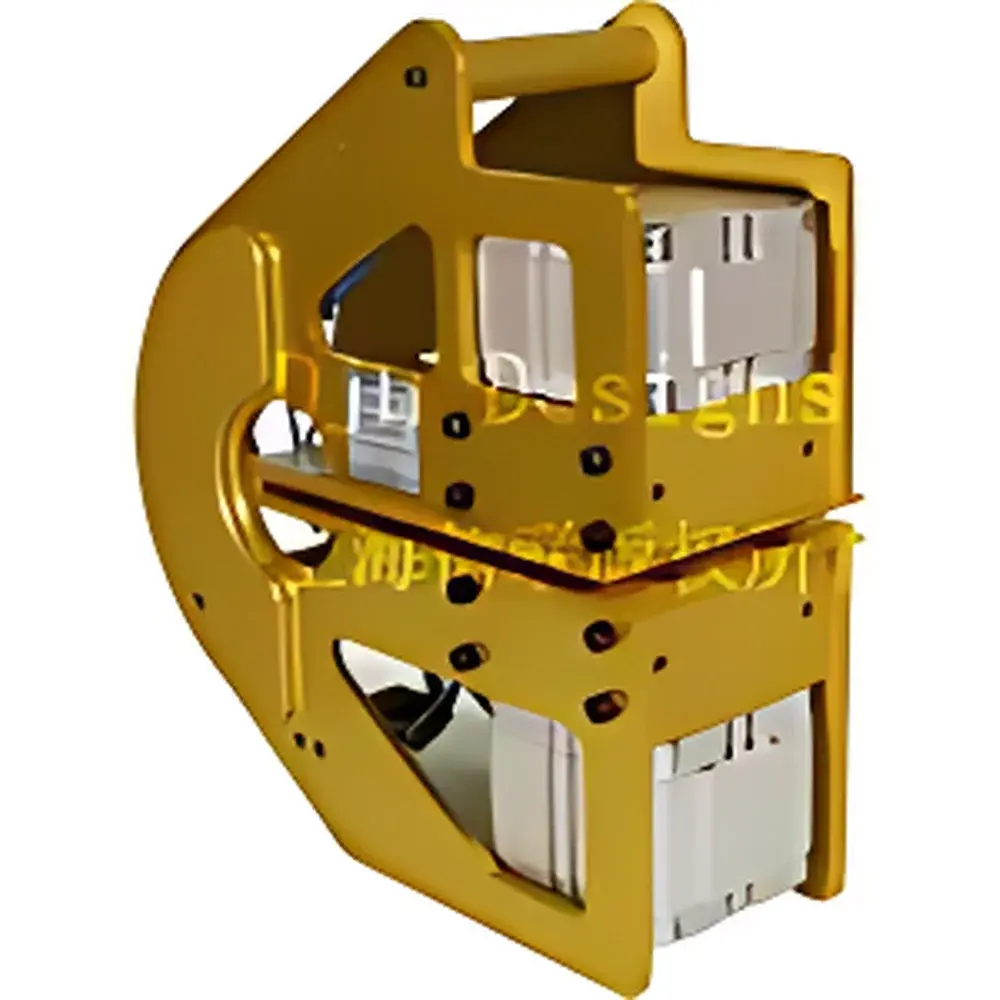
DJH STRIP-LOK Joiner GP – General Purpose Pneumatic Metal Strip Splicing Tool
| Brand | DJH Designs |
|---|---|
| Origin | Canada |
| Manufacturer Type | Authorized Distributor |
| Origin Category | Imported |
| Model | GP – General Purpose |
| Pricing | Available Upon Request |
| Operating Air Pressure | 600–760 kPa |
| Weight | 11.8 kg |
| Dimensions (L×W×H) | 33 × 155 × 368 mm |
| Entry Depth | 185 mm |
| Entry Gap Opening | 8 mm |
| Max. Soft Steel Thickness per Layer | 0.7 mm |
| Max. Total Stack Thickness | 1.8 mm |
| Noise Level | Low (No Mechanical Impact or Arcing) |
| Consumables | None Required |
Overview
The DJH STRIP-LOK Joiner GP is a precision-engineered, pneumatic-driven metal strip splicing tool designed for high-reliability seam joining in continuous coil processing lines. Unlike welding, riveting, or adhesive bonding, the STRIP-LOK GP employs cold mechanical interlocking—applying controlled compressive force to deform overlapping strip edges into a self-locking, interference-fit joint. This process preserves base material metallurgy, eliminates heat-affected zones (HAZ), and avoids volatile organic compound (VOC) emissions or consumable waste. It is purpose-built for inline repair of longitudinal splits, transverse breaks, and end-to-end splices in coated and uncoated steel, aluminum, and galvanized strip substrates—particularly within continuous hot-dip galvanizing (HDG), coil coating, and tinplate production lines where process continuity, surface integrity, and regulatory compliance are critical.
Key Features
- Lightweight portable design (11.8 kg) with ergonomic handle and low center of gravity for single-operator use in confined line-access zones.
- Compact footprint (33 × 155 × 368 mm) enables deployment between tension stands, ovens, and coating applicators without line reconfiguration.
- Pneumatic actuation (600–760 kPa) delivers consistent clamping force and repeatable joint geometry—critical for maintaining downstream tension control and minimizing web tracking deviation.
- No consumables required: eliminates dependency on weld wire, rivets, adhesives, or abrasive media—reducing total cost of ownership and simplifying inventory management.
- Zero electrical power requirement and silent operation (<65 dB(A)) support safe integration into Class I Division 2 hazardous areas and noise-sensitive facilities.
- Tool-free die change capability allows rapid adaptation between standard and reinforced joint configurations for varying substrate thicknesses and yield strengths.
Sample Compatibility & Compliance
The STRIP-LOK GP accommodates ferrous and non-ferrous metallic strips up to 1.8 mm total stack thickness—including low-carbon steel (up to 0.7 mm per layer), electrolytic tinplate, aluminized steel, and 3000/5000-series aluminum alloys. Joint integrity meets ASTM A924/A924M (Standard Specification for General Requirements for Steel Sheet, Metallic-Coated by the Hot-Dip Process) for splice strength retention under continuous tensile loading. The device complies with ISO 4414 (Pneumatic fluid power — General rules and safety requirements for systems and their components) and CSA Z432-22 (Safeguarding of Machinery). Its mechanical-only operation supports adherence to FDA 21 CFR Part 11 data integrity principles when integrated with line-level SCADA systems for event logging.
Software & Data Management
As a standalone mechanical tool, the STRIP-LOK GP does not incorporate embedded firmware or onboard software. However, its operational parameters—including air pressure setpoint, actuation count, and timestamped usage logs—are fully compatible with industrial IoT gateways (e.g., Siemens Desigo CC, Rockwell FactoryTalk Analytics) via analog 4–20 mA pressure feedback and dry-contact cycle pulse outputs. Integration enables traceable splice records aligned with GLP/GMP documentation requirements, including audit trails for corrective action review during quality system inspections.
Applications
- Emergency splice repair in continuous galvanizing lines (CGL) following strip breakage—minimizing furnace cooldown time and zinc dross generation.
- Seam reinforcement at weld zone transitions in tandem cold mills to prevent edge splitting during high-strain reduction passes.
- Temporary bridging of micro-cracks in pre-painted coil prior to recoiling—preserving coating adhesion and gloss uniformity.
- In-line splice fabrication during slitting or cut-to-length operations where laser welding is impractical due to coating interference or thermal distortion risk.
- Field service use in OEM roll-forming plants for rapid commissioning splice validation without external power sources.
FAQ
What materials can the STRIP-LOK GP join reliably?
It is validated for low-carbon steel, electrogalvanized steel, hot-dip galvanized steel, and non-heat-treatable aluminum alloys (e.g., AA3003, AA5052) with total stack thickness ≤1.8 mm.
Does the tool require calibration or periodic certification?
No scheduled calibration is mandated; however, daily verification of air pressure regulator accuracy and visual inspection of die wear per manufacturer’s maintenance checklist (Ref. DJH-MN-072) is recommended.
Can it be used on painted or polymer-coated substrates?
Yes—cold mechanical joining avoids thermal degradation of organic coatings and maintains specified film thickness integrity across the splice zone.
Is operator training required before deployment?
Yes—DJH-certified technicians must complete a 4-hour hands-on competency program covering pneumatic safety, joint geometry assessment, and line-integration protocols.
How does joint strength compare to resistance welding?
Tensile strength typically achieves 85–92% of base material UTS for properly aligned soft steel splices, with superior fatigue performance in cyclic bending applications due to absence of brittle intermetallic phases.






