
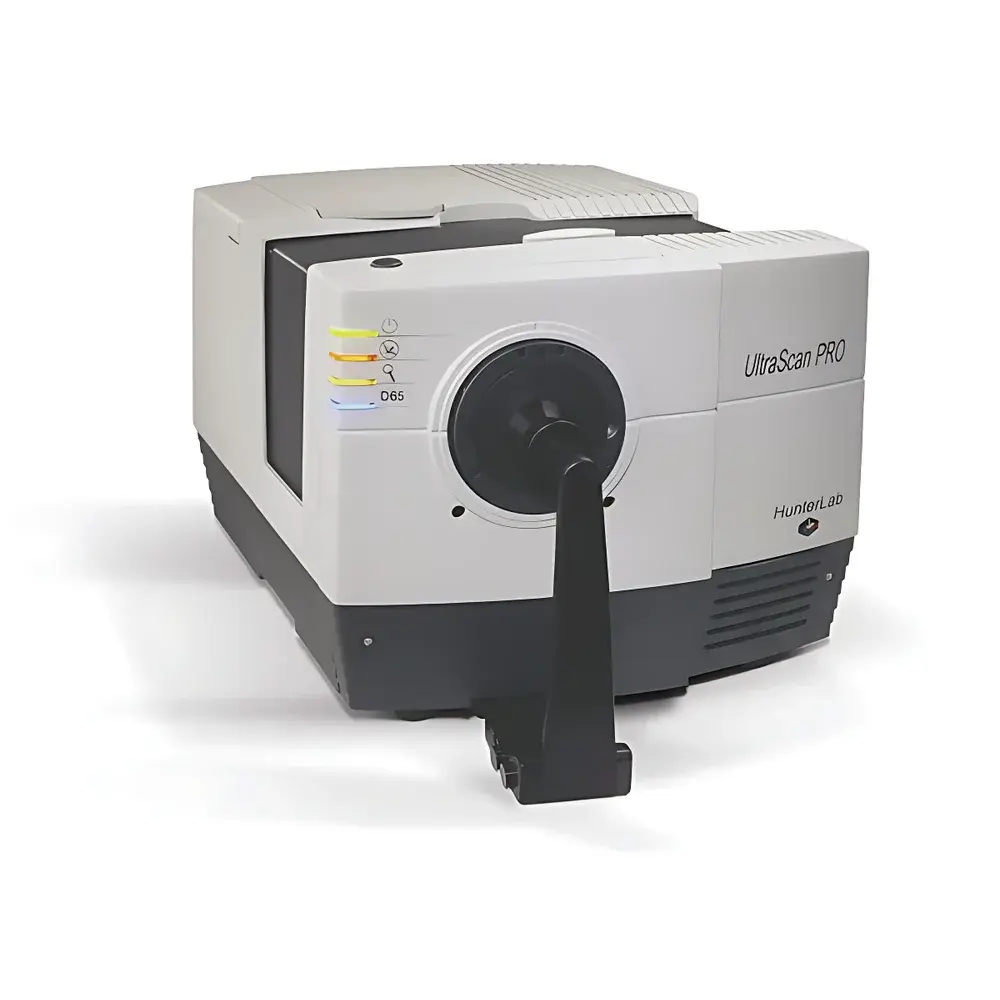
HunterLab UltraScan PRO Spectrophotometer for Optical Lenses
| Brand | HunterLab |
|---|---|
| Origin | USA |
| Model | UltraScan PRO |
| Instrument Type | Benchtop Spectrophotometer |
| Optical Geometry | d/8° Integrating Sphere (with Specular Component Included/Excluded) |
| Light Source | Pulsed Xenon Lamp (Triple-Lamp Configuration) |
| Spectral Range | 350–1050 nm |
| Spectral Resolution | <2 nm (1.37 nm FWHM) |
| Reporting Interval | 5 nm |
| Photometric Range | 0–200% |
| Photometric Repeatability | ≤0.03 ΔE*ab (mean, CIE Lab) |
| Aperture Options | 19 mm (LAV), 9 mm (MAV), 4 mm (SAV) |
| Measurement Time | ≤2 s |
| Wavelength Accuracy | ±0.1 nm |
| Stray Light | <0.05% at 340 nm |
| Detector | 512-element Silicon Photodiode Array |
| Grating | Dual Holographic Diffraction Grating |
| Integrating Sphere Coating | Spectraflect® (152 mm diameter) |
| Compliance | CIE No. 15, ASTM E308, E2153, D2244, D6290, ISO 7724, ISO 11664, USP <1061>, FDA 21 CFR Part 11 (with EasyMatch-QC v5.0+) |
Overview
The HunterLab UltraScan PRO Spectrophotometer for Optical Lenses is a high-precision, benchtop dual-beam spectrophotometer engineered specifically for quantitative color and spectral characterization of transparent, translucent, and reflective optical components—including ophthalmic lenses, AR-coated substrates, polymer lens blanks, and photochromic materials. Operating on the principle of double-monochromator diffraction grating spectroscopy with pulsed xenon illumination, it delivers full-spectrum reflectance and transmittance data across an industry-leading 350–1050 nm range—spanning ultraviolet, visible, and near-infrared (NIR) regions in a single measurement cycle. Its d/8° integrating sphere geometry (with automated specular component inclusion/exclusion) ensures compliance with CIE, ASTM, ISO, and JIS geometrical requirements for diffuse measurement, while its triple-pulsed xenon lamp system provides stable, flash-based illumination that eliminates thermal drift and enables consistent measurement of heat-sensitive or low-reflectance optical surfaces. Unlike conventional single-beam instruments, the UltraScan PRO employs true dual-optical-path architecture—separating reference and sample beams through independent gratings and detectors—to eliminate path-length variability and deliver superior photometric stability (<0.003% resolution) and long-term repeatability (≤0.03 ΔE*ab mean).
Key Features
- True dual-beam, dual-grating optical design for uncompromised photometric accuracy and baseline stability
- 350–1050 nm spectral coverage with <2 nm effective bandwidth (1.37 nm FWHM) and 5 nm reporting interval—enabling UV-corrected D65 colorimetry and NIR spectral analysis of photochromic lens response
- Pulsed xenon light source with three synchronized lamps: delivers high-intensity, cold-light illumination ideal for measuring thermally sensitive polymers and coated optics without spectral distortion
- 152 mm Spectraflect®-coated integrating sphere with automatic gloss trap and user-selectable SCI/SCE modes for precise control of specular reflectance contribution
- Three aperture sizes (4 mm SAV, 9 mm MAV, 19 mm LAV) optimized for small-diameter lens elements, curved surfaces, and large-format substrates
- Extended transmission compartment accommodating up to 80 mm pathlength cuvettes—supporting rigorous evaluation of optical density, haze, and clarity per ASTM D1003 and ISO 14782
- USB and RS-232 interfaces with native support for HunterLab EasyMatch-QC v5.0+, including audit trail, electronic signature, and 21 CFR Part 11 compliance modules
Sample Compatibility & Compliance
The UltraScan PRO accommodates flat, curved, and irregular optical substrates—including CR-39, polycarbonate, Trivex®, glass, and multi-layer anti-reflective coated lenses—without requiring custom fixtures. Its top-access measurement port and adjustable sample stage allow rapid positioning of mounted lenses or unmounted blanks. The instrument meets international standards for optical material characterization: ASTM D313 (Yellowness Index), ASTM E313 (Whiteness Index), ASTM D1003 (Haze and Luminous Transmittance), ISO 11475 (Photochromic Lens Activation Testing), and USP for pharmaceutical-grade color control in ophthalmic solutions. All firmware and software modules are validated under GLP/GMP frameworks and support full traceability for regulatory submissions.
Software & Data Management
HunterLab EasyMatch-QC v5.0+ provides comprehensive spectral data acquisition, multivariate analysis, and QC reporting tailored for optical manufacturing environments. Users can define custom metrics—including K/S ratio, scattering-to-absorption ratio (S/A), APHA/Pt-Co/Gardner indices, and ISO 11664-compliant CIELAB, CMC, and ΔE00 tolerances—with real-time pass/fail decision logic. The software supports instrument calibration verification logs, inter-instrument agreement reports, and spectral database management for historical trend analysis. When configured with 21 CFR Part 11 options, it enforces role-based access control, electronic signatures, and immutable audit trails for FDA-regulated quality systems.
Applications
- Quantitative color matching of tinted and photochromic ophthalmic lenses across UV-VIS-NIR spectra
- Measurement of yellowness index (YI E313) and whiteness index (WI CIE) for lens substrate aging studies
- Haze, clarity, and total transmittance evaluation per ASTM D1003 and ISO 14782 for anti-fog and hard-coated lenses
- Spectral characterization of AR coatings—including reflectance minima, bandwidth, and angular sensitivity
- Batch consistency monitoring of dye-doped polymer lenses using K/S curve analysis
- Regulatory submission support for ISO 13666-compliant lens certification and USP color testing of ophthalmic solutions
FAQ
Does the UltraScan PRO support measurement of photochromic lens activation kinetics?
Yes—its 350–1050 nm spectral range and pulsed xenon source enable time-resolved spectral scans before, during, and after UV exposure, supporting ISO 11475-compliant photochromic response profiling.
Can it measure lenses with strong curvature or aspheric geometry?
Yes—the 19 mm LAV aperture and integrated sample alignment guide accommodate radii down to 75 mm; optional lens-holding fixtures are available for high-curvature or freeform designs.
Is spectral data export compatible with third-party optical simulation tools?
Yes—raw spectral data (350–1050 nm at 5 nm intervals) exports in CSV, XML, and ASTM E2534-compliant .spc formats, fully interoperable with Zemax OpticStudio, CODE V, and LightTools.
How is calibration maintained across extended production shifts?
The instrument includes automated daily verification using NIST-traceable ceramic tiles and optional liquid standard cells; all calibrations are timestamped and stored with full metadata in the audit trail.
Does it comply with FDA requirements for color release testing in Class II medical devices?
Yes—when deployed with EasyMatch-QC v5.0+ and 21 CFR Part 11 configuration, it satisfies FDA expectations for instrument qualification, data integrity, and electronic record retention per MDSAP and ISO 13485 Annex A.




