
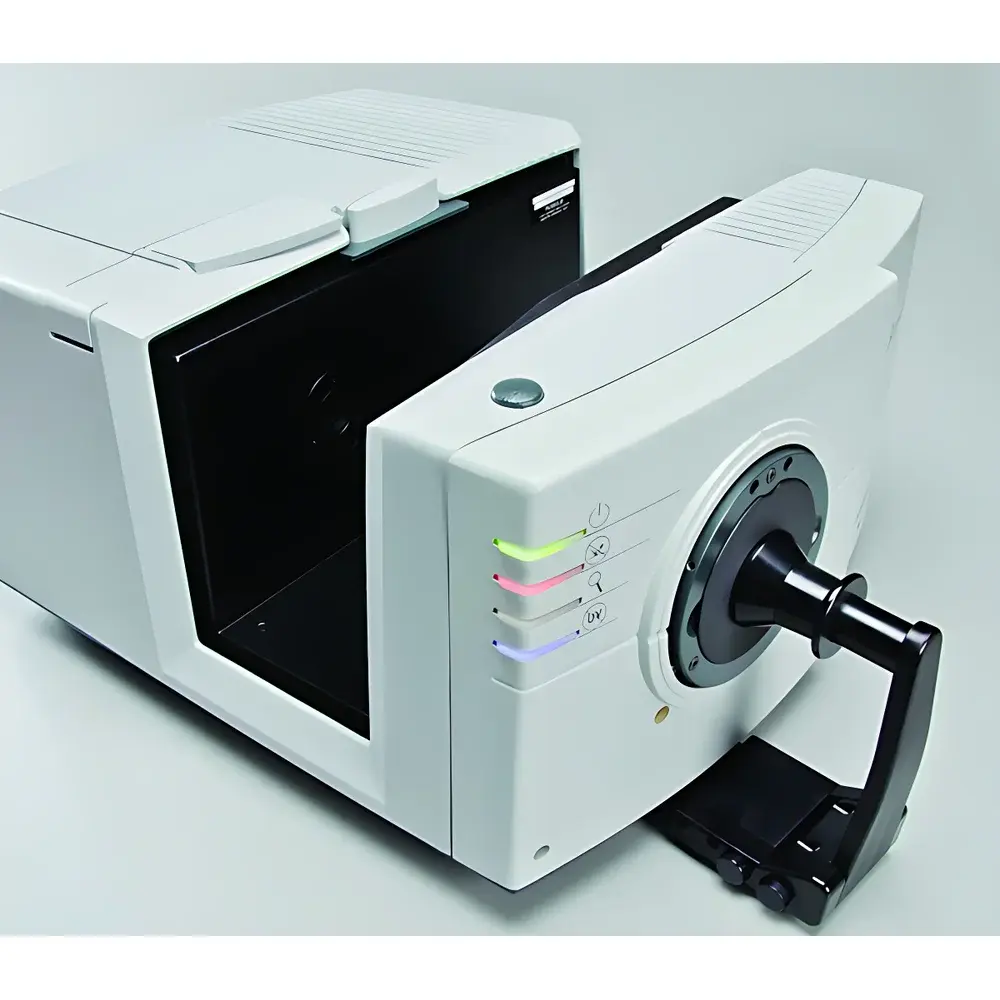
HunterLab UltraScan VIS Textile Color Measurement Spectrophotometer
| Brand | HunterLab |
|---|---|
| Origin | USA |
| Model | UltraScan VIS Textile Colorimeter |
| Type | Benchtop |
| Optical Geometry | d/8° Integrating Sphere |
| Light Source | Pulsed Xenon Lamp |
| Spectral Range | 360–780 nm |
| Repeatability | ΔE* ≤ 0.03 (CIELAB, LAV/SAV, 20 readings on white tile) |
| Wavelength Resolution | < 0.3 nm |
| Wavelength Accuracy | ±0.1 nm |
| Effective Bandwidth | 10 nm |
| Photometric Range | 0–200% |
| Photometric Resolution | 0.003% (reported as 0.01%) |
| Lamp Lifetime | > 1,000,000 flashes |
| Measurement Time | < 1 s |
| Minimum Interval Between Measurements | 3 s |
| Compliance | CIE No. 15, ISO 7724-1, ASTM E1164, DIN 5033-7 (reflectance & transmittance) |
| Dimensions (H×W×D) | 27.9 × 42.0 × 49.8 cm |
| Weight | 20.4 kg |
| Power | 100–240 VAC, 47–63 Hz |
| Interface | RS-232C, 9600 baud, DB9 female |
Overview
The HunterLab UltraScan VIS Textile Color Measurement Spectrophotometer is a high-precision, benchtop reflectance and transmittance spectrophotometer engineered for rigorous color quality control in synthetic fiber, yarn, fabric, and finished textile manufacturing. It operates on the principle of dual-beam spectral photometry with a d/8° integrating sphere geometry—compliant with CIE, ISO, and ASTM standards—to deliver traceable, reproducible spectral data across the full visible spectrum (360–780 nm). Its optical architecture features a 15.2 cm (6″) integrating sphere coated with Spectraflect™, a highly diffuse, near-Lambertian material certified for long-term stability and minimal spectral drift. The instrument employs a pulsed xenon lamp with D65 spectral simulation, eliminating thermal drift and enabling flash-based measurement without lamp warm-up delays. With 256-element diode array detection and a high-resolution concave holographic diffraction grating, the UltraScan VIS achieves wavelength accuracy of ±0.1 nm and resolution better than 0.3 nm—critical for detecting subtle metamerism and batch-to-batch hue shifts in dyed polyesters, nylons, and acrylics.
Key Features
- Dual-aperture optical system supporting Large Area View (LAV: 25.4 mm illumination / 19.0 mm measurement) and Small Area View (SAV: 9.5 mm / 6.3 mm) via motorized lens switching—enabling consistent evaluation of both uniform bulk materials and fine-textured or patterned fabrics.
- Automatic specular component included/excluded (SCI/SCE) mode selection—essential for distinguishing surface gloss effects from inherent colorant performance in filament yarns and coated textiles.
- Simultaneous reflectance and transmittance capability, including directional (direct) and total transmittance modes, with a three-sided open transmission chamber accommodating folded or layered samples up to 10 mm thick.
- Calibration traceability to the UK’s National Physical Laboratory (NPL) via certified ceramic standards; onboard verification routines ensure ongoing compliance with ISO/IEC 17025-mandated instrument monitoring protocols.
- Robust mechanical design: 20.4 kg cast-aluminum chassis with vibration-damped base; operational power consumption optimized at 60 W standby / 120 W continuous—suitable for 24/7 QC lab deployment.
Sample Compatibility & Compliance
The UltraScan VIS accommodates a broad range of textile forms—including spun and filament fibers, woven/knitted fabrics, nonwovens, and dyed or printed substrates—without requiring custom fixtures. Its large sample port and low-profile stage support standard AATCC/ISO sample holders (e.g., 50 × 50 mm swatches, 25 mm diameter fiber bundles). All optical measurements conform to international colorimetric standards: reflectance per CIE Publication 15:2018, ISO 7724-1:2022, ASTM E1164-22, and DIN 5033-7; transmittance per identical frameworks. Instrument validation reports include uncertainty budgets aligned with ISO/IEC 17025 requirements, supporting GLP and GMP-regulated environments where audit-ready documentation is mandatory.
Software & Data Management
Controlled via HunterLab’s Universal Software (version 8.x), the UltraScan VIS supports comprehensive data acquisition, statistical process control (SPC), and multi-instrument fleet management. The software enforces FDA 21 CFR Part 11-compliant user authentication, electronic signatures, and immutable audit trails for all calibration events, measurement sessions, and report generation. Spectral data export formats include CSV, XML, and CxF/XRGA—compatible with enterprise QMS platforms (e.g., TrackWise, MasterControl) and third-party color formulation systems (e.g., Datacolor MatchText, X-Rite Color iMatch). Automated pass/fail reporting against AATCC Evaluation Procedure 1 (EP1) and ISO 105-J03 tolerances is configurable per product line.
Applications
- Batch release testing of synthetic fiber lots against master standards for hue, chroma, and lightness consistency (ΔE*ab, ΔE*00).
- Colorant formulation validation in R&D labs—quantifying dye uptake efficiency, leveling behavior, and fastness-related spectral shifts post-wash or heat treatment.
- Supplier qualification audits—verifying conformance to brand-specific color tolerances across global manufacturing sites using synchronized instrument networks.
- Metamerism assessment under multiple illuminants (D65, A, F2, F7) to predict visual mismatch in retail lighting environments.
- Long-term stability monitoring of pigment dispersions used in solution-dyed fibers via spectral shift analysis at 10 nm intervals.
FAQ
What is the difference between SCI and SCE measurement modes, and when should each be used for synthetic fibers?
SCI (Specular Component Included) captures total reflectance—including surface gloss—and is recommended for evaluating intrinsic colorant performance in matte or semi-gloss fibers. SCE (Specular Component Excluded) excludes specular reflection and better correlates with visual appearance under typical viewing conditions—especially critical for high-luster polyester filaments.
Can the UltraScan VIS measure translucent or multi-layer textile composites?
Yes—the instrument supports both directional and total transmittance modes, and its open-chamber design accepts layered samples up to 10 mm thick. For laminated fabrics or coated membranes, total transmittance with integrated sphere geometry ensures accurate quantification of light diffusion and absorption characteristics.
How does the instrument maintain calibration integrity over time in a high-throughput textile lab?
Daily verification using NPL-traceable white and black standards is automated via software prompts. Drift thresholds trigger recalibration alerts, and full spectral recalibration—including grating alignment and detector gain adjustment—is performed annually by HunterLab-certified service engineers following ISO/IEC 17025 procedures.
Is spectral data export compatible with ERP or PLM systems?
Yes—CSV and XML exports include full spectral curves (360–780 nm @ 10 nm intervals), tristimulus values, and color difference metrics. APIs and middleware connectors are available for direct integration with SAP S/4HANA, Oracle Agile PLM, and Centric PLM.
Does the system support AATCC TM173 or ISO 105-B02 accelerated weathering correlation studies?
While not a weathering device itself, the UltraScan VIS provides baseline and post-exposure spectral data required for delta-E tracking per AATCC TM16 and ISO 105-B02. Its high repeatability (ΔE* ≤ 0.03) ensures statistically valid degradation trend analysis over 100+ exposure cycles.




