
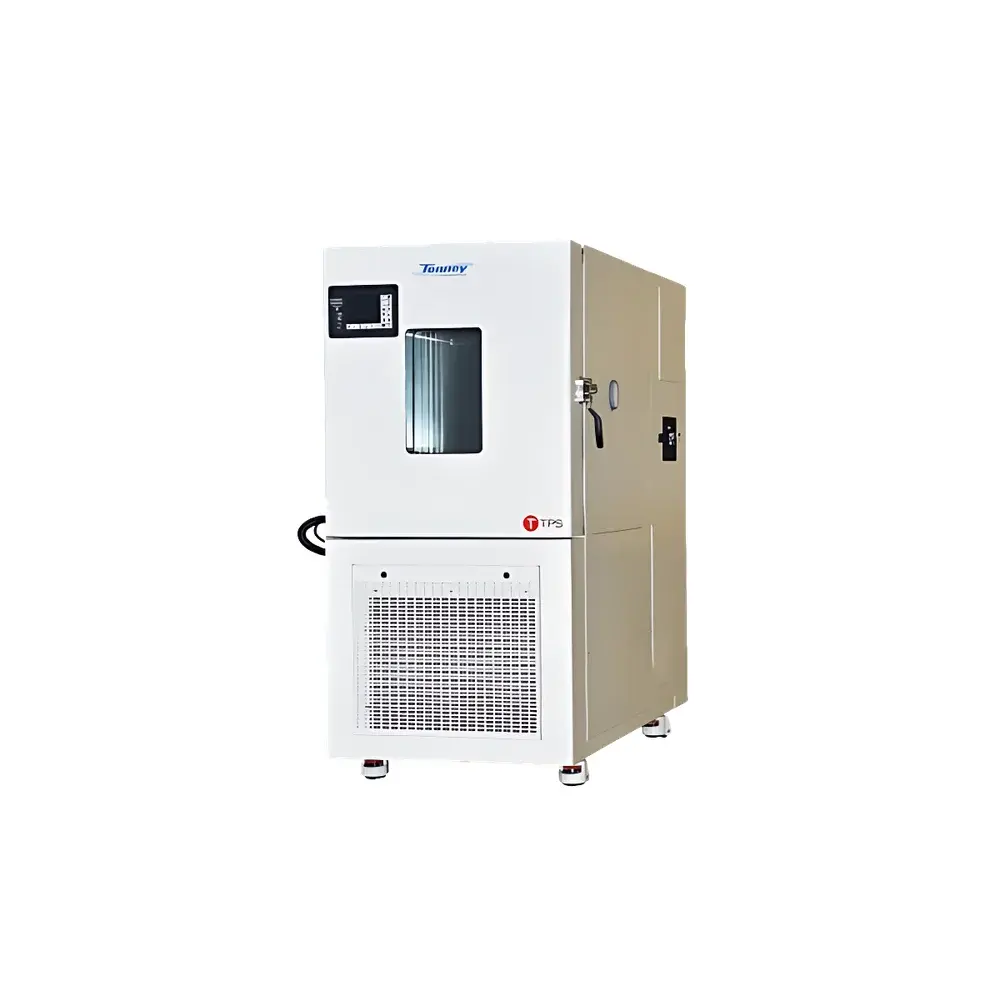
Tenney FCR Series Rapid Temperature Transition Environmental Test Chamber
| Brand | Blue M |
|---|---|
| Origin | USA |
| Model | FCR Series |
| Temperature Range | -70°C to 180°C (Single-Stage), -68°C to 180°C (Cascade) |
| Temperature Uniformity | ±1.0°C |
| Temperature Fluctuation | ±0.5°C |
| Temperature Deviation | ±1.0°C |
| Ramp Rate (Cooling) | Up to 16.5°C/min (15 HP, Single-Stage, 180°C → −35°C) |
| Ramp Rate (Heating) | Up to 17.5°C/min (15 HP, Cascade, −68°C → 180°C) |
| Internal Dimensions (W×H×D) | 1016 mm × 2057 mm × 2007 mm to 1626 mm × 2616 mm × 2515 mm |
| Airflow | 750–1500 CFM |
| Controller | Synergy Quattro Touchscreen (320×240 color LCD, PID with auto-tuning, dual-channel adaptation) |
| Compliance | ISO/IEC 17025 calibration support available |
| Power Supply | 208–460 VAC, 3-phase, 60 Hz |
| Cooling System | Scroll compressor (6/10/15 HP options), air- or water-cooled |
| Heating System | Nickel-chrome wire heaters (6/12/18 kW) |
| Safety | FM-approved OTP, backup thermal fuse, main disconnect with lockout, chamber vent |
Overview
The Tenney FCR Series Rapid Temperature Transition Environmental Test Chamber is an engineered solution for accelerated thermal stress testing under tightly controlled, dynamically variable conditions. Designed and manufactured by Tenney Environmental (a Blue M brand, headquartered in the United States), this chamber employs advanced cascade and single-stage refrigeration architectures—integrated with high-capacity scroll compressors and precision solid-state heating—to achieve industry-leading temperature transition rates. Its core operational principle relies on forced-air convection with top-down airflow distribution, ensuring uniform thermal exposure across the entire test volume. The chamber is calibrated and validated for use in qualification testing per ASTM D395, ISO 188, IEC 60068-2-14 (Change of Temperature), MIL-STD-810H Method 503.7, and other international standards governing thermal aging, material degradation, and reliability validation. It serves as a critical tool in R&D labs, quality assurance departments, and manufacturing facilities where product resilience under extreme thermal cycling must be quantified with traceable repeatability.
Key Features
- High-speed thermal ramping: Achieves up to 16.5°C/min cooling (180°C → −35°C, single-stage) and 17.5°C/min heating (−68°C → 180°C, cascade), enabled by scalable scroll compressor configurations (6/10/15 HP) and optimized heat exchanger design.
- Synergy Quattro touchscreen controller: 320 × 240 color LCD interface with intuitive English-language programming; supports unlimited profiles, multi-step cycles, real-time clock, and dual-channel adaptive PID control—adjusting setpoint response based on actual load conditions.
- Robust thermal architecture: High-density insulation, nickel-chrome air heaters, platinum RTD temperature sensors (Class A, ±0.15°C accuracy), and solid-state expansion valves ensure long-term stability and measurement fidelity.
- Comprehensive safety and compliance systems: FM-approved overtemperature protection (OTP), redundant thermal fuses, main power disconnect with padlockable shutoff, chamber ventilation ports, and pressure-sensing refrigerant monitoring.
- Flexible configuration options: Available in five standard internal volumes (10–64 ft³ / 283–1812 L); supports air- or water-cooled condensers; optional humidity control (20–95% RH, 20–85°C dry-bulb), LN₂/CO₂ boost cooling, GN₂ purge, NIST-traceable calibration, and ISO/IEC 17025-compliant validation services.
- Industrial connectivity: Standard RS-232 and Ethernet (10/100 Mbps, TCP/IP) interfaces; USB port for data logging (setpoint/actual temperature/humidity); PCMCIA and internal flash storage; independent I/O controller (Olympus) for machine diagnostics and integration into automated test systems.
Sample Compatibility & Compliance
The FCR chamber accommodates a broad spectrum of physical samples—from printed circuit boards (PCBs) and automotive electronic modules to aerospace composites, polymer seals, and medical device housings. Its large internal workspace (up to 1626 mm W × 2616 mm H × 2515 mm D), reinforced interior chamber walls, and adjustable heavy-duty shelves support both static and dynamic loading configurations. All models meet UL 61010-1 and CSA C22.2 No. 61010-1 safety requirements. Optional humidity-equipped variants comply with ASTM E1918 (water vapor transmission), ISO 62 (moisture absorption), and USP for pharmaceutical packaging stability studies. For regulated industries, the Synergy Quattro controller supports audit-ready data logging with time-stamped events, user access levels, and electronic signatures—facilitating alignment with FDA 21 CFR Part 11, GMP, and GLP documentation protocols.
Software & Data Management
Data integrity and traceability are ensured through the embedded Synergy Quattro operating system (Microsoft Windows CE-based), which logs all thermodynamic parameters—including chamber setpoints, actual sensor readings, alarm states, and controller outputs—at user-defined intervals. Logged data is stored internally on flash memory, exported via USB to external drives, or retrieved remotely via Ethernet using standard FTP or HTTP protocols. The controller supports CSV export for post-processing in MATLAB, Python (Pandas), or statistical analysis platforms such as JMP or Minitab. Optional software packages enable remote monitoring, alarm notification via email/SMS, and integration with MES/SCADA environments using Modbus TCP or OPC UA. All firmware updates are delivered via signed digital packages to preserve system integrity and cybersecurity posture.
Applications
- Thermal aging of elastomers, adhesives, and thermoplastics per ASTM D573 and ISO 188.
- Accelerated life testing (ALT) and highly accelerated life testing (HALT) of electronics assemblies and embedded controllers.
- Validation of solder joint reliability under rapid thermal cycling (JEDEC JESD22-A104).
- Material compatibility testing for battery enclosures, EV powertrain components, and avionics housings.
- Stability assessment of pharmaceutical primary packaging under ICH Q1A(R2) guidelines.
- Qualification of military-grade hardware per MIL-STD-810H environmental engineering considerations.
FAQ
What is the difference between single-stage and cascade refrigeration in the FCR series?
Single-stage systems operate from −35°C to 180°C and are optimized for speed and efficiency within moderate low-temperature ranges. Cascade systems employ two independent refrigeration circuits to achieve deeper cold performance (down to −68°C) while maintaining high ramp rates and thermal stability at extremes—ideal for applications requiring extended low-temperature dwell or wide-span cycling.
Can the FCR chamber be integrated into an automated test cell?
Yes. The standard RS-232 and Ethernet interfaces, coupled with the Olympus I/O controller, allow seamless integration with PLCs, robotic handlers, and central test management systems. Digital I/O lines support start/stop commands, door interlock feedback, and alarm status reporting.
Is NIST-traceable calibration included with purchase?
NIST-traceable calibration is available as an optional service at time of order or scheduled annually. Tenney Environmental provides ISO/IEC 17025-accredited calibration certificates upon request, including uncertainty budgets and as-found/as-left data.
What maintenance intervals are recommended for scroll compressors?
Under normal operation, scroll compressors require no scheduled oil changes. Recommended preventive maintenance includes quarterly inspection of condenser coils (air-cooled) or water flow sensors (water-cooled), annual verification of refrigerant charge and pressure transducer calibration, and biannual validation of temperature uniformity per ASTM E74.
Are custom chamber dimensions or non-standard temperature ranges possible?
Yes. Tenney offers engineering consultation and custom fabrication for non-standard internal geometries, extended temperature ranges (e.g., −80°C), specialized airflow patterns, or application-specific sensor integration (e.g., embedded thermocouple arrays, strain gauges, or optical ports).
Related Products



