
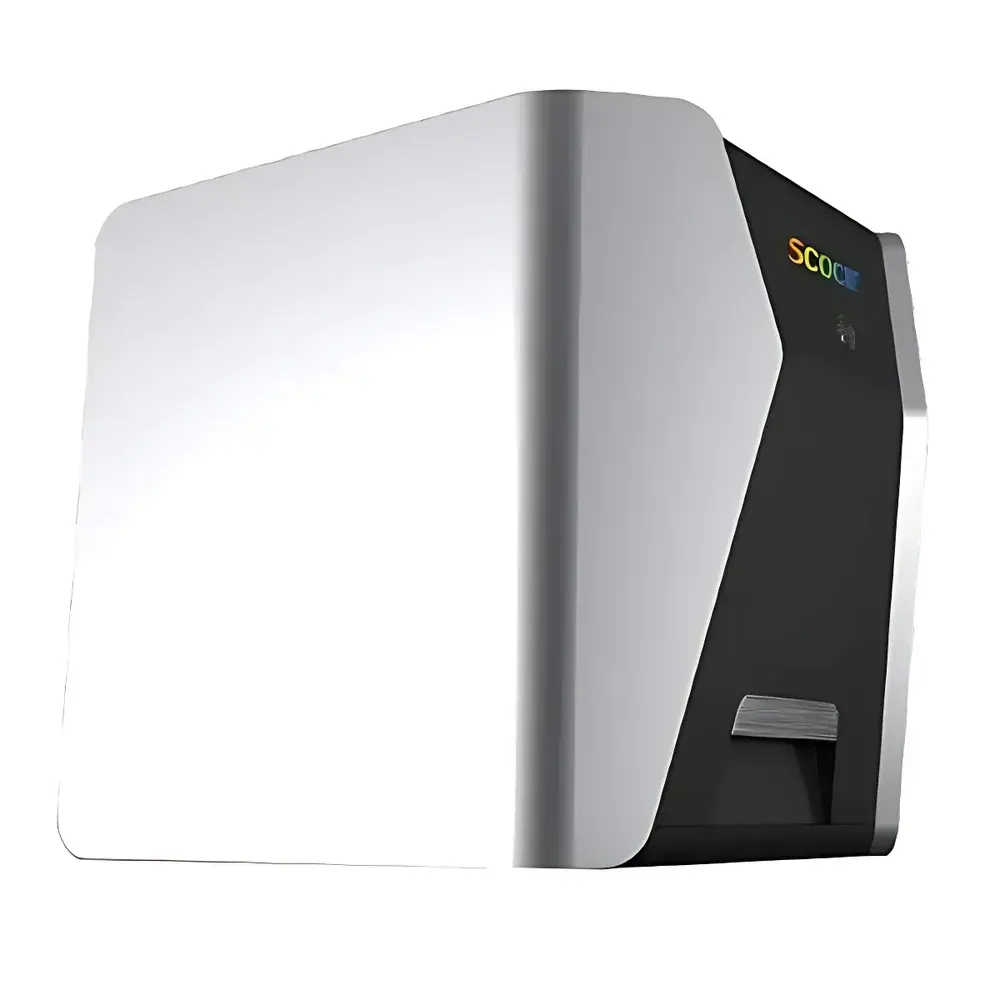
Scosie Digieye Digicolor Desktop Spectrophotometric Color Measurement System
| Brand | Scosie |
|---|---|
| Origin | Shanghai, China |
| Model | Digieye Digicolor |
| Instrument Type | Benchtop |
| Optical Geometry | 0°/45° Integrating Sphere |
| Illuminant | Standard D65 |
| Spectral Range | 400–700 nm |
| Repeatability | ΔE*ab ≤ 0.03 |
| Color Spaces | CIELAB, CIELCH, CIELUV, Hunter Lab, Munsell |
| Observer Angles | 2° & 10° |
| Color Difference Formulas | CIE L*a*b*, CMC (l:c), CIE94, CIEDE2000 |
| Data Export Formats | CSV, QTX, TXT, DAT |
| Compliance | ISO 11664, ASTM E308, CIE No. 15, GB/T 3978–2008 |
| Warranty | 24 months |
Overview
The Scosie Digieye Digicolor is a benchtop spectrophotometric color measurement system engineered for high-fidelity, non-contact digital color and appearance evaluation across heterogeneous, textured, and geometrically complex surfaces. Unlike conventional tristimulus colorimeters or handheld spectrophotometers constrained by fixed aperture size and contact-based geometry, the Digicolor employs a calibrated 0°/45° integrating sphere optical architecture coupled with a high-resolution monochrome CCD imaging sensor and spectral reconstruction algorithms. This enables spatially resolved reflectance sampling across user-defined regions of interest (ROIs), delivering both pixel-level spectral data (400–700 nm at 10 nm intervals) and statistically robust mean color values in standardized CIE color spaces. Its D65-illuminated measurement environment adheres to ISO/CIE daylight simulation protocols, ensuring metrological traceability to international photometric standards. Designed for integration into QC laboratories and production line environments, the system supports objective, operator-independent assessment—eliminating subjective visual grading while maintaining perceptual uniformity aligned with human observer response under standard viewing conditions.
Key Features
- Non-contact, image-based color acquisition eliminates physical pressure, surface abrasion, or gloss interference—critical for delicate, soft, or thermally sensitive substrates (e.g., textiles, confectionery coatings, printed electronics).
- 0°/45° integrating sphere illumination and detection geometry ensures compliance with ISO 7724-1 and ASTM D2244 for diffuse reflectance measurement, minimizing directional bias from surface texture or microstructure.
- Simultaneous multi-point ROI analysis: up to 100 user-defined areas per image, each yielding full CIELAB, CIELCH, and spectral reflectance curves—enabling batch homogeneity mapping and defect localization.
- Integrated multi-illuminant simulation (D65, A, F11, D50, F02, F07) with real-time CIE color space conversion, supporting metamerism evaluation and lighting-condition-specific pass/fail judgment.
- Automated calculation of industry-specific metrics: K/S (color strength), whiteness (CIE, Ganz), yellowness (ASTM E313), opacity (ISO 2814), ISO 105-A11 staining/colour change ratings, and optical density (OD) for translucent films.
- Full GLP-compliant audit trail: timestamped measurements, operator ID logging, instrument calibration history, and version-controlled firmware—all retained locally and exportable via secure network protocols.
Sample Compatibility & Compliance
The Digicolor accommodates samples ranging from 10 mm × 10 mm to 300 mm × 300 mm without mechanical repositioning, making it suitable for rigid panels, flexible rolls, irregular artifacts (e.g., archaeological ceramics), and bulk food items. Its large-field-of-view optics support measurement of spatially varying color phenomena—including print mottle, dye migration, pigment settling, and coating orange peel—where traditional spot instruments fail. The system conforms to ISO 11664 (CIE colorimetry), ASTM E308 (computation of color coordinates from spectral data), and GB/T 3978–2008 (Chinese national standard for color measurement geometry). It satisfies foundational requirements for FDA 21 CFR Part 11 electronic records when deployed with validated software configuration and access controls.
Software & Data Management
Digicolor Control Suite v4.x provides a deterministic, scriptable interface for method-driven workflows. Users define measurement templates—including ROI layout, illuminant set, tolerance ellipsoids (ΔE*ab, CMC, CIEDE2000), and automated pass/fail logic—with configurable alerts for out-of-spec events. All raw spectral data, processed colorimetric values, and annotated images are stored in an ACID-compliant SQLite database. Export modules support CSV (for statistical process control), QTX (for textile ERP integration), and DAT (for legacy spectral analysis platforms). Audit logs include cryptographic hash verification of measurement integrity, enabling retrospective validation during regulatory inspections.
Applications
The Digicolor serves as a primary color verification tool in industries where visual consistency directly impacts brand equity and regulatory compliance: textile dyeing and finishing (ISO 105-C06 wash fastness correlation), pharmaceutical tablet coating uniformity (USP appearance assessment), cosmetic emulsion batch release (L’Oréal internal specification alignment), food packaging ink migration monitoring (EU 10/2011 compliance), and heritage conservation pigment documentation (CEN/TS 16470 spectral archiving). Its ability to quantify spatial heterogeneity makes it indispensable for R&D labs developing pearlescent pigments, structural-color films, or bio-based dyes requiring multi-angle spectral characterization.
FAQ
What distinguishes Digicolor from conventional spectrophotometers?
It combines imaging spectroscopy with 0°/45° sphere geometry—capturing both spatial distribution and spectrally resolved color in a single acquisition, unlike point-measurement devices.
Can Digicolor validate metamerism between two materials?
Yes—by acquiring full reflectance spectra under multiple CIE illuminants and computing inter-illuminant ΔE values using CIEDE2000 or CMC formulas.
Is calibration traceable to NIST or equivalent national standards?
Factory calibration uses NIST-traceable ceramic tile standards; users perform daily verification with supplied calibration tiles certified to ISO 13655.
Does the system support automated pass/fail reporting per customer-defined tolerances?
Yes—tolerance ellipsoids can be defined per color space and formula, with real-time flagging and exportable compliance reports.
What is the minimum measurable sample area?
Effective resolution is 0.2 mm/pixel at standard working distance; smallest reliable ROI is 2 × 2 mm² for homogeneous surfaces.




