
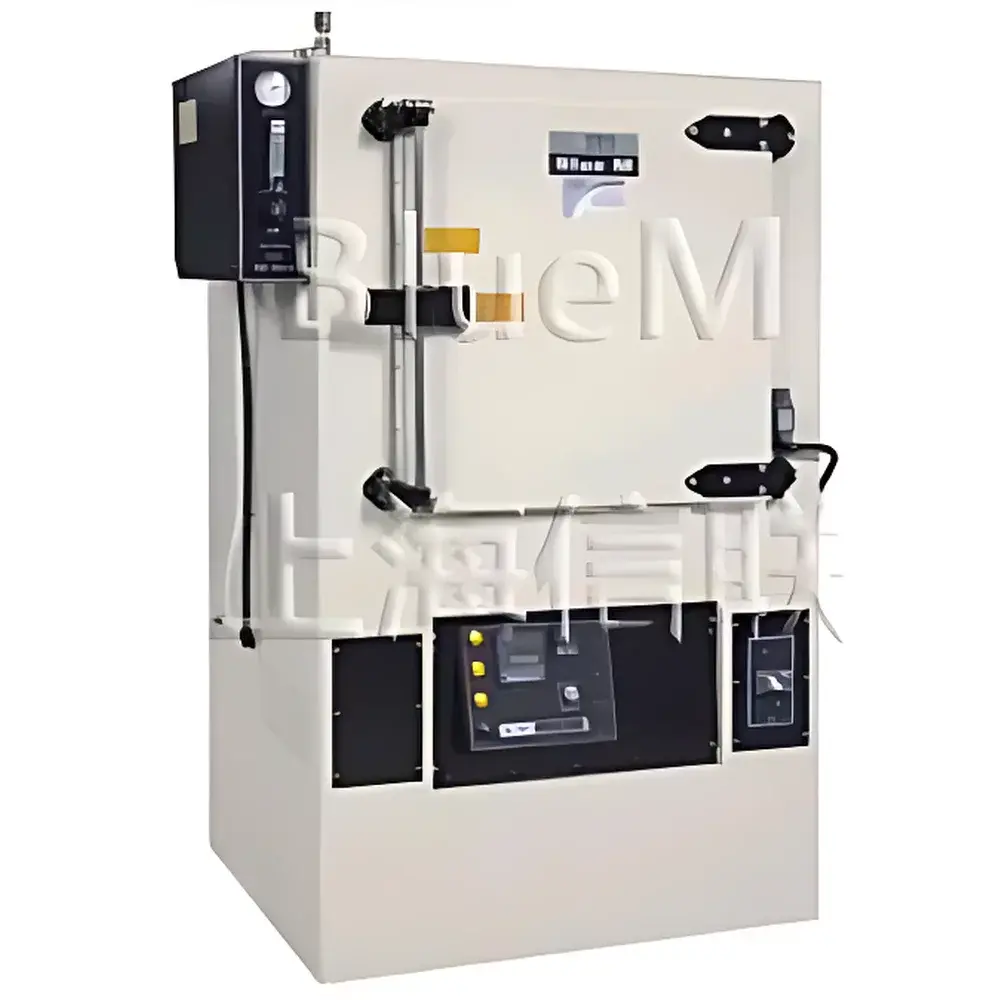
Blue M 146 Series Inert Atmosphere High-Temperature Forced-Air Oven
| Brand | Blue M |
|---|---|
| Origin | USA |
| Model | 146 Series Inert Gas Oven |
| Temperature Range | Ambient +15°C to 316°C |
| Temperature Uniformity | ±1% |
| Control Accuracy | ±0.5°C |
| Resolution | ±0.1°C |
| Chamber Volume | 1.6–24 cu.ft |
| Construction | Fully Welded 304 Stainless Steel Interior |
| Insulation | 4-inch Mineral Wool |
| Door Seal | High-Performance Fiberglass Gasket |
| Heating Method | Forced-Air Convection |
| Power Input | Standard Voltage (Configurable for 208–240V/3-phase or 208–480V/3-phase) |
Overview
The Blue M 146 Series Inert Atmosphere High-Temperature Forced-Air Oven is an engineered solution for thermal processing under controlled, oxygen-free environments. Designed specifically for applications requiring strict atmospheric integrity—such as sintering of sensitive ceramics, annealing of oxide-sensitive metallurgical samples, outgassing of ultra-high-purity components, and moisture-free drying of hygroscopic materials—the oven integrates a fully welded 304 stainless steel chamber with inert gas purge capability (N₂, Ar, or forming gas) to maintain trace-level oxygen suppression (<10 ppm typical when properly purged and sealed). Its forced-air convection system ensures rapid thermal response and high spatial uniformity across the working volume, while the robust thermal architecture minimizes heat loss and supports stable long-duration holds at temperatures up to 316°C (600°F). Unlike standard benchtop ovens, the 146 Series adheres to fundamental engineering principles of containment integrity, thermal fidelity, and process repeatability—making it suitable for GLP-compliant laboratories, R&D cleanrooms, and production-scale pre-conditioning workflows.
Key Features
- Fully welded, seamless 304 stainless steel interior chamber prevents gas migration into insulation layers and eliminates crevices where contaminants may accumulate.
- 4-inch thick mineral wool insulation provides low thermal conductivity (<0.04 W/m·K at 200°C), reducing standby energy consumption and improving temperature stability during extended cycles.
- Heavy-gauge cold-rolled steel outer casing (minimum 16-gauge) offers structural rigidity and long-term dimensional stability under repeated thermal cycling.
- High-integrity fiberglass-reinforced door gasket maintains consistent sealing pressure across the full perimeter—even after thousands of open/close cycles—ensuring inert atmosphere retention during operation.
- Interlocked safety door switch de-energizes heating elements upon door opening, preserving chamber integrity and supporting compliance with ANSI Z218.1 and IEC 61000-6-4 electromagnetic compatibility standards.
- Standard inert gas inlet/outlet ports (¼” NPT) enable integration with external mass flow controllers, exhaust scrubbers, or closed-loop recirculation systems.
Sample Compatibility & Compliance
The 146 Series accommodates a broad range of sample types—including powdered metal compacts, thin-film substrates, battery electrode coatings, pharmaceutical excipients, and semiconductor packaging assemblies—without risk of oxidation or hydrolysis. Its chamber geometry (available in 7 standard internal volumes from 1.6 to 24 cu.ft) supports both small-batch R&D and medium-scale validation runs. All models comply with UL 61010-1 (2nd Ed.) for laboratory equipment safety and meet the mechanical construction requirements of ASTM E145–22 (“Standard Specification for Gravity-Convection and Forced-Ventilation Ovens”). Optional upgrades include Class 100 cleanroom-rated air filtration (HEPA + activated carbon), data logging with NIST-traceable calibration certificates, and 21 CFR Part 11–compliant software packages for audit-ready electronic records.
Software & Data Management
Equipped with a programmable digital controller (standard), the oven supports up to 16-stage ramp-soak profiles with real-time monitoring of chamber temperature, purge gas flow rate (when interfaced), and elapsed cycle time. Optional Ethernet-enabled controllers provide Modbus TCP or BACnet MS/TP communication for integration into centralized lab information management systems (LIMS) or SCADA platforms. Data export formats include CSV and PDF reports compliant with ISO/IEC 17025 documentation requirements. Audit trail functionality—including user login logs, parameter change history, and alarm event timestamps—is available with validated firmware versions for regulated environments operating under FDA, EMA, or PMDA oversight.
Applications
- Pre-sintering atmosphere stabilization for advanced ceramics (e.g., Al₂O₃, SiC, YSZ)
- Oxidation-sensitive annealing of copper and aluminum alloy foils prior to microstructural analysis
- Residual solvent removal from lithium-ion battery cathode slurries under nitrogen blanket
- Drying of optical-grade quartz substrates without surface hydration layer formation
- Thermal aging studies of polymer composites per ASTM D3045 protocols
- Outgassing of vacuum chamber components prior to UHV assembly
FAQ
What inert gases are compatible with the 146 Series oven?
Nitrogen (N₂), argon (Ar), hydrogen-nitrogen blends (e.g., 5% H₂/95% N₂), and other non-reactive, non-corrosive gases may be used. Flammable or oxidizing gases (e.g., pure O₂, Cl₂) are strictly prohibited.
Can the oven operate continuously at 316°C?
Yes—continuous operation at maximum rated temperature is supported by design, provided ambient conditions remain within specified limits (≤30°C ambient, ≤80% RH) and ventilation clearance requirements are met.
Is third-party calibration certification available?
Yes. Factory-installed PT100 sensors are calibrated per ISO/IEC 17025 by an A2LA-accredited laboratory; NIST-traceable certificates with uncertainty budgets are supplied with each unit.
How is oxygen level monitored inside the chamber?
While the oven does not include an integrated O₂ sensor, it features dedicated ports for external analyzers (e.g., electrochemical or zirconia-based trace oxygen meters) and supports analog signal input for closed-loop feedback control via optional PLC interface modules.



