
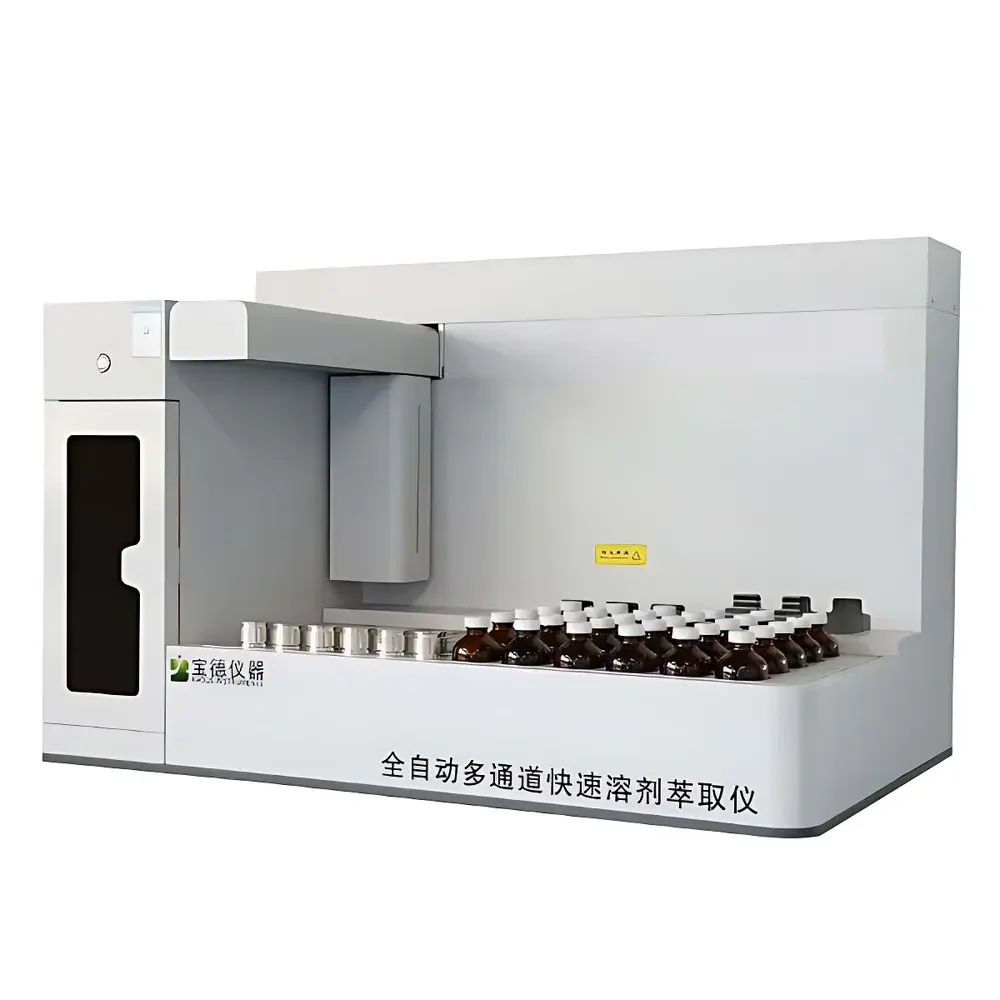
BASE-30 Automated Multi-Channel Accelerated Solvent Extractor
| Brand | Bode Instruments |
|---|---|
| Origin | Beijing, China |
| Manufacturer Type | Original Equipment Manufacturer (OEM) |
| Product Category | Domestic |
| Model | BASE-30 |
| Pricing | Upon Request |
| Extraction Type | Solid-Liquid Extraction |
Overview
The BASE-30 Automated Multi-Channel Accelerated Solvent Extractor is an engineered solution for high-throughput, pressure-assisted solid-liquid extraction (PLE), also known as pressurized fluid extraction (PFE). Operating under elevated temperature (up to 200 °C) and pressure (up to 20 MPa), the system enhances solvent penetration and mass transfer kinetics, significantly reducing extraction time while maintaining analyte integrity and recovery reproducibility. Unlike conventional Soxhlet or ultrasonic extraction, the BASE-30 employs a closed-loop, inert environment with precisely controlled thermal ramping and static/dynamic extraction cycles—ensuring compliance with regulatory requirements for method robustness and inter-laboratory comparability.
Key Features
- Integrated chemically inert extraction cell assembly (patented design): Cell body, end cap, frit, and sealing ring are pre-assembled as a single maintenance-free unit—eliminating cross-contamination risk and minimizing downtime during cell replacement.
- Full-circumferential heating furnace: Ensures uniform thermal distribution across all extraction channels, critical for consistent solvent boiling point elevation and matrix swelling behavior across parallel runs.
- Dual-mode operation: Supports both single-channel sequential extraction and simultaneous multi-channel (up to 6 channels) batch processing—enabling flexible method development and routine QC throughput scaling.
- Time-efficient workflow: Achieves average extraction cycle times ~50% shorter than legacy ASE®-style systems, primarily due to optimized heat-up kinetics, reduced solvent equilibration lag, and automated post-extraction purge protocols.
- Optional solvent blending module: Programmable dual-solvent controller enables on-demand preparation of binary or ternary solvent mixtures (e.g., acetone/hexane, methanol/water) with volumetric precision ±1.5%—critical for gradient polarity applications in complex matrices.
Sample Compatibility & Compliance
The BASE-30 accommodates solid and semi-solid samples ranging from 1 g to 30 g, including soil, sediment, plant tissue, animal feed, pharmaceutical tablets, polymer composites, and food commodities. Its extraction cells (11–100 mL volume options) are compatible with standard stainless steel, titanium, or PEEK-lined configurations to prevent metal leaching or acid degradation. The system conforms to multiple international and national standards, including EPA Method 3545A (1996) for organochlorine pesticides, OCPs, PAHs, PCDD/Fs, and semi-volatile organics; HJ 782–2016 and HJ 783–2016 (China’s environmental solid waste and soil extraction protocols); SL 391.4–2007 (Chinese standard for PLE-based organic analysis); and GB-series food safety standards such as GB 23200.9–2016 (GC-MS multiresidue pesticide analysis in cereals) and GB/T 23376–2009 (GC/MS pesticide screening in tea). All hardware and software architecture support GLP-compliant audit trails and instrument qualification documentation per ISO/IEC 17025:2017 requirements.
Software & Data Management
The BASE-30 is operated via a Windows-based control interface with intuitive graphical workflow builder. Each extraction method stores full parameter sets—including temperature ramp profiles, pressure hold durations, static/dynamic cycle counts, flush volumes, and solvent composition schedules—with version-controlled method archiving. System logs record real-time pressure/temperature curves, solvent delivery accuracy, cell status, and error flags—all timestamped and exportable in CSV or PDF format. Optional 21 CFR Part 11 compliance package includes electronic signatures, role-based access control, and immutable audit trail generation for regulated pharmaceutical and clinical laboratories.
Applications
- Environmental analysis: Extraction of PAHs, PCBs, organophosphorus pesticides, brominated flame retardants (PBDEs), phenolic compounds (per HJ 703–2014), and dioxins from soils, sediments, and sludge.
- Food safety testing: Multiresidue pesticide screening in fruits, vegetables, grains, dairy powders, and animal feed—aligned with MRL enforcement workflows under GB 23200.x series.
- Natural product research: Isolation of ginsenosides (per GB/T 22996–2008), flavonoids, alkaloids, and terpenoids from botanicals and herbal formulations.
- Pharmaceutical quality control: Recovery of excipient-bound actives, residual solvents, and degradation products from solid dosage forms.
- Electronics materials testing: Leaching of PAHs and phthalates from printed circuit boards and polymer housings (per SN/T 2593.1–2010).
FAQ
What sample matrices are validated for use with the BASE-30?
Soil, sediment, plant tissues, animal feed, cereal grains, tea leaves, pharmaceutical tablets, polymer composites, and food homogenates—provided particle size is ≤ 0.5 mm and moisture content is < 15% w/w.
Is method transfer possible from ASE®-type instruments?
Yes. The BASE-30 supports identical cell dimensions, pressure/temperature setpoints, and static/dynamic timing logic—enabling direct porting of existing ASE methods with minor optimization for thermal inertia differences.
Can the system be integrated with downstream analytical platforms?
All extract vials comply with standard 12 × 32 mm autosampler formats (e.g., Agilent, Waters, Shimadzu). Optional fraction collector and SPE interface modules enable seamless coupling to LC/GC systems.
Does the BASE-30 meet FDA or EU regulatory requirements for GMP environments?
With optional 21 CFR Part 11 and Annex 11 add-ons, the system satisfies electronic record and signature requirements for pharmaceutical manufacturing and contract research organizations operating under ICH-GCP or EU GMP guidelines.
What maintenance intervals are recommended for routine operation?
Cell assemblies require no routine servicing; annual calibration of pressure transducers and temperature sensors is advised, along with quarterly verification of solvent delivery accuracy using gravimetric checks.
Related Products



