
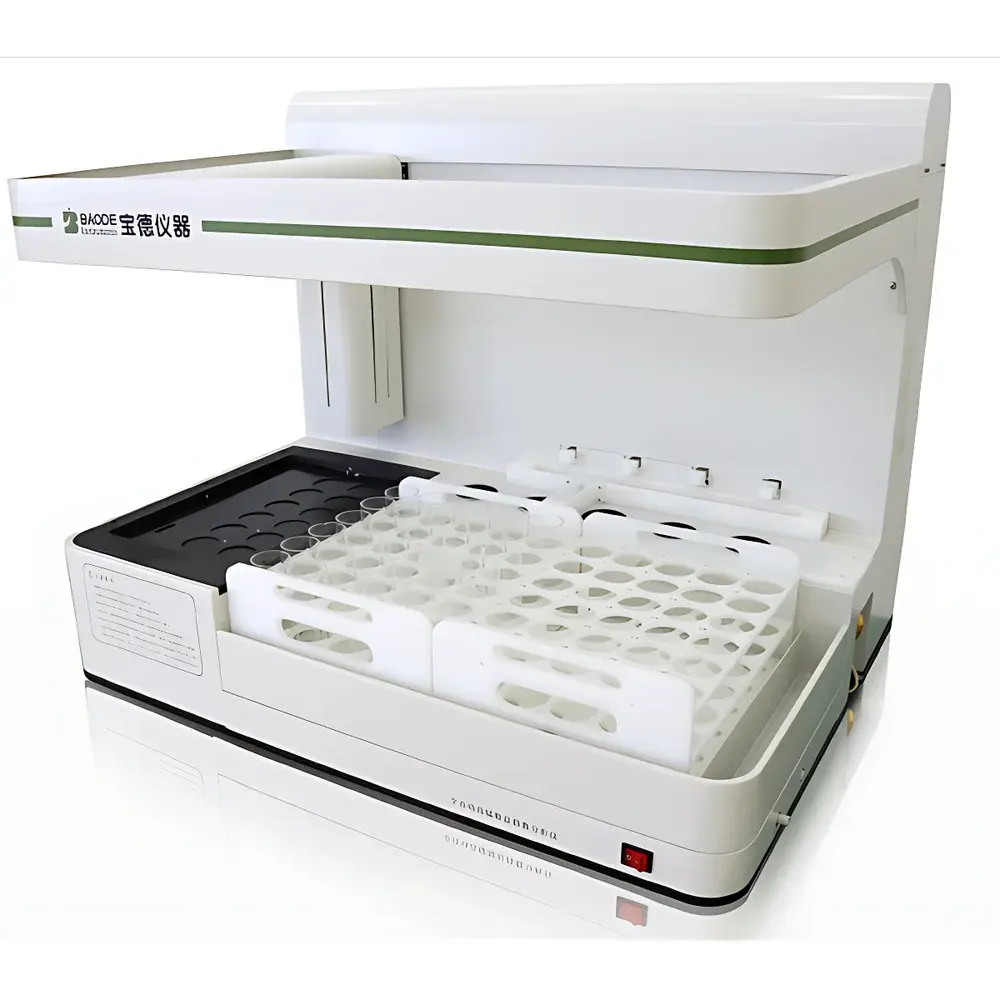
Bode Instruments BCODMn-60S Automated Permanganate Index Analyzer
| Brand | Bode Instruments |
|---|---|
| Origin | Beijing, China |
| Manufacturer Type | Direct Manufacturer |
| Country of Origin | China |
| Model | BCODMn-60S |
| Pricing | Upon Request |
Overview
The Bode Instruments BCODMn-60S Automated Permanganate Index Analyzer is a fully integrated, programmable titration platform engineered for standardized determination of permanganate index (CODMn) in water matrices—principally based on the controlled oxidation of organic and inorganic reductants by potassium permanganate under acidic or alkaline conditions at elevated temperature (typically 100 °C), followed by back-titration with standardized sodium oxalate solution. This gravimetrically calibrated redox titration system conforms rigorously to multiple national standard methodologies, including GB 11892–1989, GB/T 5750.7–2023 (Standard Methods for Examination of Drinking Water – Organic Parameters), GB/T 5750.4–2023 (Inorganic Non-Metallic Parameters), GB/T 13025.7–2012 (Salt Analysis – Iodine Content), and GB 17378.4–2007 (Marine Monitoring – Chemical Analysis of Seawater). Designed for routine compliance testing in regulated environmental and public health laboratories, the BCODMn-60S eliminates manual endpoint judgment, thermal inconsistency, and operator-induced variability—ensuring high reproducibility (RSD < 2.5% at 1.0 mg/L CODMn) across batched analyses.
Key Features
- Automated dual-mode digestion and titration: supports both acidic and alkaline permanganate index protocols with precise temperature control (±0.5 °C) and timed heating cycles (0–120 min adjustable)
- Multi-channel configurable architecture: up to 6 independent sample positions per run, each with dedicated reagent dispensing, heating, stirring, and photometric endpoint detection
- Integrated photometric endpoint recognition: uses 525 nm LED-based optical sensor array to detect subtle color transitions during KMnO4 decolorization or Na2C2O4 titration, eliminating subjective visual interpretation
- Self-calibrating liquid handling system: syringe pumps with ±0.2% volumetric accuracy (1–10 mL range); auto-purge and rinse cycles between samples prevent cross-contamination
- Embedded thermal management: Peltier-assisted cooling module ensures rapid post-digestion cooldown (< 8 min from 100 °C to 40 °C), enabling high-throughput operation without thermal carryover
- Compliance-ready firmware: audit trail logging (user ID, timestamp, method version, raw absorbance data, titrant volume), aligned with GLP and ISO/IEC 17025 documentation requirements
Sample Compatibility & Compliance
The BCODMn-60S accommodates a broad spectrum of aqueous and saline matrices without matrix-specific hardware modification. Validated applications include potable water, source water, surface water, groundwater, seawater (open ocean and estuarine), wastewater effluents with low turbidity (< 10 NTU), brines, and iodized salt extracts. It meets regulatory acceptance criteria under China’s Ministry of Ecology and Environment (MEE) and National Center for Food Safety Risk Assessment (CFSA) guidelines. All operational parameters—including digestion time, titrant concentration, sample volume (10–100 mL), and blank correction protocols—are user-configurable within pre-validated method templates. The instrument complies with ISO 8467:1993 (Water quality – Determination of permanganate index) principles and supports traceability to NIM-certified reference materials (e.g., GBW(E) 080396 potassium hydrogen phthalate CRM).
Software & Data Management
The BCODMn-60S operates via BodeLink™ v3.2 analytical software, a Windows-based application supporting method development, sequence scheduling, real-time monitoring, and automated report generation (PDF/CSV/XLSX). All raw photometric signals, temperature logs, titrant consumption curves, and endpoint flags are stored with SHA-256 hashed integrity verification. Audit trails are immutable and exportable for internal QA review or external accreditation audits (CNAS, CMA). Software supports 21 CFR Part 11-compliant electronic signatures when deployed with domain-authenticated Windows accounts and time-stamped digital certificates. Data backup is configurable to network drives or encrypted USB storage; no cloud transmission occurs unless explicitly enabled by administrator.
Applications
- Determination of permanganate index (CODMn) in drinking water and environmental waters (range: 0.05–5.0 mg/L O2 equivalent)
- Total hardness analysis via EDTA titration (Ca2+/Mg2+), compliant with GB/T 5750.4–2023 (detection limit: 1.0 mg/L as CaCO3, using 50 mL sample)
- Iodine quantification in iodized table salt: direct titration (KIO3-fortified salts) and redox titration (KI-fortified or reducing-agent-containing salts), LOD ≥ 0.5 mg/kg
- Chemical oxygen demand (COD) in marine environments per GB 17378.4–2007, optimized for chloride-rich matrices with minimal interference
- Chloride determination by argentometric titration and other colorimetric endpoints (e.g., dichromate-based CODCr screening where applicable)
FAQ
Does the BCODMn-60S support method validation according to ISO/IEC 17025?
Yes—built-in calibration verification routines, documented uncertainty budgets per parameter, and full traceability to national standards enable formal method validation per ISO/IEC 17025:2017 Clause 7.2.
Can the instrument be integrated into a LIMS environment?
Yes—via ASTM E1482-compliant ASCII output or ODBC-enabled database export; custom API integration is available under NDA.
Is reagent consumption monitored and reported per sample?
Yes—real-time tracking of KMnO4, Na2C2O4, H2SO4, and EDTA usage is logged and included in final reports.
What maintenance intervals are recommended for long-term reliability?
Daily: tip rinse and optical window wipe; quarterly: pump tubing replacement and photometer dark-current calibration; annually: full thermal sensor verification and gravimetric pipette calibration.
Are consumables proprietary or third-party compatible?
All fluidic components (syringes, tubing, cuvettes) adhere to ISO 8573-1 and ASTM D1193 Type II water purity specifications; non-proprietary replacements are supported with performance validation documentation.




