
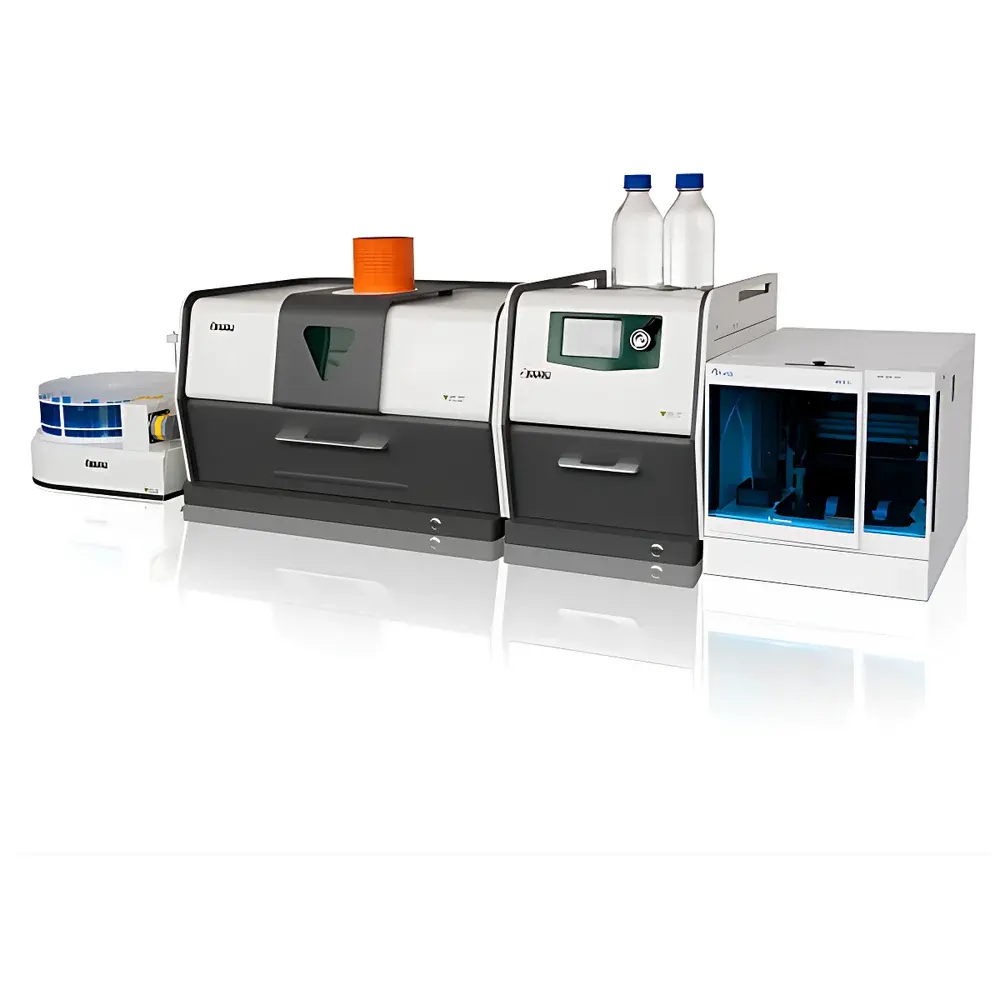
Brookfield BSA-100C Liquid Chromatography–Atomic Fluorescence Spectrometry Hyphenated System
| Brand | Brookfield |
|---|---|
| Origin | Beijing, China |
| Manufacturer Type | Direct Manufacturer |
| Country of Origin | Domestic (China) |
| Model | BSA-100C |
| Pricing | Upon Request |
| Target Analytes | Speciated trace heavy metals — including arsenic species (As(III), As(V), MMA, DMA, AsB, AsC, p-ASA, Roxarsone), mercury species (Hg²⁺, MeHg, EtHg, PhHg), selenium species (Se(IV), Se(VI), SeCys, SeMeCys, SeMet), antimony species (Sb(III), Sb(V)) |
| Detection Principle | Post-column hydride generation coupled with atomic fluorescence detection (HG-AFS) after LC separation |
Overview
The Brookfield BSA-100C is a fully integrated liquid chromatography–atomic fluorescence spectrometry (LC-AFS) hyphenated system engineered for quantitative and qualitative speciation analysis of trace heavy metal elements in complex matrices. Unlike total-element assays, which lack toxicological relevance, the BSA-100C enables precise differentiation and measurement of individual chemical species—each exhibiting distinct bioavailability, mobility, metabolic pathways, and toxicity profiles. The system operates on a post-column hydride generation–atomic fluorescence detection principle: analytes are first separated via high-resolution anion- or cation-exchange liquid chromatography, then subjected to on-line chemical derivatization (e.g., sodium borohydride reduction under controlled acid conditions) to generate volatile hydride or cold-vapor species, which are swept into a quartz atomization cell and excited by a high-intensity hollow cathode lamp. Fluorescence emission at element-specific wavelengths is measured with photomultiplier tube detection, delivering sub-ppt (pg/L) sensitivity for target species. Designed for routine compliance-driven laboratories, the BSA-100C meets the analytical rigor required for regulatory monitoring under frameworks such as EU Commission Regulation (EC) No 1881/2006, US FDA Elemental Impurities Guidance (ICH Q3D), and China’s GB 5009 series food safety standards.
Key Features
- Fully automated LC-AFS interface with real-time synchronization of gradient elution, post-column reagent mixing, gas–liquid separation, and AFS signal acquisition
- Triple-channel atomic fluorescence detection module (compatible with BAF-3000 architecture), enabling simultaneous quantification of up to three co-eluting species without spectral interference
- Optimized hydride generation kinetics for As, Hg, Se, and Sb species—minimizing inter-species conversion during online derivatization
- Integrated column oven with ±0.1 °C temperature stability to ensure retention time reproducibility across multi-day method validation runs
- Modular design supporting interchangeable LC columns (PRP-X100, Hamilton PRP-X200, IonPac AS7/AG7) for tailored selectivity toward inorganic vs. organometallic species
- On-board calibration verification using certified reference materials (CRMs) such as NIST SRM 8625 (arsenic species in rice flour) and BCR-627 (methylmercury in fish tissue)
Sample Compatibility & Compliance
The BSA-100C accommodates aqueous extracts from solid and liquid samples—including food homogenates (rice, seafood, infant formula), environmental water (groundwater, wastewater, seawater), biological tissues (urine, blood, hair), soil leachates, and pharmaceutical excipients. Sample introduction is compatible with standard 10–100 µL loop injection and supports offline microwave-assisted extraction (MAE) or enzymatic digestion protocols. All hardware and software modules comply with ISO/IEC 17025:2017 requirements for testing laboratories, and data handling workflows support audit-ready documentation per FDA 21 CFR Part 11 (electronic signatures, user access control, immutable audit trails). Method validation follows ICH Q2(R2) guidelines, with demonstrated linearity (r² ≥ 0.999), intra-day precision (RSD ≤ 3.2%), and recovery rates of 85–115% across certified reference materials.
Software & Data Management
Control and data processing are managed through BD-Insight™ v4.2, a validated Windows-based platform featuring dual-mode operation: sequence-driven batch analysis for high-throughput labs and interactive method development mode for research applications. The software provides peak identification via retention time matching against embedded spectral libraries, automatic baseline correction using asymmetric least-squares smoothing, and species-specific calibration curve fitting (linear, quadratic, or weighted). Raw data files (.bdx) are stored in a relational database with built-in version control; export formats include CSV, PDF analytical reports, and XML for LIMS integration. Electronic records include full metadata: instrument configuration, column lot numbers, reagent batch IDs, analyst ID, and timestamped QC checkpoints.
Applications
- Regulatory food safety testing: quantification of inorganic arsenic in rice products per EU No 2015/1006; methylmercury in seafood per FDA Fish and Fisheries Products Hazards Guide
- Environmental monitoring: speciation of antimony in landfill leachate and selenium in agricultural runoff per EPA Method 1638 revision
- Pharmaceutical quality control: detection of arsenobetaine vs. inorganic As in algal-derived supplements; residual arsenic species in herbal extracts per Chinese Pharmacopoeia 2020 Edition
- Clinical toxicology: differential diagnosis of chronic arsenic poisoning via urinary As(III)/DMA ratios; prenatal exposure assessment using cord blood MeHg levels
- Method development for emerging contaminants: characterization of novel organoselenium metabolites in nutraceuticals and transformation products of roxarsone in poultry manure
FAQ
What sample preparation methods are recommended prior to LC-AFS analysis?
Solid samples require extraction using dilute nitric acid (1–2% v/v) or enzymatic hydrolysis (e.g., protease XIV for protein-bound Se species), followed by centrifugation, filtration (0.22 µm nylon), and pH adjustment to match mobile phase conditions.
Can the BSA-100C be used for chromium or lead speciation?
No—chromium and lead do not form stable, volatile hydrides under standard HG-AFS conditions; alternative techniques such as LC-ICP-MS are recommended for those elements.
Is method transfer supported between different BSA-series instruments?
Yes—BD-Insight™ enforces standardized method templates and retains all chromatographic and AFS parameters in portable .bdm files, enabling seamless transfer across BSA-100B, BSA-100C, and future-generation platforms.
Does the system support GLP-compliant reporting?
Yes—preconfigured report templates include analyst signature fields, instrument calibration logs, CRM traceability statements, and uncertainty budgeting per GUM (JCGM 100:2008).




