
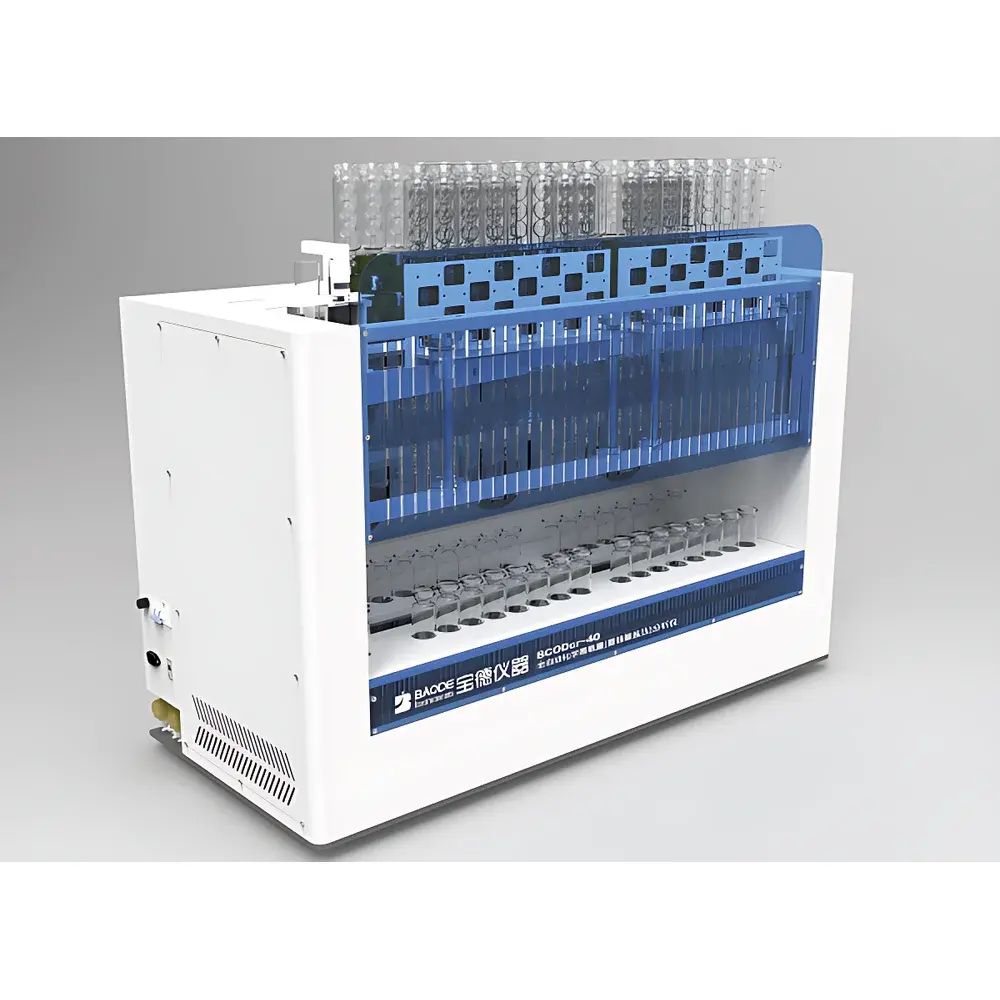
Brookfield BCODcr-40 Automated COD Analyzer (Dichromate Method)
| Brand | Brookfield |
|---|---|
| Origin | Beijing, China |
| Manufacturer Type | Direct Manufacturer |
| Country of Origin | China |
| Model | BCODcr-40 |
| Pricing | Available Upon Request |
Overview
The Brookfield BCODcr-40 Automated Chemical Oxygen Demand (COD) Analyzer is a fully integrated laboratory system engineered for precise, standardized determination of chemical oxygen demand in aqueous samples using the dichromate oxidation method. It operates strictly in accordance with China’s national environmental monitoring standard HJ 828–2017, which specifies the open-reflux titrimetric procedure based on potassium dichromate under strongly acidic conditions. The instrument implements a closed-loop, sequential reagent delivery and thermal management protocol: automatic dosing of mercury sulfate (to mask chloride interference), standardized potassium dichromate solution, and sulfuric acid–silver sulfate catalyst; followed by controlled reflux at boiling temperature for exactly 120 minutes; post-reflux dilution with deionized water; endpoint detection via automated potentiometric or photometric titration with ferrous ammonium sulfate (FAS); and final COD calculation based on stoichiometric oxygen equivalence (1 mol K₂Cr₂O₇ ≡ 1.5 mol O₂ ≡ 48 g O₂). This architecture ensures full traceability to regulatory methodology while eliminating manual handling variability.
Key Features
- Integrated monolithic chassis with compact footprint—designed for high-density lab environments without compromising service access or thermal safety.
- 32-position sample carousel with independent heating zones, enabling unattended batch processing of up to 32 samples per run.
- Dedicated FAS standardization station—physically isolated from the digestion manifold to prevent cross-contamination and ensure metrological integrity of titrant concentration.
- Four modular heating blocks, each independently controllable for power output (0–100% adjustable), temperature ramp rate, and hold duration—supporting method flexibility for diverse matrix types (e.g., high-chloride, high-suspended-solid, or low-COD samples).
- Corrosion-resistant, high-thermal-conductivity alloy heating plates with uniform surface temperature distribution (±1.5 °C across entire zone), certified for continuous operation at ≥150 °C in aggressive sulfuric acid vapor environments.
- Automated endpoint recognition using dual-wavelength photometric detection (510 nm/620 nm) of the ferroin redox indicator transition—eliminating subjective visual interpretation and delivering reproducible titration precision (RSD ≤ 2.1% at 100 mg/L COD).
Sample Compatibility & Compliance
The BCODcr-40 is validated for use with raw and treated waters exhibiting COD concentrations ranging from 10 to 7000 mg/L O₂, including surface water, domestic wastewater, municipal effluent, and industrial discharges from pharmaceutical, textile, pulp & paper, agrochemical, metallurgical, and dye manufacturing sectors. All operational sequences—including reagent addition volumes, reflux timing, cooling profiles, and titration parameters—are hard-coded to HJ 828–2017 specifications. The system supports audit-ready data logging compliant with GLP principles: timestamped event records (reagent dispense, heating start/stop, titration curve capture), user authentication logs, and electronic signature capability. Optional 21 CFR Part 11–compliant software module available for regulated QA/QC laboratories requiring electronic record integrity and change control.
Software & Data Management
The embedded Windows-based control software provides real-time monitoring of all hardware states (temperature, valve position, pump status, photometric signal), interactive method editing (within HJ 828 constraints), and automated report generation in PDF/CSV formats. Raw titration curves are stored with metadata (sample ID, operator, calibration history, ambient lab temperature). Data export supports LIMS integration via ASTM E1384-compliant HL7 or direct ODBC connection. Audit trail functionality records all parameter modifications, result overrides, and user logins with immutable timestamps—enabling full retrospective verification during internal or third-party quality audits.
Applications
This analyzer serves as a primary tool in environmental compliance laboratories performing routine discharge monitoring, pretreatment verification, and process optimization in wastewater treatment plants. Its robust design accommodates high-salinity matrices common in coastal industrial zones and enables reliable COD assessment in complex effluents containing surfactants, chelating agents, or refractory organics that resist conventional biological degradation. Regulatory agencies utilize the BCODcr-40 for enforcement sampling under China’s “Blue Sky and Clear Water” initiative, while research institutions deploy it in method validation studies comparing dichromate-based COD against TOC or respirometric BOD₅ correlations.
FAQ
Does the BCODcr-40 comply with international standards such as ISO 6060 or APHA 5220B?
It is fully aligned with HJ 828–2017, which is technically equivalent to ISO 6060:1989 and APHA Standard Method 5220B (Closed Reflux, Titrimetric). Cross-validation reports are available upon request.
Can the instrument handle samples with chloride concentrations above 2000 mg/L?
Yes—via programmable mercury sulfate dosing (up to 2 mL of 10% HgSO₄ solution per sample), enabling effective chloride masking up to 20,000 mg/L Cl⁻.
Is remote diagnostics or preventive maintenance scheduling supported?
The system includes Ethernet-enabled remote access for firmware updates and diagnostic telemetry; predictive maintenance alerts are triggered based on cumulative heater cycles, pump actuation counts, and reagent usage thresholds.
What is the typical throughput for a full 32-sample batch?
Including sample loading, digestion (120 min), cooling (30–40 min), and titration (≤90 sec/sample), total cycle time is approximately 3.5 hours—achieving ~9 samples/hour average throughput.
Are calibration certificates and IQ/OQ documentation provided?
Factory-issued calibration certificates traceable to NIM (National Institute of Metrology, China) are included; IQ/OQ protocols and execution templates are supplied for site-specific validation under ISO/IEC 17025 or CNAS requirements.







