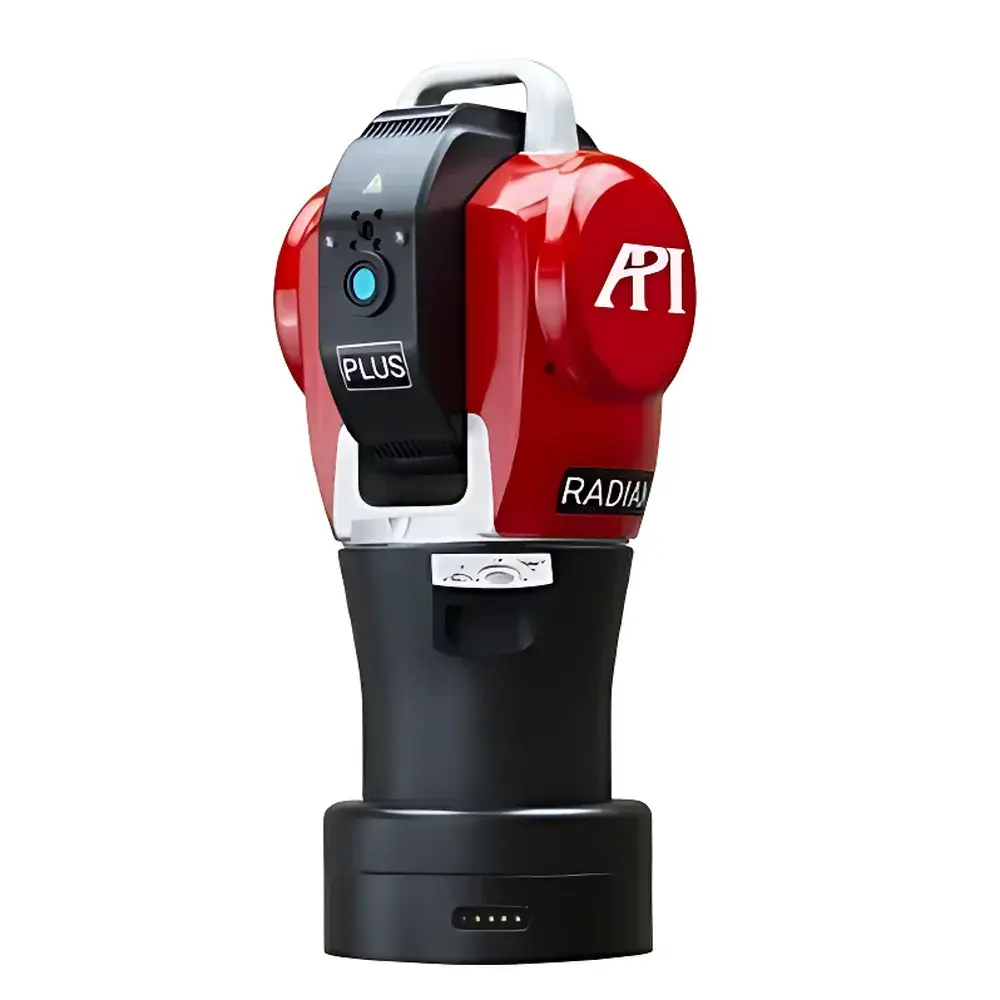
API Radian Plus Wireless Laser Tracker
| Origin | USA |
|---|---|
| Manufacturer Type | Authorized Distributor |
| Origin Category | Imported |
| Model | Radian Plus |
| Price Range | USD 135,000 – 270,000 (FOB) |
| Maximum Measurement Range | 160 m |
| Measurement Resolution | 0.08 µm |
| Volumetric Accuracy | 15 µm + 5 µm/m |
| Horizontal Rotation | ±320° |
| Vertical Pitch | −59° to +79° |
| Tilt Capability | Unlimited (via integrated inclinometer feedback) |
Overview
The API Radian Plus Wireless Laser Tracker is a fully integrated, self-contained metrology system engineered for high-accuracy, portable 3D coordinate measurement in industrial and field environments. Based on Absolute Distance Measurement (ADM) technology—complemented by interferometric verification—the Radian Plus delivers traceable, real-time spatial coordinates with volumetric accuracy of 15 µm + 5 µm/m over its full 160-meter working envelope. Unlike conventional laser trackers requiring external controllers, cabling, or auxiliary environmental sensors, the Radian Plus embeds all core subsystems—including motion control electronics, environmental compensation (integrated meteorological station), dual-axis inclinometer, rechargeable Li-ion battery, and dual-band WiFi module—within a single, monolithic enclosure. This architecture eliminates signal latency, reduces setup time, and ensures deterministic synchronization between distance, angle, and environmental data streams. Designed for compliance with ISO 10360-12 (laser tracker performance verification) and compatible with ASME B89.4.19 and VDI/VDE 2617 standards, the Radian Plus supports both static and dynamic measurement modes, enabling applications ranging from large-part alignment to robotic calibration and real-time kinematic tracking.
Key Features
- Fully wireless operation: No external controller, no tethered PC connection, no separate environmental sensor unit
- Integrated ADM-based distance measurement with sub-micron resolution (0.08 µm) and real-time atmospheric compensation
- Monolithic mechanical design with sealed optical path; IP54-rated enclosure for factory-floor and outdoor deployment
- Self-contained power system: Internal non-removable rechargeable battery supporting 3–6 hours of continuous operation (typical)
- Onboard 6-axis inertial measurement unit (IMU) and dual-axis inclinometer enabling tilt-compensated positioning and multi-orientation mounting
- Auto-target acquisition via integrated CMOS camera with real-time centroid tracking and predictive lock algorithms
- Horizontal angular range of ±320° and vertical pitch of −59° to +79°, optimized for unrestricted line-of-sight coverage
- Lightweight chassis (8 kg including transport case); compatible with standard API quick-connect tripods, magnetic bases, and custom fixtures
Sample Compatibility & Compliance
The Radian Plus is designed to measure reflective spheroidal targets (e.g., SMR-1.5″, SMR-0.5″) and active retroreflective probes across diverse material surfaces—including machined metal, composite tooling, painted aerospace structures, and unprepared concrete foundations. Its robust thermal management enables stable operation across −10°C to +60°C ambient conditions, making it suitable for uncontrolled shop-floor, hangar, or outdoor survey environments. The system complies with CE marking requirements (EMC Directive 2014/30/EU, RoHS 2011/65/EU), meets FCC Part 15 Class A emissions limits, and supports audit-ready data logging per FDA 21 CFR Part 11 when paired with validated software platforms (e.g., SpatialAnalyzer v2023+). Calibration certificates are traceable to NIST standards and include full uncertainty budgets per ISO/IEC 17025.
Software & Data Management
Data acquisition, visualization, and analysis are performed using API’s SpatialAnalyzer (SA) software suite—certified for GLP/GMP workflows and configurable with role-based access control, electronic signatures, and immutable audit trails. SA supports direct WiFi streaming from the Radian Plus at up to 1,000 Hz (dynamic mode) or 10 Hz (high-precision static mode), with native export to STEP, IGES, ASCII XYZ, and industry-standard metrology formats (e.g., .xyz, .csv, .pcd). All onboard sensor readings—including temperature, pressure, humidity, and inclination—are timestamped and embedded in raw measurement records. Optional SA modules enable automated GD&T evaluation (per ASME Y14.5–2018), robot cell validation, photogrammetry fusion, and statistical process control (SPC) reporting with SPC-compatible charting and capability indices (Cp/Cpk).
Applications
- Aerospace: Tooling verification, wing spar alignment, fuselage section assembly, and flight control surface rigging
- Automotive: Body-in-white dimensional analysis, jig and fixture certification, battery pack cell placement validation
- Energy: Wind turbine blade geometry inspection, nuclear containment vessel deformation monitoring, LNG tank shell roundness assessment
- Heavy Machinery: Gearbox housing bore alignment, excavator boom articulation mapping, gantry crane rail straightness verification
- Research & Development: Large-scale optical bench alignment, particle accelerator component positioning, geodetic reference network establishment
FAQ
Does the Radian Plus require an external computer to operate?
No—it operates autonomously with onboard processing and supports remote control via WiFi-connected tablet or laptop running SpatialAnalyzer.
Can it be mounted upside-down or on curved surfaces?
Yes—its integrated inclinometer and tilt-tolerant ADM optics support inverted, inclined, or flush-mounted configurations without recalibration.
Is battery replacement user-serviceable?
No—the Li-ion battery is permanently sealed and serviced only by authorized API service centers to maintain IP rating and calibration integrity.
What environmental corrections are applied during measurement?
Real-time compensation for air temperature, pressure, relative humidity, and CO₂ concentration is performed using the embedded meteorological station per Edlén equation revision (ISO 10360-12 Annex C).
How is traceability maintained across firmware and software updates?
Each system ships with a unique calibration certificate; subsequent recalibrations are documented in SA’s built-in calibration log with version-stamped digital signatures and NIST-traceable uncertainty statements.