
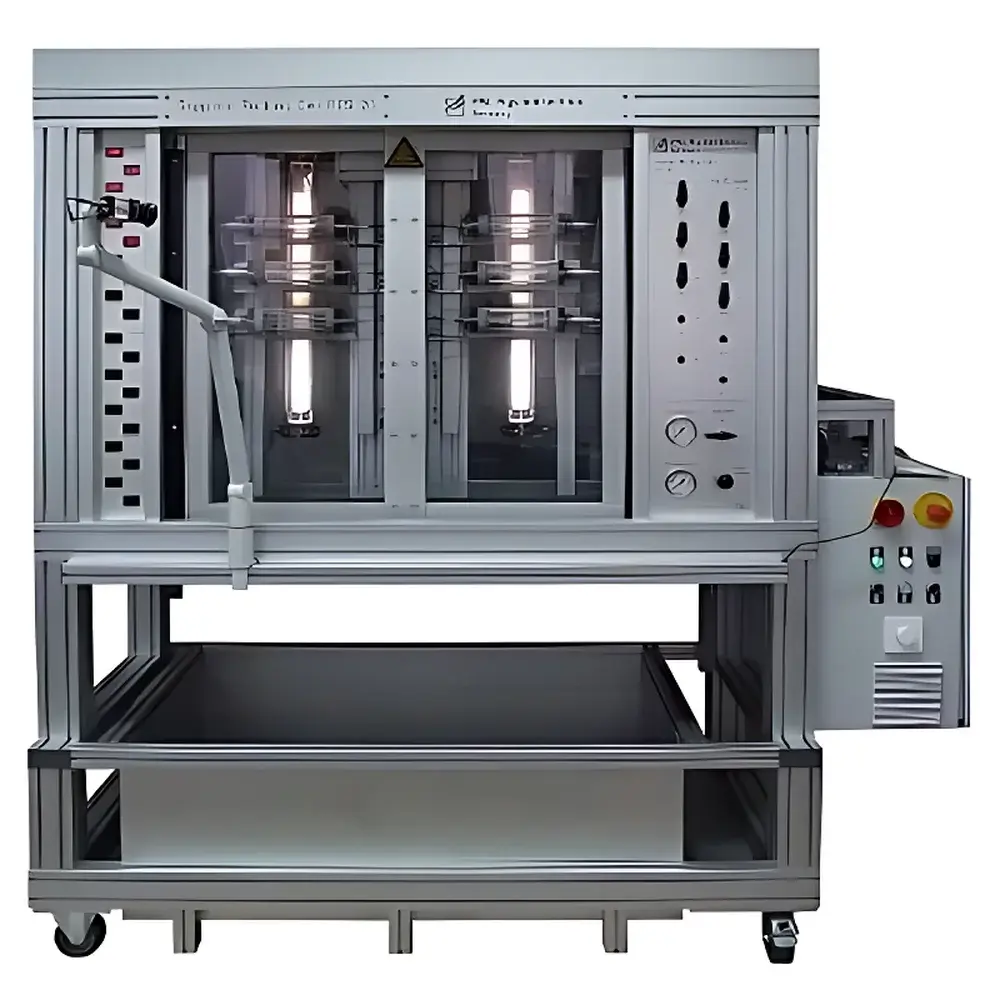
PSL Sapphire Rocking Cell RC20
| Origin | Germany |
|---|---|
| Manufacturer Type | Authorized Distributor |
| Origin Category | Imported |
| Model | RC20 |
| Pricing | Upon Request |
Overview
The PSL Sapphire Rocking Cell RC20 is a high-precision, optically transparent high-pressure experimental platform engineered for the quantitative evaluation of low-dosage hydrate inhibitors (LDHIs), kinetic hydrate inhibitors (KHIs), and anti-agglomerants (AAs) under dynamically controlled thermobaric conditions. It operates on the principle of controlled mechanical agitation—via programmable rocking motion combined with internal stainless-steel or ceramic balls—to replicate turbulent multiphase flow regimes encountered in subsea pipelines. The cell’s sapphire windows enable real-time, in-situ optical observation of hydrate nucleation, growth, agglomeration, and dissociation events across gas–liquid–solid phases. Designed to simulate deepwater operational environments, it maintains pressures up to 200 bar (2900 psi) and temperatures from –10 °C to +60 °C, supporting rigorous assessment of inhibitor performance under realistic shear and mass-transfer conditions.
Key Features
- Optically transparent sapphire viewing windows for unobstructed visual monitoring of hydrate morphology, phase distribution, and interfacial behavior
- Modular multi-cell configuration: systems available with 2, 6, or 20 independently controlled rocking cells for parallel screening
- Precise dynamic control of rocking frequency (1–20 rpm), amplitude (1°–45° tilt angle), and duration via integrated PLC and HMI interface
- Integrated ball-based agitation system to generate controlled shear stress profiles mimicking pipeline turbulence and droplet breakup
- Embedded temperature and pressure transducers with ±0.1 °C and ±0.5 bar accuracy, respectively, linked to closed-loop PID control
- Non-invasive magnetic or inductive position sensing for ball motion detection—enabling reliable operation even in opaque or highly scattering fluids
- Compatible with synchronized high-resolution video capture (up to 120 fps) for time-resolved hydrate event analysis
Sample Compatibility & Compliance
The RC20 accommodates complex hydrocarbon–aqueous systems including crude oil/water/condensate mixtures, synthetic brines, and inhibitor formulations containing corrosion inhibitors (CIs), asphaltene inhibitors (AIs), wax inhibitors (WIs), and scale inhibitors (SIs). Its inert sapphire–stainless-steel construction ensures chemical compatibility with aggressive sour service fluids and acidic environments. All pressure containment components comply with PED 2014/68/EU and ASME BPVC Section VIII Div. 1 design standards. Temperature and pressure logging meet GLP audit requirements, with timestamped data traceability aligned with ISO/IEC 17025 and ASTM D7692–21 (Standard Practice for Evaluation of Hydrate Inhibitors in High-Pressure Systems).
Software & Data Management
The RC20 is operated via PSL’s proprietary HydrateLab™ software, which provides full automation of experiment sequencing, parameter ramping, and real-time data acquisition at user-defined intervals (1–30 seconds). Software modules support automated hydrate onset detection through image analysis algorithms, pressure-drop threshold triggering, and differential temperature profiling. All raw sensor outputs—including pressure, temperature, rocking status, and camera timestamps—are stored in HDF5 format with embedded metadata (sample ID, operator, date/time, environmental calibration logs). Export options include CSV, MATLAB .mat, and XML for integration into LIMS or statistical modeling platforms. Audit trails and electronic signatures conform to FDA 21 CFR Part 11 requirements for regulated R&D environments.
Applications
- Screening and dose optimization of LDHIs, KHIs, and AAs under representative deepwater pressure–temperature–shear conditions
- Investigation of synergistic or antagonistic interactions between hydrate inhibitors and other production chemicals (e.g., CIs, AIs, WIs)
- Quantitative assessment of hydrate agglomeration kinetics, particle size distribution evolution, and slurry rheology onset
- Validation of thermodynamic and kinetic hydrate prediction models using experimentally observed induction times and growth rates
- Development and qualification of novel inhibitor chemistries for HP/HT field applications and carbon capture transport scenarios
- Supporting API RP 14E and ISO 13703 risk assessments for flow assurance strategy development
FAQ
What is the maximum operating pressure and temperature range of the RC20?
The RC20 supports pressures up to 200 bar and temperatures from –10 °C to +60 °C, enabling simulation of water depths exceeding 2,000 meters.
Can multiple samples be tested simultaneously, and how many cells are supported?
Yes—systems are configurable with 2, 6, or 20 independent rocking cells mounted on a shared base frame, each with individual thermal and motion control.
How does the rocking mechanism simulate pipeline flow conditions?
Controlled angular oscillation combined with internal ball motion generates reproducible shear gradients and interfacial mixing, replicating key hydrodynamic features of three-phase slug or annular flow.
Is the system compatible with corrosive or sour fluid systems?
All wetted parts are constructed from ASTM A182 F22 stainless steel and sapphire; optional Hastelloy C-276 components are available for severe H₂S/CO₂ service.
Does the system support regulatory-compliant data recording for QA/QC documentation?
Yes—HydrateLab™ provides full 21 CFR Part 11 compliance, including user authentication, electronic signatures, immutable audit trails, and secure data export protocols.





