
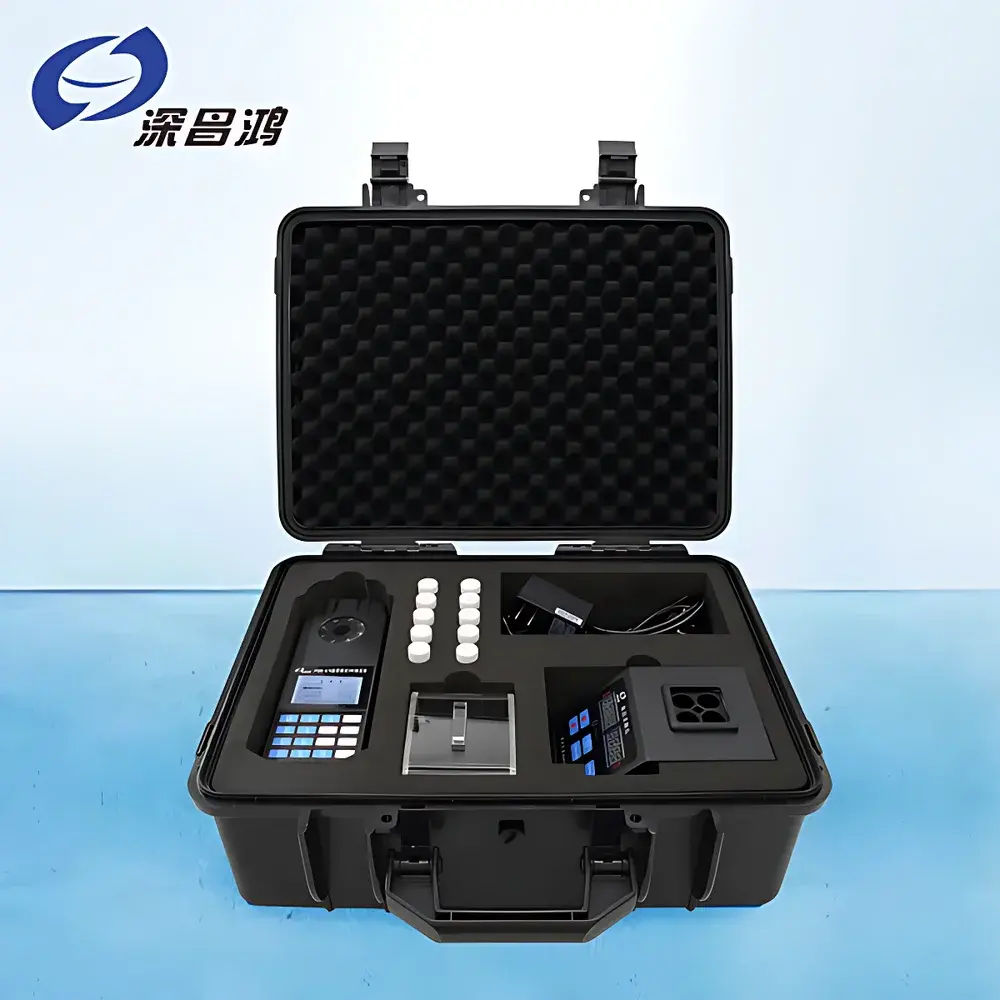
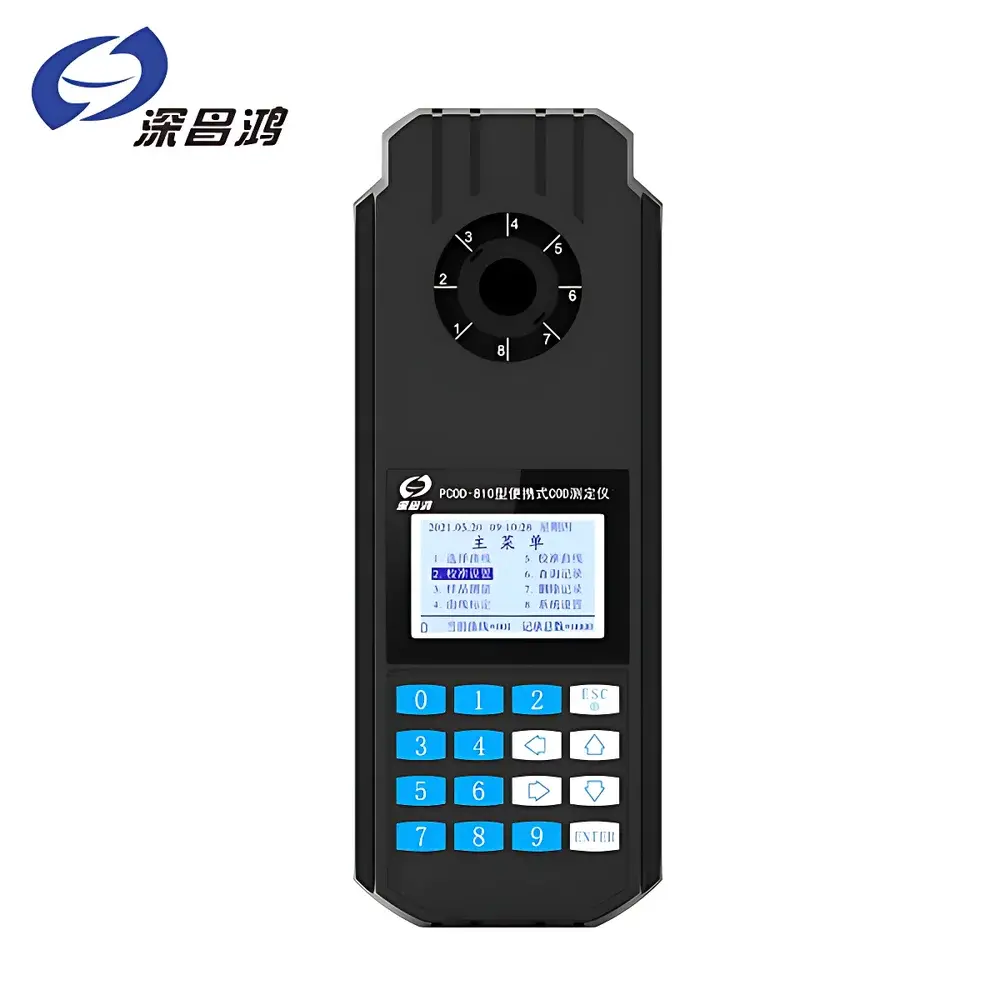
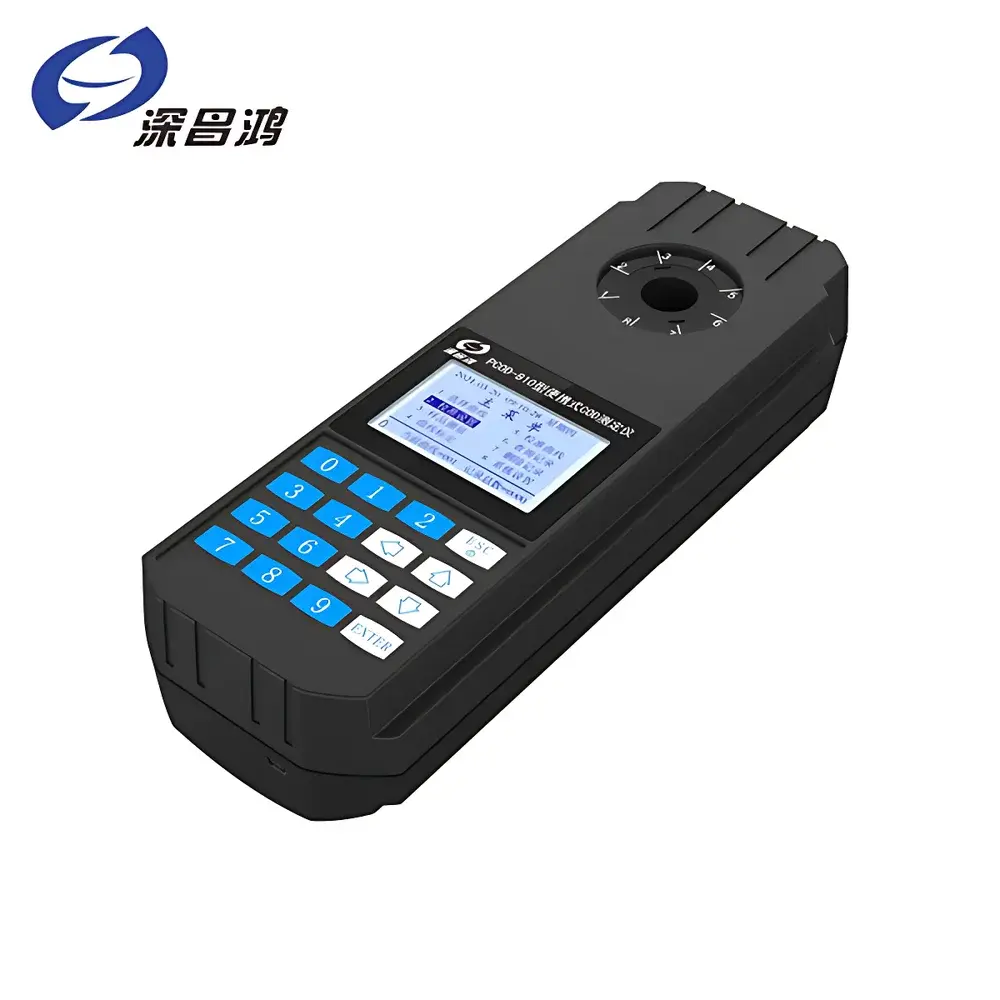
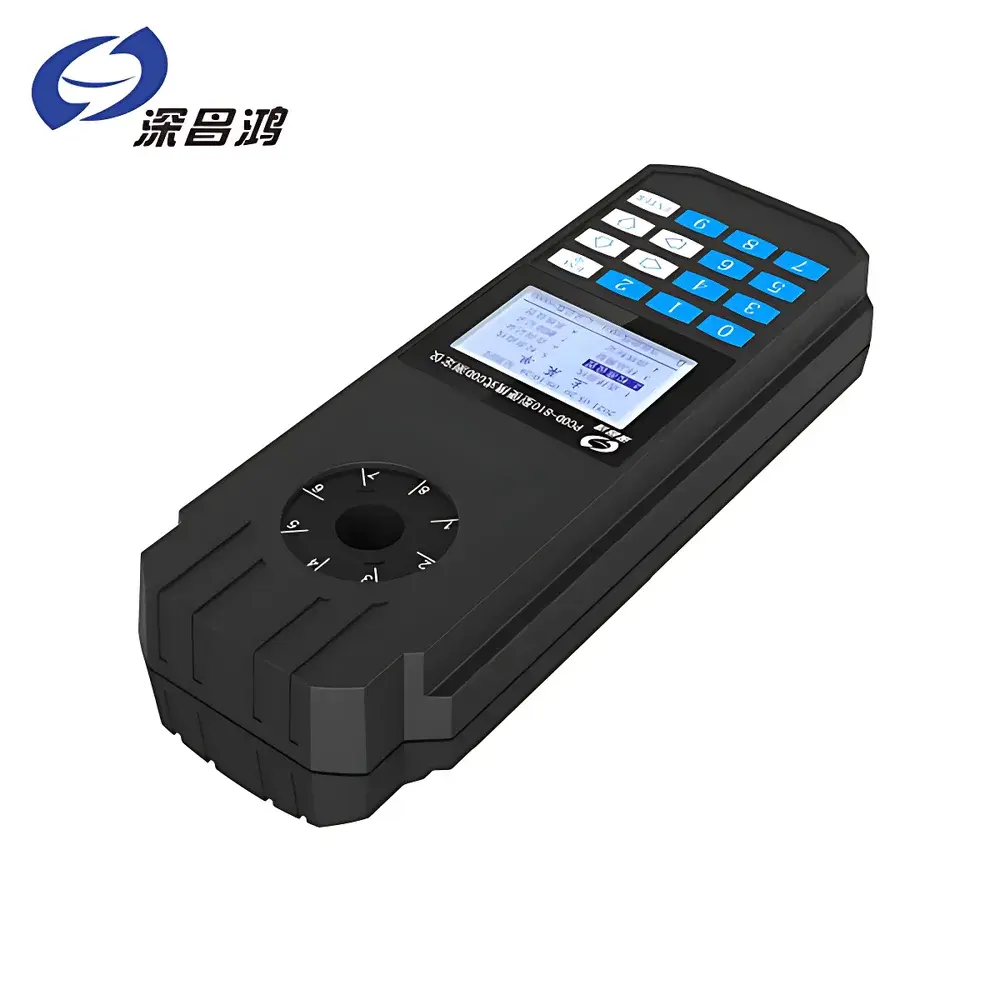
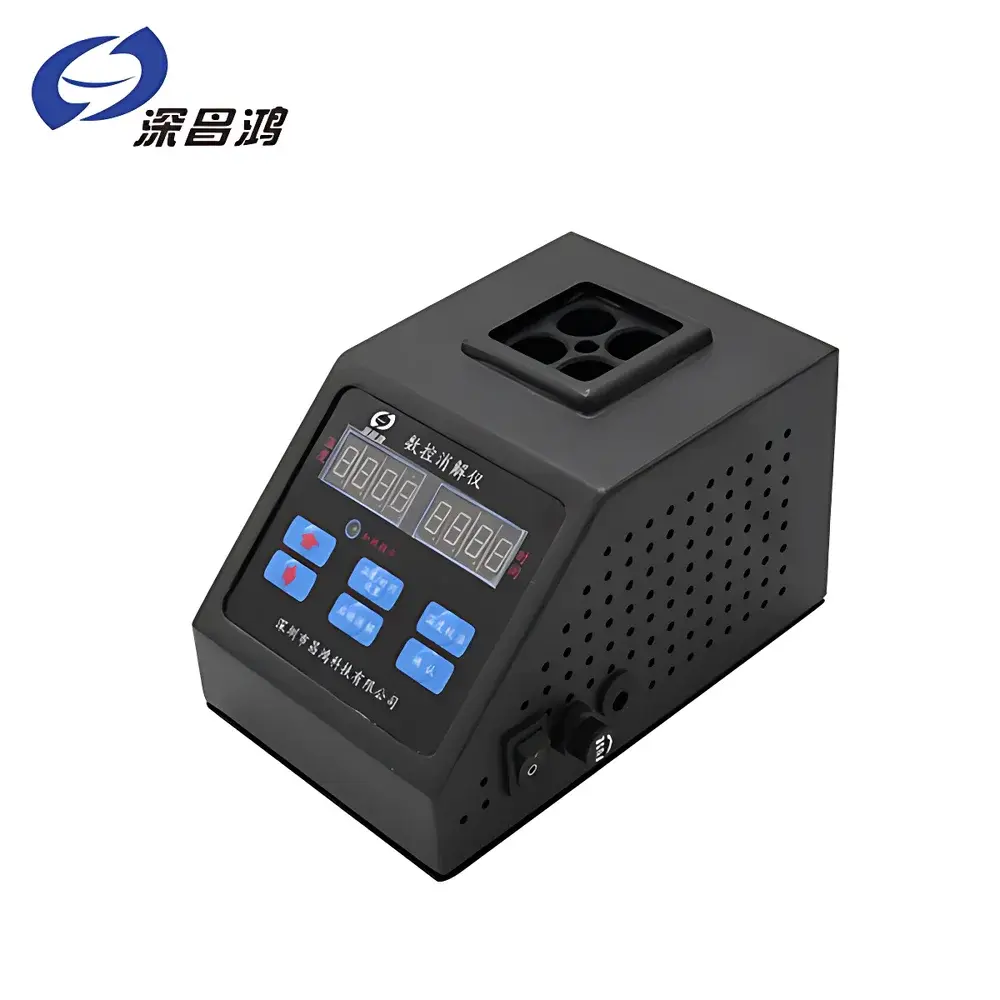
Shenchanghong PCOD-810 Portable COD Analyzer
| Brand | Shenchanghong |
|---|---|
| Origin | Guangdong, China |
| Manufacturer Type | Direct Manufacturer |
| Product Origin | Domestic (China) |
| Model | PCOD-810 |
| Instrument Type | Portable |
| Measurement Principle | High-Temperature Sealed Catalytic Digestion + Photometric Colorimetry at Fixed Wavelength |
| Measurement Wavelength | 610 nm (high-range), 420 nm (low-range) |
| Measurement Range | 5–2000 mg/L COD (dilutable beyond range) |
| Accuracy | ≤ ±5% of reading |
| Repeatability | ≤ ±0.3% |
| Detection Limit | 0.1 mg/L |
| Digestion Temperature | 165 °C ± 1.0 °C |
| Digestion Time | 15 min |
| Sample Throughput | 4 samples per batch (16-sample digestion block optional) |
| Chloride Interference Tolerance | ≤ 2000 mg/L Cl⁻ |
| Optical System | Cold LED Light Source with Narrow-Band Interference Filters |
| Data Storage | 500 measurement records with non-volatile memory |
| Calibration Curves | Up to 50 user-programmable or factory-loaded curves |
| Power Supply | Rechargeable Li-ion battery (host) |
| Enclosure Rating | IP65 |
| Dimensions (Host) | 80 × 230 × 55 mm |
| Weight (Host) | 0.5 kg |
| Dimensions (Digestor) | 130 × 120 × 95 mm |
| Weight (Digestor) | 1.0 kg |
Overview
The Shenchanghong PCOD-810 Portable COD Analyzer is an integrated field-deployable instrument engineered for rapid, reliable quantification of Chemical Oxygen Demand (COD) in water and wastewater samples. It combines high-temperature sealed catalytic digestion—conducted at a precisely controlled 165 °C ±1.0 °C—with fixed-wavelength photometric colorimetry using cold LED light sources and narrow-band interference optical filters. This dual-stage methodology ensures robustness against matrix interferences while maintaining metrological integrity across diverse environmental matrices, including municipal effluents, industrial discharges, surface waters, and groundwater. Unlike benchtop spectrophotometric systems requiring separate digestion and measurement steps, the PCOD-810 employs a single-use digestion/cuvette tube, eliminating cross-contamination risks and streamlining workflow. Its compact form factor, combined with extended battery autonomy and multi-source power compatibility, enables uninterrupted operation in remote sampling locations, mobile laboratories, emergency response units, and regulatory field audits.
Key Features
- Integrated digestion and measurement in one disposable reaction tube—reducing procedural error and contamination risk.
- True portability: host unit weighs only 0.5 kg; fully functional without external AC power via built-in rechargeable Li-ion battery (6+ months standby life).
- Triple-power flexibility: operates from internal battery, 12 V DC (vehicle cigarette lighter socket), or 220 V AC—ideal for mixed urban/rural deployment scenarios.
- Dual-wavelength optical system (420 nm for low-range COD: 5–150 mg/L; 610 nm for high-range: 150–2000 mg/L) with cold LED source and thermal-stable interference filters—ensuring long-term photometric stability and minimal drift.
- IP65-rated ABS polymer housing—resistant to dust ingress and low-pressure water jets—validated for outdoor use in humid, rainy, or dusty environments.
- Onboard data management: stores up to 500 test results with timestamp and sample ID; retains calibration curves (up to 50) and measurement history even after power loss.
- USB interface compliant with standard CDC/ACM protocols—enables direct connection to Windows/macOS/Linux systems for raw data export, firmware updates, and audit log retrieval.
Sample Compatibility & Compliance
The PCOD-810 accommodates standard 16 mm diameter digestion tubes and supports chloride concentrations up to 2000 mg/L without requiring mercury sulfate masking—meeting the practical requirements of many municipal and light-industrial effluent monitoring programs. While not certified to ISO 6060 or ASTM D1252 by default, its measurement protocol aligns with the core principles of the dichromate reflux method (closed-system variant). The instrument’s accuracy (≤ ±5%) and repeatability (≤ ±0.3%) satisfy routine compliance screening thresholds under China’s HJ/T 399–2007 and are suitable for pre-screening prior to confirmatory lab analysis. For GLP/GMP-aligned deployments, the non-volatile memory and USB traceability support basic audit trail requirements; however, full 21 CFR Part 11 compliance requires supplementary validation documentation and electronic signature implementation at the organizational level.
Software & Data Management
The embedded microcontroller—a low-power 16-bit RISC architecture—executes real-time temperature regulation during digestion and performs linear/nonlinear curve fitting against stored calibration functions. All measurement parameters (wavelength selection, digestion time, curve ID, sample ID) are programmable via intuitive button navigation. Data export via USB yields CSV-formatted files containing date/time stamp, measured absorbance, calculated COD value, selected curve index, and operator ID (if entered). No proprietary software is required for data ingestion; exported files integrate natively with LIMS platforms, Excel-based QA/QC dashboards, or statistical process control tools. Firmware updates are delivered as signed binary packages to ensure integrity and version traceability.
Applications
- Routine field verification of wastewater treatment plant influent/effluent compliance with local discharge limits.
- Emergency spill response—rapid assessment of organic loading in rivers, lakes, or stormwater outfalls.
- Environmental consulting firms conducting multi-site baseline surveys with minimal logistical overhead.
- Educational field labs where students perform standardized COD determinations under instructor supervision.
- Industrial facility self-monitoring programs requiring documented, repeatable on-site measurements for internal reporting or regulatory submission support.
FAQ
Does the PCOD-810 require hazardous reagents such as mercury sulfate for chloride compensation?
No—the instrument is designed to tolerate up to 2000 mg/L chloride without mercury-based masking agents, reducing chemical handling risks and disposal complexity.
Can calibration curves be customized or imported from external sources?
Yes—users may program up to 50 custom curves using reference standards; factory-default curves follow HJ/T 399–2007 methodology.
Is the digestion module compatible with standard EPA-approved digestion vials?
It accepts 16 mm OD borosilicate glass tubes conforming to common sealed-digestion specifications; however, vial geometry must match the heating block’s cavity dimensions.
What is the expected service life of the rechargeable battery under typical field use?
With average usage of 10–15 assays per day, the Li-ion battery maintains ≥80% capacity for ≥500 charge cycles (approx. 2 years under normal conditions).
How is measurement traceability ensured for regulatory submissions?
Each result includes embedded metadata (time, curve ID, operator input); USB-exported logs provide machine-readable evidence for internal QA review—though formal accreditation requires site-specific validation per ISO/IEC 17025.







