
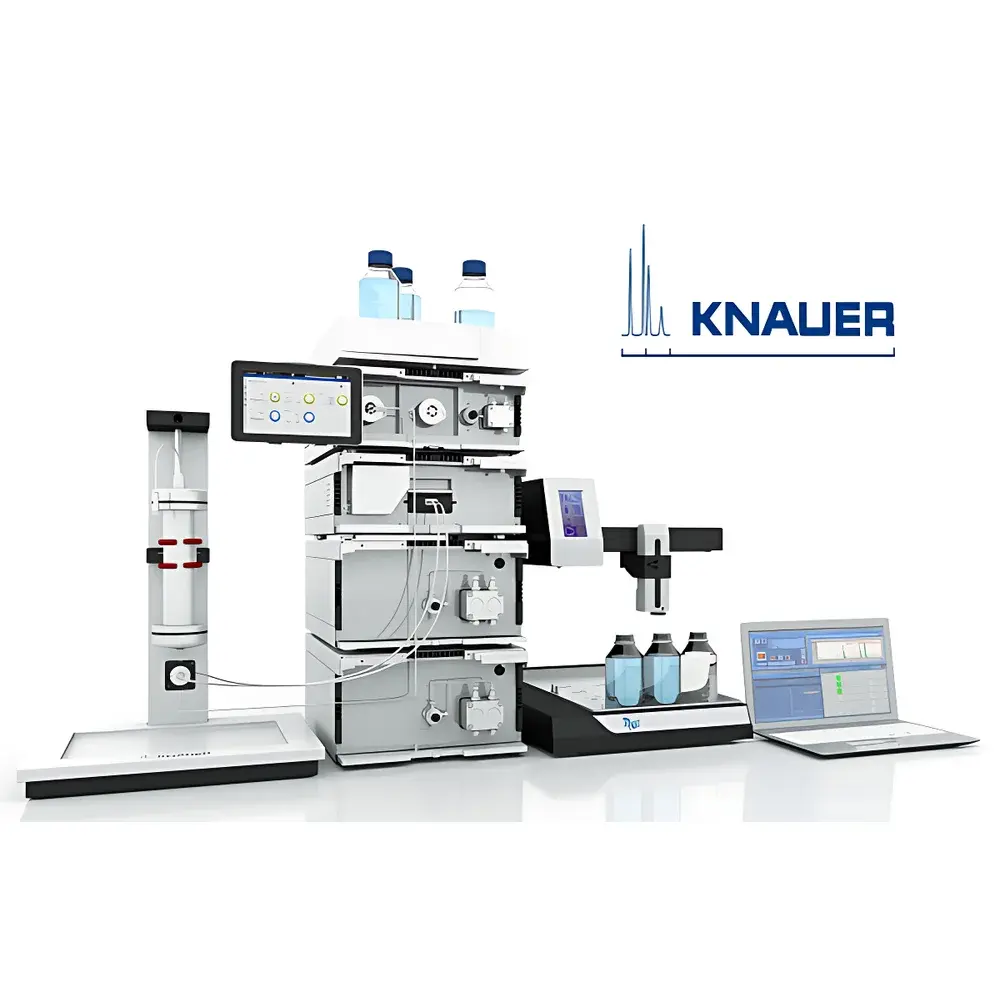
Knauer Prep HPLC System – High-Pressure Preparative Liquid Chromatography
| Brand | Knauer |
|---|---|
| Origin | Germany |
| Instrument Type | High-Pressure Preparative LC |
| Model | Prep HPLC |
| Flow Rate Range | 50–1000 mL/min |
| Flow Accuracy | RSD ≤ 0.1% |
| Flow Precision | RSD ≤ 0.1% |
| Maximum Pressure | 400 bar |
| Wavelength Range | ±0.2 nm |
| Wavelength Repeatability | 0.1 nm |
| Baseline Noise | 3 × 10⁻⁶ AU |
| Data Acquisition Rate | 100 Hz |
Overview
The Knauer Prep HPLC System is a high-pressure preparative liquid chromatography platform engineered for scalable, reproducible, and chemically robust purification across research, development, and early-stage process transfer environments. Built upon Knauer’s decades of German precision engineering in analytical and preparative chromatography, this system operates on the fundamental principle of differential partitioning of analytes between a mobile phase (liquid solvent gradient) and a stationary phase (packed column), enabling high-resolution separation under controlled high-pressure conditions up to 400 bar. Its modular architecture supports seamless transition from analytical method development to gram- to kilogram-scale purification—critical for synthetic organic chemistry, peptide synthesis, natural product isolation, fermentation broth processing, and impurity profiling in pharmaceutical development. Unlike fixed-configuration systems, the Knauer Prep HPLC integrates pressure-stable fluidic modules with chemically inert titanium pump heads, allowing stable operation even in aggressive mobile phases containing high concentrations of hydrochloric acid, sodium hydroxide, or ammonium acetate—conditions commonly encountered in ion-pairing or pH-gradient purifications.
Key Features
- Modular, LEGO-style hardware architecture enabling flexible configuration—from semi-preparative (50 mL/min) to full preparative (1000 mL/min) flow regimes
- Titanium-alloy pump heads rated for continuous operation with corrosive solvents, including concentrated mineral acids and alkalis
- High-accuracy dual-plunger piston pumps delivering flow precision and repeatability of ≤0.1% RSD across the full 50–1000 mL/min range
- Integrated gradient mixing system with low dwell volume and high compositional accuracy for reliable method translation from analytical to preparative scale
- Expandable detection suite: configurable UV/Vis detectors (fixed-wavelength, variable-wavelength, and diode-array DAD), ELSD, RI, pH/conductivity, and mass spectrometry interfaces
- Optional automated fraction collection, loop-based injection valves, recycling modules, and integrated system control via Knauer ChromGate software
Sample Compatibility & Compliance
The system accommodates diverse sample matrices—including small-molecule APIs, protected/unprotected peptides, polar glycosides, alkaloids, polyphenols, and complex fermentation extracts—without compromising column integrity or detector stability. All wetted components comply with USP Class VI and ISO 10993 biocompatibility standards where applicable. The platform supports compliance-driven workflows: data acquisition, audit trails, user access controls, and electronic signatures align with FDA 21 CFR Part 11 requirements when deployed with validated ChromGate software configurations. Method documentation, calibration records, and maintenance logs adhere to GLP and GMP-aligned laboratory practices, facilitating regulatory submissions in pharmaceutical and biotech settings.
Software & Data Management
ChromGate software serves as the central control and data handling environment, supporting real-time monitoring, method sequencing, peak tracking, and fraction triggering logic. It provides native support for AIA/CDF export, CSV-based reporting, and integration with LIMS platforms via OPC UA or custom API endpoints. Raw chromatographic data are stored with embedded metadata (instrument ID, operator, timestamp, method version), ensuring traceability. Software validation packages—including IQ/OQ documentation templates and test protocols—are available upon request to support regulated environments. Batch processing tools enable retrospective analysis of multi-run purification campaigns, while spectral deconvolution algorithms in DAD mode assist in co-elution assessment during method scouting.
Applications
- Synthetic chemistry: Isolation of reaction intermediates and final products; chiral separations using dedicated preparative columns
- Peptide purification: Desalting, removal of deletion sequences, and purification of crude SPPS lysates under acidic or basic mobile phases
- Natural products: Fractionation of plant extracts and marine-derived metabolites with minimal degradation
- Biopharmaceuticals: Purification of oligonucleotides, antibody-drug conjugate (ADC) payloads, and modified amino acids
- Impurity isolation: Targeted preparation of ICH Q3A/B-level impurities for structural characterization and toxicology studies
- Process development: Gradient scouting, column screening, and scalability assessment from 4.6 mm ID analytical columns to 50 mm ID preparative columns
FAQ
Can the system be upgraded from semi-preparative to full preparative flow rates without replacing the entire platform?
Yes—the modular pump design allows field-replacement of pump modules to extend flow capacity from 50–200 mL/min up to 1000 mL/min while retaining existing controllers, detectors, and software licenses.
Is the titanium pump head compatible with TFA-containing mobile phases at elevated temperatures?
Yes—titanium construction resists pitting and stress corrosion cracking in trifluoroacetic acid (TFA) solutions up to 60 °C and concentrations ≥0.1%, making it suitable for peptide purification protocols.
Does the system support unattended overnight operation with automatic fraction collection?
Yes—integrated fraction collectors with position-synchronized triggering, UV threshold-based collection logic, and vial rack identification ensure reliable multi-hour runs with minimal operator intervention.
Are method transfer files compatible between Knauer analytical and preparative systems?
Yes—ChromGate uses unified method syntax and retention time normalization algorithms, enabling direct scaling of gradient profiles, flow rates, and injection volumes based on column geometry and particle size ratios.
What level of technical support is available for method development and process optimization?
Knauer partners with Unichrom Process Service (UPCS) to provide end-to-end application support—including method scouting, purity assessment, yield optimization, and tech-transfer documentation—delivered by chromatographers with industry experience in small-molecule and biopolymer purification.





