
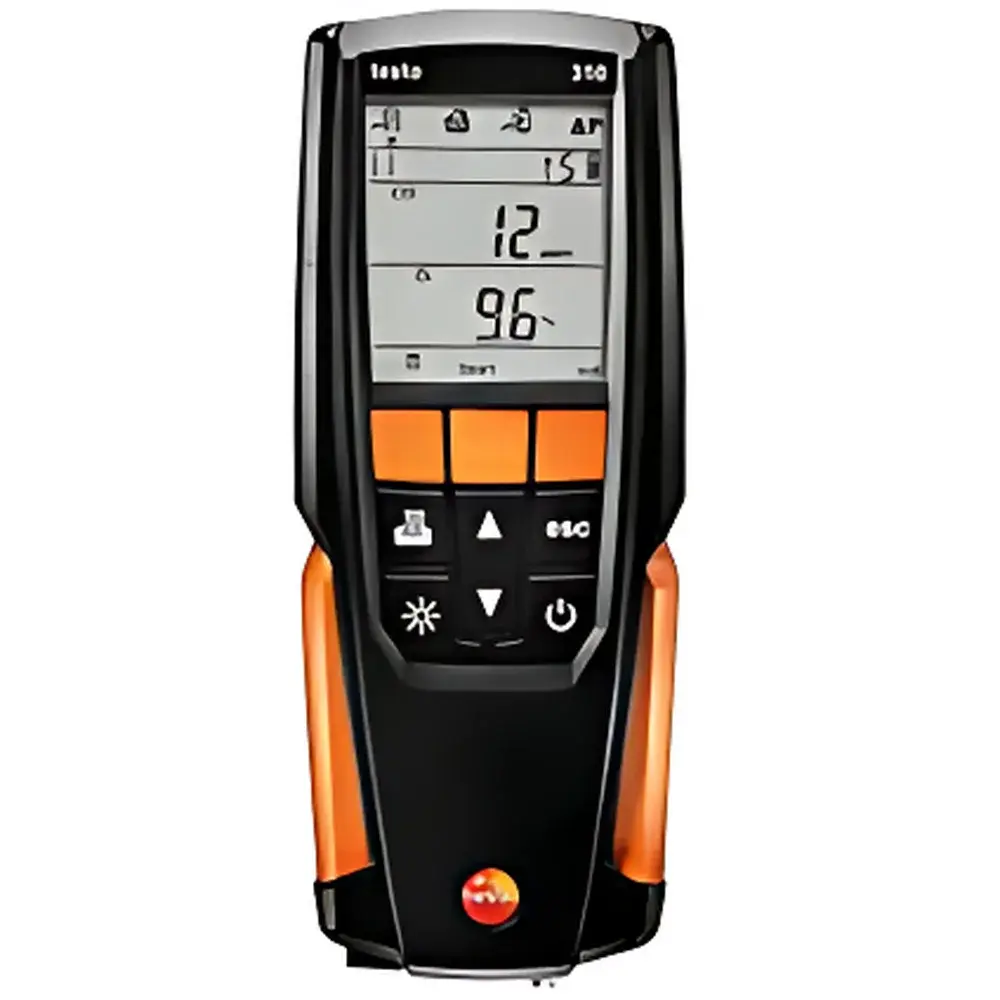
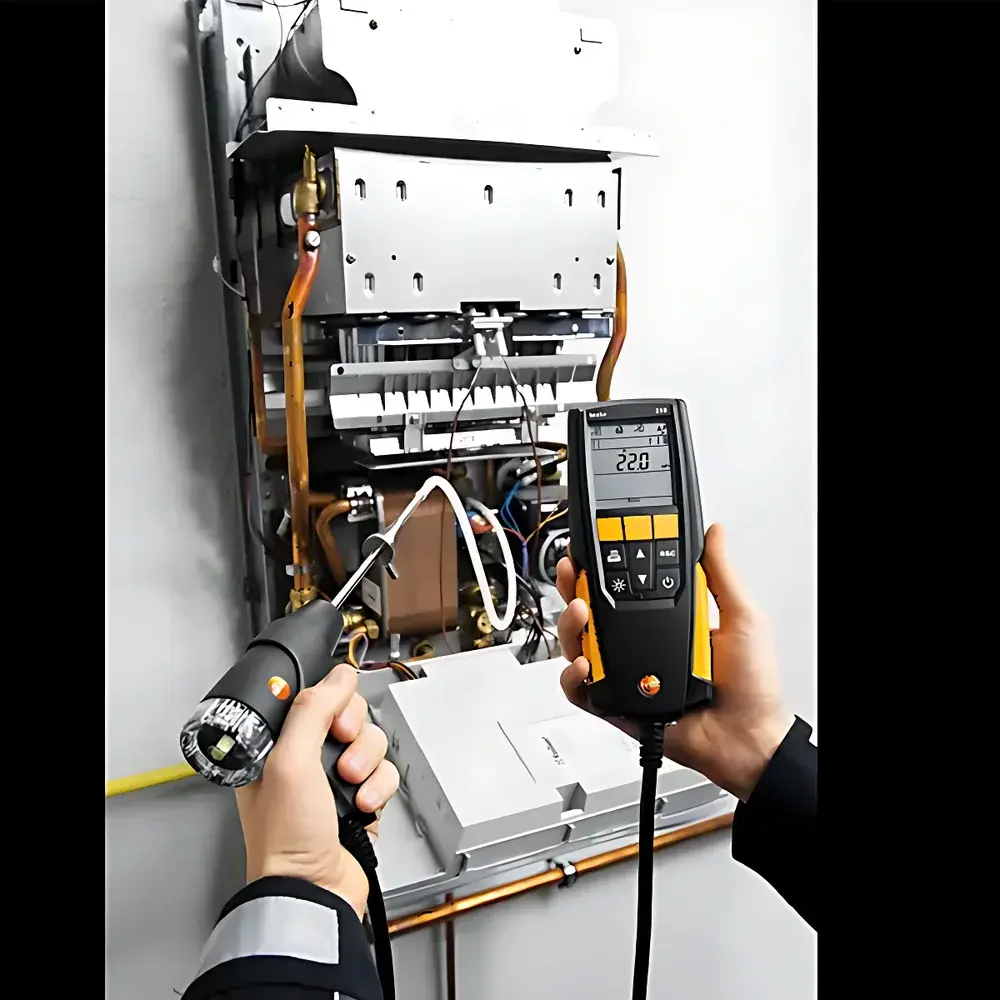
testo 310 Portable Flue Gas Analyzer
| Brand | testo |
|---|---|
| Origin | Germany |
| Model | testo 310 |
| Instrument Type | Portable Flue Gas Analyzer |
| Measured Gases | O₂, CO, CO₂ |
| O₂ Range | 0–21 Vol.% |
| Accuracy (O₂) | ±0.2 Vol.% (within 0–10 Vol.%), ±0.5 Vol.% (within 10–21 Vol.%) |
| CO Range | 0–4000 ppm |
| CO Accuracy | ±5 ppm (0–100 ppm), ±5% of reading (>100 ppm) |
| Response Time (t₉₀) | ≤30 s |
| Zero Stability | <±0.1 Vol.% O₂/8 h |
| Drift (O₂) | <±0.1 Vol.% over 24 h |
| Operating Temperature | 0–50 °C |
| Display | Backlit LCD |
| Data Interface | Infrared (IrDA) |
| Power Supply | Rechargeable Li-ion battery (up to 10 h operation) |
| Compliance | EN 50379-1, EN 50379-2, CE marked for use in explosion group II 2G (non-certified for Zone 0/1) |
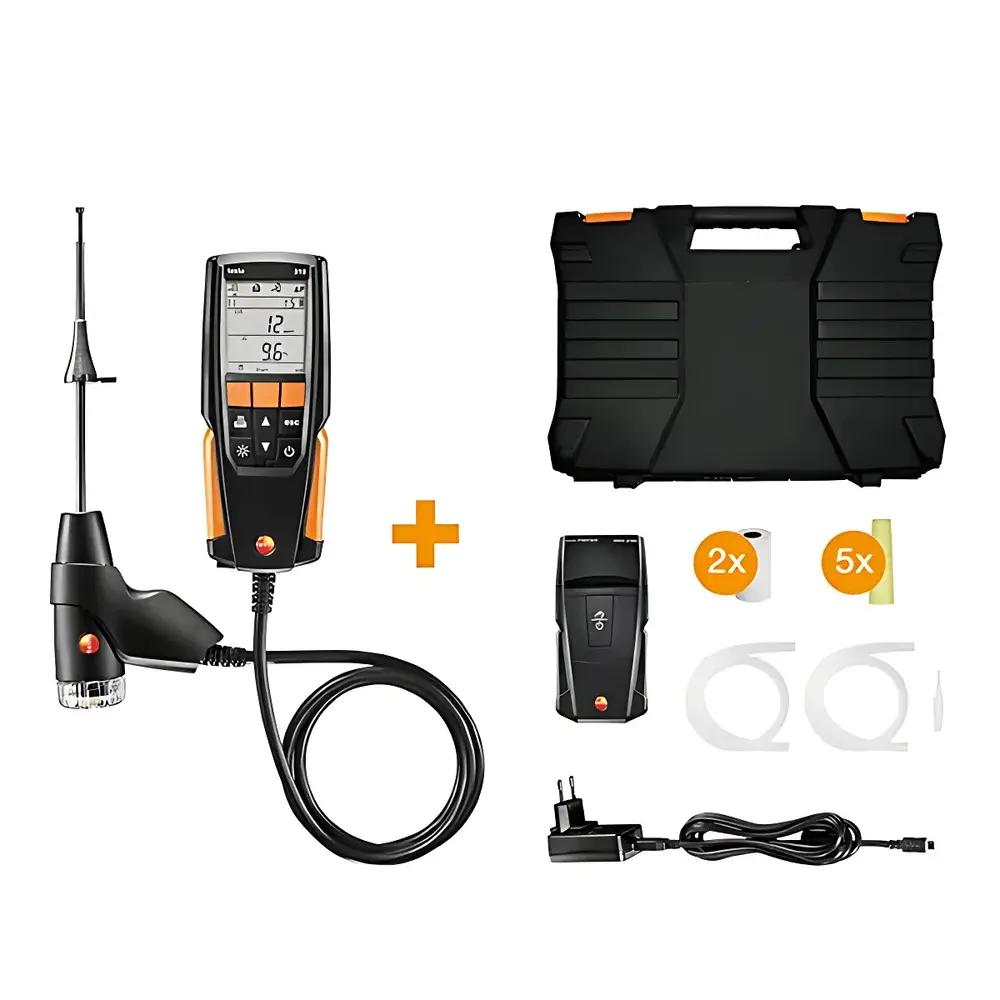
| Accessories Included | 180 mm fixed-cone flue gas probe, silicone pressure hose, 10 dust filters, condensate trap, carrying case, calibration certificate for O₂, CO, hPa, and °C |
Overview
The testo 310 Portable Flue Gas Analyzer is an entry-level, handheld instrument engineered for routine combustion efficiency assessment and safety verification in residential and light commercial heating systems. Based on electrochemical sensor technology for O₂ and CO detection, and non-dispersive infrared (NDIR) for CO₂ (derived via calculation from O₂ and stoichiometric combustion equations), the device delivers field-deployable accuracy aligned with European standards for portable flue gas analysis. Its architecture prioritizes operational robustness in variable ambient conditions — including low-light environments and confined mechanical rooms — while maintaining traceability through factory calibration and documented metrological traceability to national standards. The analyzer operates under the physical principle of partial pressure measurement and catalytic oxidation (for CO), enabling real-time quantification of key combustion parameters critical to energy optimization, regulatory compliance, and occupant safety.
Key Features
- Four guided measurement workflows: flue gas analysis, draft pressure measurement, ambient CO monitoring, and differential pressure assessment — all accessible via intuitive menu navigation
- Integrated magnetic mount on rear housing enables secure attachment to ferromagnetic surfaces (e.g., boiler casings, ductwork), freeing operator hands during setup or adjustment
- Automatic zero calibration for O₂ and CO sensors completed in ≤30 seconds, minimizing downtime between measurements
- Removable condensate trap with tool-free emptying mechanism — designed to prevent liquid ingress into sensor chambers during high-moisture sampling
- Backlit monochrome LCD display with adjustable contrast ensures legibility across lighting conditions, from dim basements to sunlit rooftops
- Infrared (IrDA) communication interface compliant with IrDA 1.1 standard for wireless data transfer to testo thermal printers (e.g., testo 805i, testo 810i) without cables or pairing
- Rechargeable lithium-ion battery supporting up to 10 hours of continuous operation; charge status and estimated runtime displayed in real time
Sample Compatibility & Compliance
The testo 310 is validated for use with dry or moderately moist flue gases from natural gas, liquefied petroleum gas (LPG), oil, and solid fuel combustion appliances rated up to 100 kW thermal input. It accommodates particulate-laden streams via replaceable hydrophobic dust filters (10 included), rated to ISO 12103-1 A4 standard. The 180 mm fixed-cone probe (included) meets EN 50379-2 requirements for probe geometry and thermal mass, ensuring representative gas sampling at typical stack velocities (<5 m/s). The instrument complies with EN 50379-1 (safety) and EN 50379-2 (performance) for portable flue gas analyzers, carries CE marking per Directive 2014/30/EU (EMC) and 2014/35/EU (LVD), and is rated for non-hazardous areas (Group II 2G, unclassified for ATEX Zone 0/1). Calibration certificates include uncertainty statements referenced to DKD/DAkkS-accredited standards.
Software & Data Management
While the testo 310 does not feature onboard data logging or PC connectivity beyond IrDA, it supports full documentation integrity through its built-in reporting logic. Each measurement cycle stores date/time stamps, ambient and flue temperatures, O₂ %, CO ppm, calculated CO₂ %, draft (hPa), and combustion efficiency (%). These values are directly printable via testo infrared printers — generating audit-ready hard copies with instrument ID, calibration validity dates, and operator-defined job identifiers. For extended traceability, users may manually record serial numbers, calibration due dates, and field observations in accordance with ISO/IEC 17025 internal quality procedures. The device requires no firmware updates in normal service life and maintains calibration stability per manufacturer-specified intervals (recommended annual recalibration).
Applications
- Routine commissioning and periodic maintenance of domestic boilers, condensing furnaces, and small-scale biomass heaters
- Verification of safe CO levels in ambient air near heating equipment, as required by local building codes and insurance protocols
- Draft pressure evaluation across heat exchangers, flues, and ventilation pathways to confirm adequate chimney draw
- Combustion efficiency estimation using standardized algorithms per DIN EN 12953-10 and VDI 2066
- Pre-service diagnostic screening prior to advanced analysis with multi-gas instruments (e.g., testo 320, testo 350)
- Technical training and vocational education in HVACR programs where cost-effective, standards-aligned instrumentation is required
FAQ
Does the testo 310 measure CO₂ directly?
No — CO₂ concentration is calculated indirectly using the measured O₂ value and stoichiometric combustion equations based on the assumed fuel type (natural gas default). Direct NDIR CO₂ measurement is not implemented in this model.
Can the testo 310 be used for natural draft appliance testing?
Yes — its integrated differential pressure mode supports draft measurements down to ±100 hPa with ±0.03 hPa resolution, suitable for evaluating chimney performance in naturally aspirated systems.
Is the instrument suitable for high-temperature flue gas applications?
The standard probe is rated to 180 °C continuous duty. For higher temperatures, users must select an optional high-temp probe (e.g., testo 0554 1020, rated to 400 °C) — the base unit remains unchanged.
How often does the testo 310 require calibration verification?
Testo recommends functional check before each day’s use using certified span gas, and full recalibration at least annually by an accredited laboratory, per ISO 9001 and EN 50379-2 Clause 7.3.
What happens if condensate accumulates in the sampling line?
The integrated condensate trap captures moisture upstream of the sensors. When full, a visual indicator appears on-screen; draining is performed by unscrewing the trap cap — no tools required.
Related Products







