
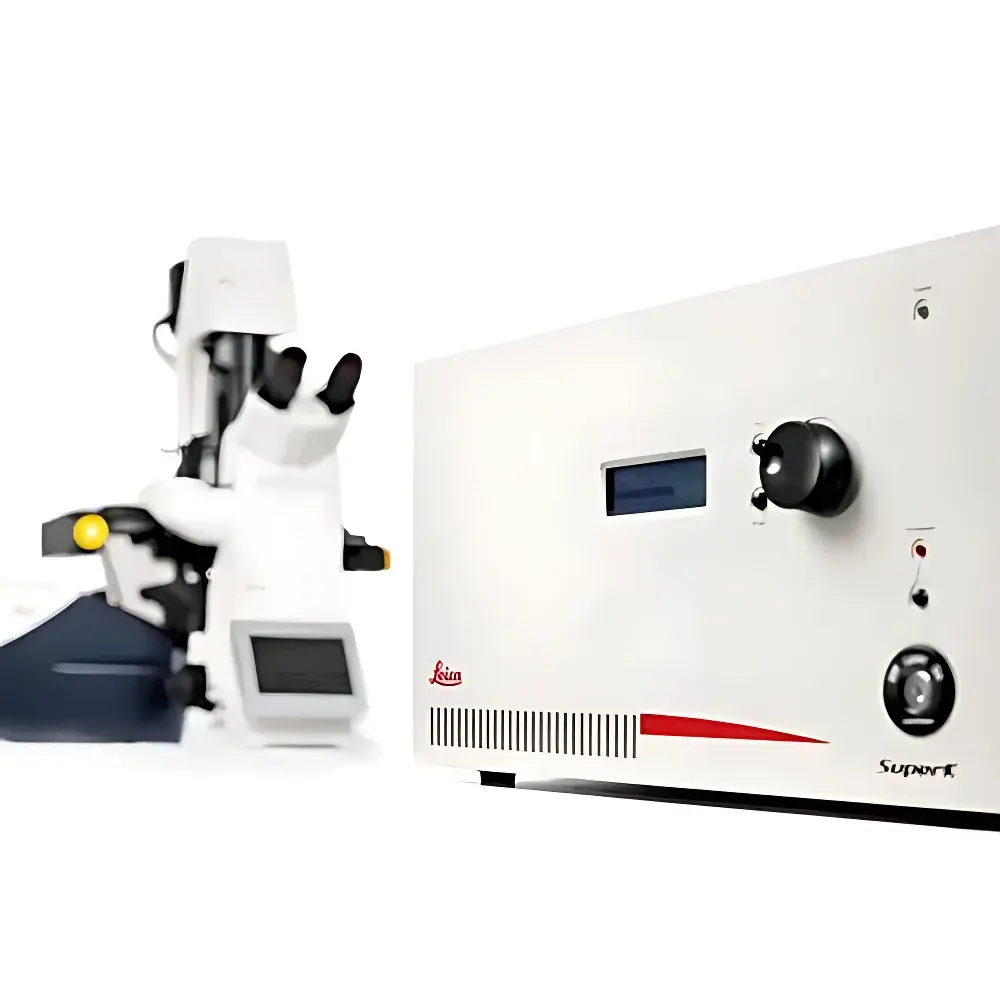
Leica TCS SP8 X Laser Scanning Confocal Microscope
| Brand | Leica |
|---|---|
| Origin | Germany |
| Model | TCS SP8 X |
| Excitation Source | Tunable White Light Laser (WLL), Pulsed |
| Detection Channels | Up to 5 Spectral Detection Channels |
| Excitation Lines | Up to 8 Simultaneous Lines |
| FLIM Compatibility | Yes, with Adjustable Repetition Rate via Pulse Picker |
| LightGate Technology | Time-Gated Spectral Detection |
| Spectral Resolution | Continuous Excitation & Emission Acquisition (Excitation–Emission Matrix Mapping) |
| Application Scope | Live-Cell Imaging, Multicolor Fluorescence, Spectral Unmixing, FLIM, pH/Binding Microenvironment Analysis |
Overview
The Leica TCS SP8 X is a high-performance laser scanning confocal microscope engineered for quantitative, multi-parametric fluorescence imaging in life science research. Built upon Leica Microsystems’ proprietary spectral detection architecture and tunable white light laser (WLL) technology, the system operates on the principle of point-scanning confocality combined with time-resolved and wavelength-resolved photon collection. Unlike conventional fixed-line laser systems, the TCS SP8 X enables continuous, independent tuning of excitation wavelength across the visible and near-UV/NIR range (470–670 nm), while simultaneously acquiring full emission spectra (typically 400–800 nm) with sub-nanometer resolution per detection channel. This dual spectral flexibility supports rigorous photophysical characterization—including excitation–emission matrix (EEM) mapping—and eliminates reliance on predefined laser lines or dichroic filter sets. The system is optimized for low-phototoxicity live-cell imaging, spectral unmixing of overlapping fluorophores, and fluorescence lifetime imaging microscopy (FLIM), delivering molecular-level insights into microenvironmental parameters such as local pH, ion concentration, and protein–ligand binding dynamics.
Key Features
- Tunable White Light Laser (WLL): Continuously adjustable pulsed excitation source (470–670 nm), enabling optimal matching to fluorophore absorption maxima and minimizing photodamage during long-term acquisition.
- LightGate Technology: A hardware-based time-gating mechanism that synchronizes detector activation exclusively within user-defined temporal windows relative to the laser pulse—effectively suppressing autofluorescence, scattered light, and out-of-focus background without optical filters.
- Up to 8 Simultaneous Excitation Lines: Supports complex multicolor experiments with precise spectral separation and minimal crosstalk through real-time spectral unmixing algorithms.
- 5-Channel Spectral Detection: Each channel acquires full emission spectra with <1 nm spectral sampling resolution; data is stored in native spectral format (e.g., .lif) for post-acquisition reprocessing and linear unmixing.
- Integrated FLIM Capability: Compatible with time-correlated single-photon counting (TCSPC) modules; repetition rate precisely controlled via pulse picker (10 kHz–80 MHz range) to match fluorophore lifetimes and avoid pile-up effects.
- Motorized, Precision Optomechanics: Includes automated correction collar objectives, adaptive focus stabilization (AFS), and environmental chamber integration support for temperature, CO₂, and humidity control in live-cell workflows.
Sample Compatibility & Compliance
The TCS SP8 X accommodates a broad range of biological specimens—from fixed tissue sections and 3D organoids to adherent and suspension live cells, zebrafish embryos, and thin plant tissues. Its low-energy excitation strategy and gated detection significantly extend viable imaging duration for sensitive primary cultures and stem cell derivatives. The system complies with ISO 13485 design control principles for research instrumentation and supports audit-ready documentation workflows aligned with GLP and GMP environments. Data integrity is reinforced through optional 21 CFR Part 11-compliant software modules (LAS X Security Pack), including electronic signatures, role-based access control, and immutable audit trails for all acquisition and processing parameters.
Software & Data Management
Controlled by Leica LAS X software (v4.x or later), the platform provides unified acquisition, visualization, and analysis tools for spectral, intensity, and lifetime datasets. Key capabilities include automatic spectral library generation from reference samples, supervised and unsupervised unmixing (e.g., N-FINDR, MCR-ALS), lifetime histogram mapping, phasor plot analysis, and batch-processing pipelines exportable to HDF5 or OME-TIFF formats. All raw spectral and TCSPC data are stored with complete metadata (excitation wavelength, pinhole size, dwell time, gain, offset, objective ID, immersion medium), ensuring FAIR (Findable, Accessible, Interoperable, Reusable) data practices. Integration with Python (via LAS X SDK) and MATLAB enables custom algorithm deployment for advanced biophysical modeling.
Applications
- Quantitative co-localization analysis using spectrally resolved channels to distinguish structurally similar fluorophores (e.g., GFP/mCherry variants) without bleed-through artifacts.
- Discovery and validation of novel fluorescent proteins and synthetic dyes via excitation–emission spectral fingerprinting.
- Microenvironmental sensing: FLIM-based quantification of intracellular pH using pH-sensitive probes (e.g., SNARF, BCECF) or metabolic state assessment via NAD(P)H lifetime shifts.
- Protein interaction studies via fluorescence resonance energy transfer (FRET) validated by lifetime reduction and spectral unmixing.
- Neuroscience applications including dendritic spine morphology tracking, synaptic vesicle recycling assays, and calcium dynamics in brain slices under physiological conditions.
- Developmental biology: Long-term timelapse imaging of morphogenetic events in model organisms with minimal phototoxicity and high signal fidelity.
FAQ
Is the TCS SP8 X compatible with third-party detectors or TCSPC modules?
Yes—the system features standard NIM and TTL synchronization interfaces and supports integration with Becker & Hickl, PicoQuant, and other industry-standard TCSPC hardware via LAS X drivers.
Can spectral unmixing be performed retrospectively on saved datasets?
Absolutely. All spectral data is acquired and stored in full-resolution format; unmixing parameters (reference spectra, constraints, algorithms) can be modified and reapplied at any time without reacquisition.
Does the LightGate technology require specialized sample preparation?
No—LightGate operates entirely optically and electronically; no labeling modifications, quenchers, or clearing agents are needed to achieve background suppression.
What objective lenses are certified for use with the WLL and LightGate?
Leica HC PL APO 40x/1.30 Oil, 63x/1.40 Oil, and 100x/1.40 Oil objectives are fully corrected for WLL spectral bandwidth and optimized for time-gated detection efficiency.
How is calibration traceability maintained for spectral and lifetime measurements?
The system includes built-in NIST-traceable reference standards (e.g., fluorescent microspheres, rhodamine B solution) and automated calibration routines for spectral dispersion, timing offset, and detector linearity—logs are embedded in every dataset.






