
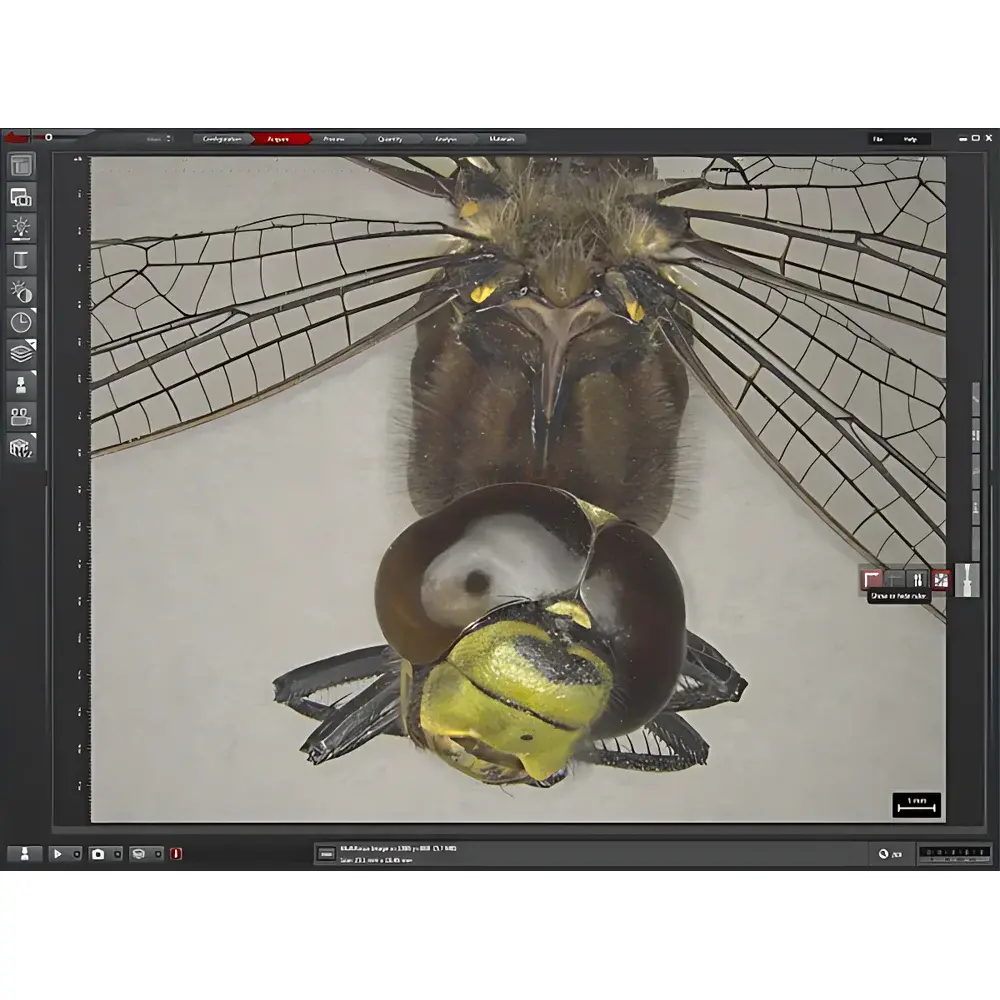
Leica LAS X Software Platform for Life Sciences
| Brand | Leica |
|---|---|
| Country of Origin | Germany |
| Model | LAS X |
| Type | Integrated Microscopy Imaging & Analysis Platform |
| Compatibility | Leica Confocal, Widefield, Stereo, Super-Resolution, and Light-Sheet Microscopes |
| Regulatory Compliance | Designed for GLP/GMP-aligned workflows |
| Deployment | Windows-based client-server architecture with optional remote access via LAS X Mobile Connect module |
Overview
Leica LAS X is a unified, modular software platform engineered specifically for life science microscopy workflows. Built on a robust, object-oriented architecture, LAS X implements a centralized control paradigm that eliminates the need for disparate, instrument-specific applications—reducing workflow fragmentation and minimizing user-induced variability. The platform operates on a principle of hardware-agnostic imaging orchestration: it abstracts low-level microscope control (e.g., laser power modulation, filter wheel positioning, stage motion synchronization, Z-stack acquisition timing) into reproducible, parameterized protocols. This enables precise spatiotemporal coordination between illumination, detection, and mechanical actuation—critical for quantitative fluorescence applications such as FRAP, FRET, time-lapse 3D reconstruction, and multi-channel co-localization analysis. LAS X does not function as a standalone image processor; rather, it serves as an integrated acquisition-execution-analysis environment where experimental intent is encoded at the protocol level and preserved across sessions, users, and instruments.
Key Features
- Unified platform supporting Leica’s full portfolio: SP8/SP5 confocal systems, DMi8/DM6 widefield platforms, M205 FA stereo microscopes, STED nanoscope variants, and THUNDER and LIGHTNING light-sheet systems.
- Protocol-driven acquisition: Define, save, and re-execute complete imaging workflows—including objective selection, fluorescence filter cube assignment, exposure time, binning, Z-step interval, tile overlap, and environmental trigger conditions.
- Real-time 2D/3D visualization engine with GPU-accelerated rendering; supports live volume rotation, orthogonal slicing, maximum intensity projection (MIP), and surface rendering during acquisition.
- Quantum Stage integration: Synchronizes high-speed linear motorized stage movement (< ±1 µm absolute positional accuracy) with camera exposure timing to eliminate motion blur—even at 5 positions/sec under 40× magnification.
- Environmental control interface: Direct integration with Leica’s incubation chambers for concurrent monitoring and logging of temperature, CO2, O2, and humidity parameters alongside image metadata.
- MobileConnect module: Enables secure remote initiation, pausing, and termination of acquisitions from iOS or Windows devices; supports full-resolution image download and real-time display of acquisition parameters.
Sample Compatibility & Compliance
LAS X natively supports standard life science specimen formats including glass slides, multi-well plates (6–384-well), Petri dishes, and chambered coverslips. It accommodates diverse labeling modalities—immunofluorescence, GFP/RFP-tagged constructs, quantum dots, and organic dyes—across spectral ranges from DAPI to Cy7. All acquired data are stored in Leica’s proprietary LIF format (based on TIFF v6.0 extensions), which embeds calibrated spatial, temporal, and intensity metadata compliant with MIAS (Minimum Information About a Microscopy Image) guidelines. When deployed within validated laboratory IT environments, LAS X supports configurable audit trails, electronic signatures, and user-access hierarchies aligned with FDA 21 CFR Part 11 and ISO/IEC 17025 requirements for analytical instrument software.
Software & Data Management
The LAS X Core module provides foundational functionality: live image viewing, annotation, overlay comparison, and basic measurement tools—sufficient for routine brightfield or epifluorescence documentation. For advanced quantification, LAS X Navigator and LAS X Quantify modules extend capabilities to automated cell segmentation, spot counting, intensity profiling, and trajectory tracking across time-series datasets. Results export options include CSV, Excel, and HDF5 for downstream statistical analysis in MATLAB, Python (NumPy/Pandas), or R. All analysis pipelines retain full provenance: each measurement links back to its source image, acquisition settings, and applied algorithm version. Batch processing supports parallel execution across multi-core systems, with progress monitoring and error logging integrated into the central dashboard.
Applications
LAS X is routinely deployed in academic core facilities and pharmaceutical R&D labs for applications including: high-content screening of drug-treated cell populations; longitudinal tracking of neural progenitor migration in organoid cultures; quantitative co-localization analysis of receptor internalization kinetics; 3D morphometric assessment of zebrafish embryogenesis; and multi-parameter phenotyping in CRISPR-edited iPSC-derived cardiomyocytes. Its macro scripting interface (via Python API) allows integration with external hardware triggers (e.g., electrophysiology rigs, microfluidic controllers) enabling true multimodal experimentation.
FAQ
Does LAS X support third-party cameras or stages?
LAS X communicates exclusively with Leica-certified hardware via proprietary firmware interfaces; non-Leica peripherals are not supported.
Can LAS X be used for regulatory submissions (e.g., IND, BLA)?
Yes—when installed on validated hardware, configured with enabled audit trails, and operated under documented SOPs, LAS X meets evidentiary requirements for image-based endpoints in preclinical studies.
Is offline analysis possible without a Leica microscope connected?
Yes—LAS X Viewer enables full metadata inspection, measurement, and rendering of previously acquired LIF files without active hardware linkage.
What operating systems are supported?
Windows 10/11 (64-bit), with specific driver and .NET Framework version dependencies outlined in the official Leica System Requirements document.
How is data backup and version control managed?
LAS X does not include built-in version control; users must implement external solutions (e.g., network-attached storage with snapshot policies, Git-LFS for pipeline scripts) to ensure traceability of analysis configurations.





