
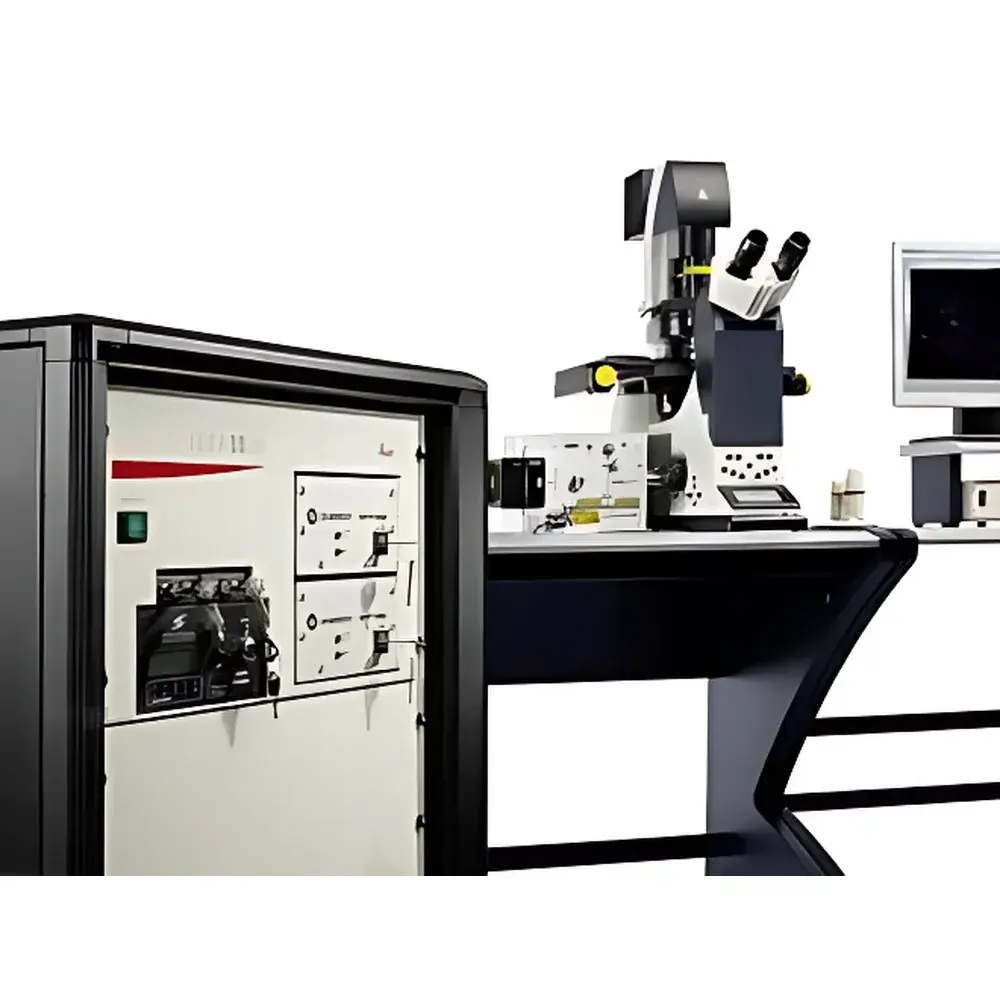
Leica SD AF Rapid Spinning Disk Laser Confocal System
| Brand | Leica |
|---|---|
| Origin | Germany |
| Model | Leica SD AF |
| Configuration | Import (OEM-manufactured in Germany) |
| Software Platform | Leica MM AF |
| Core Technology | Yokogawa CSU-X1 Spinning Disk Unit Integrated with Leica Optical Path and Adaptive Focus Control |
Overview
The Leica SD AF is a high-speed, spinning disk–based laser confocal imaging system engineered for quantitative, low-phototoxicity live-cell microscopy. Unlike point-scanning confocal platforms, it employs a Yokogawa CSU-X1 spinning disk unit—comprising thousands of precisely aligned microlenses and pinholes—to simultaneously illuminate and detect fluorescence across the entire field of view. This parallel acquisition architecture enables frame rates exceeding 100 fps at full resolution, making it uniquely suited for dynamic subcellular processes such as calcium signaling, vesicle trafficking, mitochondrial fission/fusion, and rapid organelle reorganization. The system is optically integrated into Leica’s DMI6000 B inverted microscope platform, leveraging Leica’s proprietary Advanced Correction System (ACS) for chromatic aberration correction across 405–640 nm excitation wavelengths. This ensures diffraction-limited performance and pixel-accurate colocalization fidelity in multicolor Z-stacks—critical for rigorous 3D reconstruction and time-lapse morphometric analysis under physiological conditions.
Key Features
- High-Speed Optical Sectioning: Real-time confocal imaging at >100 frames per second with minimal photobleaching and phototoxicity—validated for >24-hour continuous observation of sensitive primary neurons and stem cell cultures.
- Leica ACS Optics: Multi-element apochromatic objectives (e.g., HC PL APO 63×/1.20 W CORR) corrected for spherical and chromatic aberrations across UV–visible spectrum; enables quantitative CFP/DAPI/GFP/mCherry co-imaging with <0.1 µm lateral registration accuracy.
- Adaptive Focus Control (AFC): Infrared-based autofocus system continuously monitors coverslip–water interface displacement with ±5 nm stability over 8+ hours—eliminating Z-drift during long-term timelapse without mechanical intervention.
- Water Immersion Compatibility: Fully automated water-top-up module maintains stable refractive index matching throughout acquisition; preserves axial resolution (≤0.7 µm) and signal-to-noise ratio (SNR >35 dB) even during motorized stage translation.
- Modular Integration: Compatible with Leica DMI6000 B (inverted), DM6000 FS (upright), and fixed-stage DM5500 B configurations; supports optional FRAP, photoactivation, uncaging, and structured illumination modules via shared optical train.
Sample Compatibility & Compliance
The Leica SD AF is validated for use with standard glass-bottom dishes (MatTek, WillCo), microfluidic chambers (CellASIC, Ibidi), and custom 3D hydrogel scaffolds (e.g., collagen I, Matrigel). Its low-intensity illumination profile meets ISO 10993-5 cytocompatibility requirements for live-cell assays. All hardware control firmware and Leica MM AF software comply with FDA 21 CFR Part 11 for electronic records and signatures—including audit trail logging, user role-based access control, and immutable raw data export (TIFF, OME-TIFF, ND2). System documentation conforms to GLP/GMP Annex 11 principles for regulated biopharma applications involving phenotypic screening and mechanistic toxicology studies.
Software & Data Management
Leica MM AF provides a unified environment for acquisition, processing, and metadata annotation. It supports multi-dimensional acquisition (x,y,z,t,λ,phase), real-time deconvolution (Wiener filter), and batch-based 3D rendering using GPU-accelerated volume reconstruction. Quantitative outputs include intensity-normalized fluorescence profiles, object-based segmentation (via trainable Weka classifiers), and time-resolved kinetic parameter extraction (e.g., τ½ of Ca2+ transients). Raw datasets are stored in OME-TIFF format with embedded EXIF-compliant metadata (objective NA, exposure time, laser power, pinhole size, Z-step), ensuring FAIR (Findable, Accessible, Interoperable, Reusable) compliance. Export options include MATLAB (.mat), Python (HDF5), and ImageJ-compatible formats for downstream statistical modeling.
Applications
- Live-cell dynamics: Mitochondrial network remodeling, lysosomal pH mapping, endocytic vesicle tracking
- Neuroscience: Synaptic bouton turnover, dendritic spine motility, axonal transport kinetics
- Developmental biology: Embryonic cell migration, gastrulation movements, epithelial sheet folding
- Drug discovery: High-content phenotypic screening of GPCR internalization, ion channel modulation, and apoptosis progression
- Photomanipulation workflows: Precise spatial-temporal uncaging of caged Ca2+/glutamate, optogenetic activation (ChR2), and ROI-specific FRAP
FAQ
What is the maximum achievable Z-resolution with water immersion objectives?
Axial resolution is ≤0.7 µm (FWHM) when using the HC PL APO 63×/1.20 W CORR objective with 488 nm excitation and optimal pinhole setting (1 Airy unit).
Does the system support spectral unmixing for highly overlapping fluorophores?
Yes—MM AF includes linear unmixing algorithms calibrated against reference spectra acquired using the integrated spectrograph module (optional); supports up to 5-channel spectral separation.
Can the AFC maintain focus during temperature-controlled incubation (e.g., 37°C, 5% CO₂)?
Yes—the infrared AFC remains fully operational inside standard stage-top incubators; thermal expansion of coverslip and water layer is compensated in real time.
Is third-party software integration supported (e.g., MicroManager, Python API)?
Leica provides documented COM/DCOM interfaces and a Python SDK (Leica Application Suite X SDK) for custom automation, including synchronization with external hardware triggers and TTL-gated acquisition.
What maintenance protocols ensure long-term calibration stability?
Annual factory recalibration includes pinhole alignment verification, laser power linearity validation (NIST-traceable photodiode), and objective chromatic shift profiling—documented per ISO/IEC 17025.




