
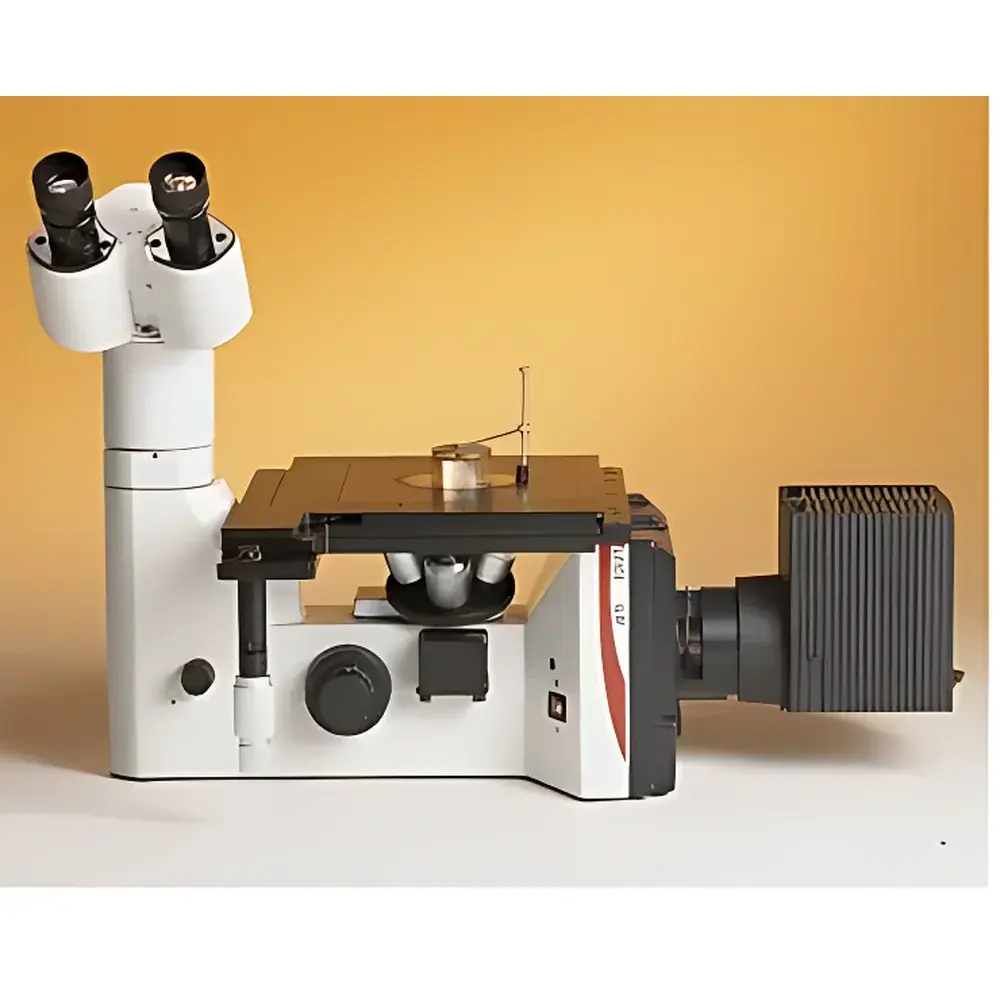
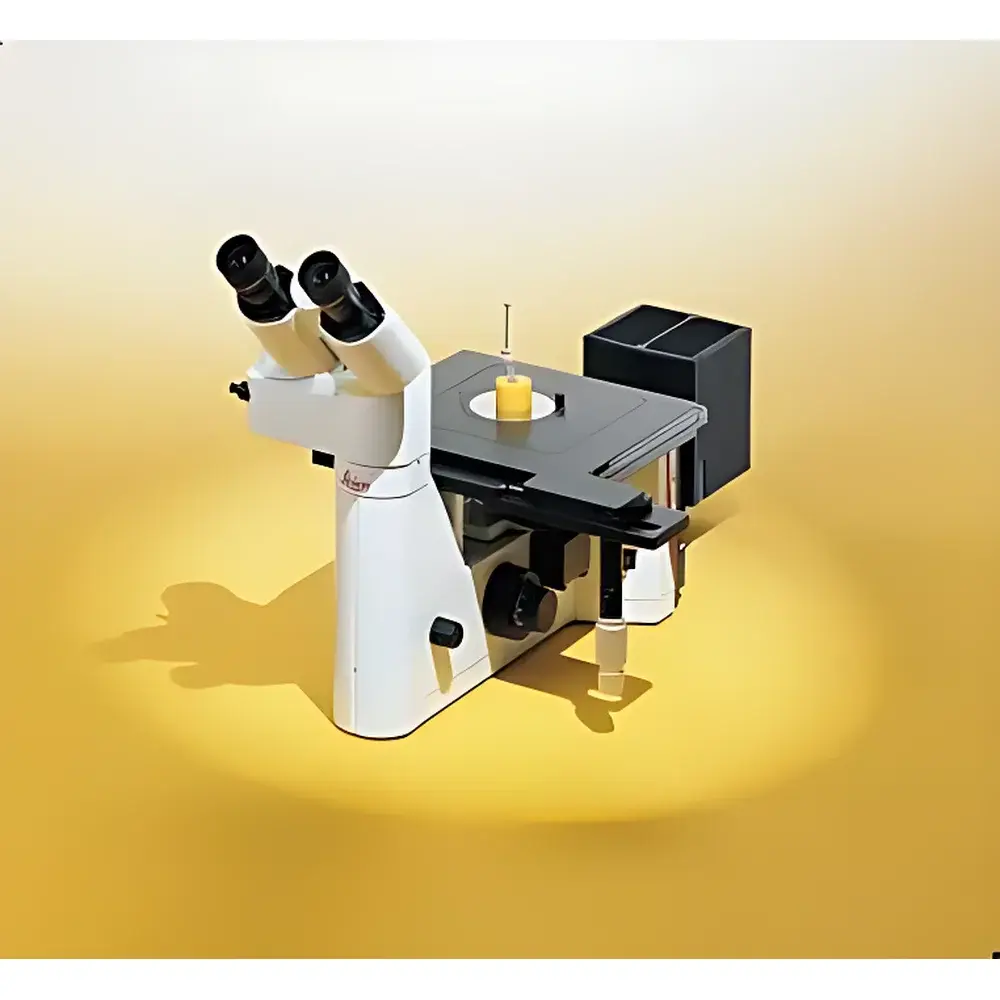
Leica DMILM Inverted Metallurgical Microscope
| Brand | Leica |
|---|---|
| Origin | Germany |
| Model | DM ILM |
| Configuration | Inverted |
| Total Magnification | 1000× |
| Eyepiece Magnification | 10× |
| Objective Magnification | 100× |
| Field of View Diameter | 20 mm |
| Objective Turret | 4-position manual |
| Illumination Modes | Brightfield and Polarized Light |
| Stage Options | Fixed or Three-Plate Mechanical Stage |
| Camera Interface | C-mount compatible |
| Software Compatibility | Leica Application Suite (LAS) X |
Overview
The Leica DMILM is a compact, inverted metallurgical microscope engineered for routine microstructural analysis of metallographic specimens, including polished cross-sections, castings, welds, and heat-treated alloys. Its inverted optical architecture positions the objective lenses beneath the specimen stage—enabling unobstructed access to large, heavy, or irregularly shaped samples that cannot be easily mounted on upright microscopes. The system employs a high-NA, infinity-corrected optical path optimized for contrast-rich brightfield and polarized light imaging, with a 20 mm field-of-view diameter supporting efficient overview scanning and precise localization of features of interest. Designed for laboratory durability and long-term stability, the DMILM integrates Leica’s legacy of precision optics manufacturing with ergonomic usability in QC, failure analysis, and academic metallurgy workflows.
Key Features
- Inverted configuration with robust, vibration-damped base—ideal for large-volume industrial samples and time-resolved observation of specimen surfaces during thermal or mechanical testing.
- Four-position manual objective turret accommodating Leica’s full range of metallurgical objectives (5×, 10×, 20×, 50×, 100× oil), all featuring anti-fungal coatings and parfocal alignment for seamless magnification transitions.
- Brightfield illumination with Köhler optimization and integrated polarizer/analyzer pair for birefringence-sensitive analysis of grain structure, phase distribution, and inclusion morphology in steels, aluminum alloys, and titanium-based materials.
- Modular stage options: standard fixed stage for static sample positioning or optional three-plate mechanical stage with 76 × 52 mm travel range and vernier-scale fine adjustment (1 µm resolution) for systematic grid-based inspection.
- C-mount interface (1× coupling lens) enabling direct integration with monochrome or color digital cameras—including Leica DMC series—for real-time image preview, documentation, and quantitative measurement.
- Optical path optimized for high transmission across visible spectrum (400–700 nm), minimizing chromatic aberration and ensuring faithful color reproduction in photomicrographs used for ASTM E3, ISO 643, and EN 10295 compliance reporting.
Sample Compatibility & Compliance
The DMILM accommodates specimens up to 120 mm in diameter and 80 mm in height, supporting standard metallographic mounts (30 mm, 40 mm, 50 mm diameter) as well as oversized billets, turbine blades, and coated substrates. Its low-profile stage clearance (up to 100 mm) allows compatibility with hardness testers and micro-indenters for correlative analysis. The system complies with CE marking requirements for laboratory equipment and meets essential safety provisions under IEC 61000-6-3 (EMC) and IEC 61000-6-2 (immunity). When paired with Leica LAS X software and validated camera modules, it supports audit-ready documentation aligned with GLP and GMP principles—including electronic signatures, user access control, and metadata-embedded image archiving per FDA 21 CFR Part 11 guidelines.
Software & Data Management
Leica LAS X software provides native integration with the DMILM for image acquisition, annotation, measurement (grain size per ASTM E112, inclusion rating per ASTM E45), and report generation. The platform supports multi-user configuration, customizable measurement templates, and batch processing of tiled scans. All captured images retain embedded EXIF metadata—including objective ID, magnification, illumination mode, and timestamp—ensuring traceability in quality records. Export formats include TIFF (uncompressed), JPEG2000 (lossless compression), and PDF/A-1b for long-term archival. Optional LAS X Core modules enable automated particle analysis, phase fraction quantification, and statistical reporting compliant with ISO 13006 and ASTM E1382 standards.
Applications
- Routine metallographic evaluation in foundries and heat-treatment facilities—grain size determination, porosity assessment, and decarburization depth measurement.
- Failure analysis laboratories—crack propagation mapping, intergranular corrosion identification, and weld fusion zone characterization.
- Research environments—phase transformation studies in Fe-C systems, precipitation hardening analysis in Al-Li alloys, and oxide scale thickness measurement on high-temperature superalloys.
- Standards-compliant certification—production lot release per MIL-STD-150A, ISO 4949, or JIS G 0551, where documented microstructure evidence is required for material acceptance.
- Training and education—modular design facilitates student access to core metallurgical imaging techniques without requiring advanced automation.
FAQ
Is the DMILM compatible with third-party digital cameras?
Yes—the C-mount interface supports industry-standard 1″ sensor cameras (e.g., Sony IMX series) with appropriate relay lens adapters; however, optimal color fidelity and exposure synchronization are guaranteed only with Leica DMC or DFC camera models.
Can polarized light imaging be used for non-metallic inclusions?
Yes—polarized contrast enhances birefringent phases such as silicates, oxides, and nitrides in steel matrices, enabling differentiation from isotropic matrix constituents per ASTM E45 Annex A3.
What is the maximum working distance achievable with the 100× objective?
The Leica 100×/0.85 dry objective offers a working distance of 0.9 mm, sufficient for observation through standard 0.17 mm cover slips or thin protective coatings applied to sensitive specimens.
Does the DMILM support fluorescence observation?
No—the DMILM is not equipped with epi-illumination or filter cube slots; fluorescence capability requires the Leica DM6 M or DM4 M platforms with dedicated light sources and dichroic optics.
How is calibration traceability maintained for measurement functions?
Calibration is performed using NIST-traceable stage micrometers and certified reference slides; LAS X software logs calibration date, operator ID, and verification results within each project file for internal QA audits.




