
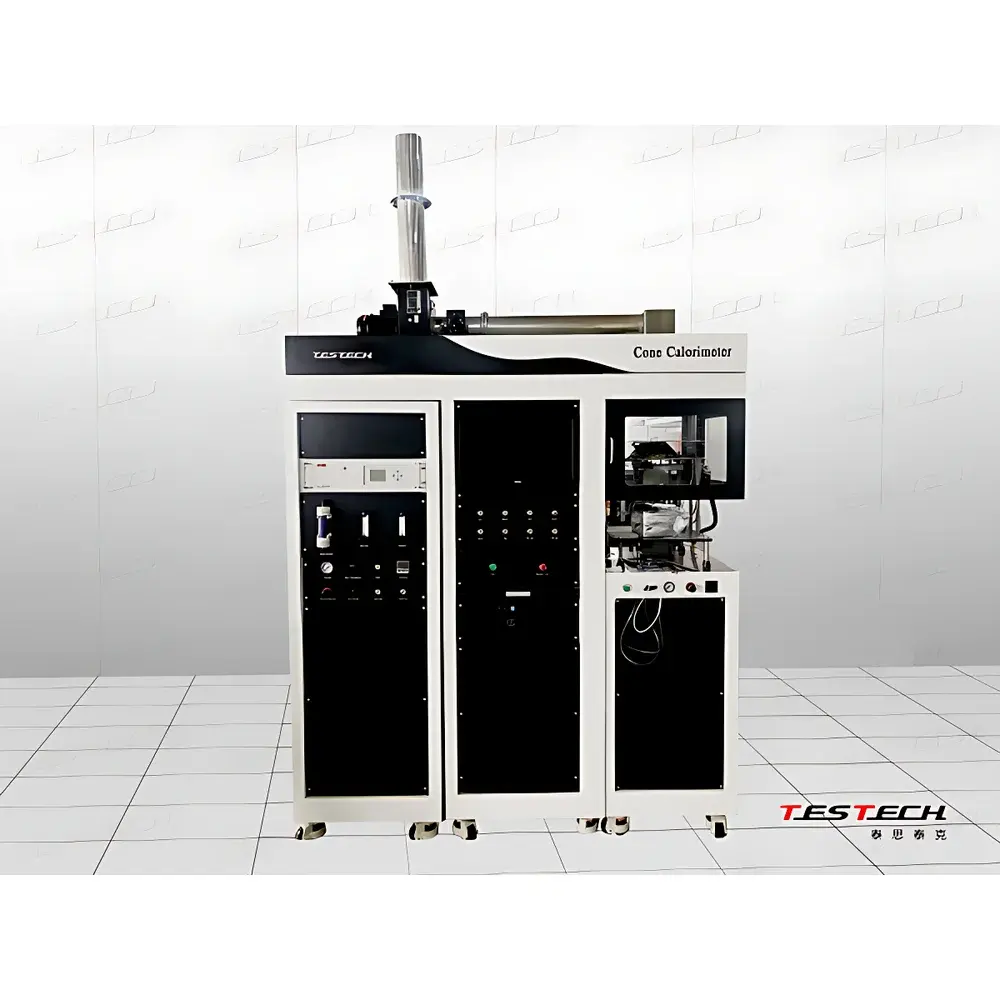
TESTech TTech-GBT16172 Cone Calorimeter
| Brand | TESTech |
|---|---|
| Origin | Jiangsu, China |
| Manufacturer Type | Direct Manufacturer |
| Model | TTech-GBT16172 |
| Compliance | ISO 5660-1, ASTM E1354, ASTM E1474, ASTM E1740, ASTM F1550, ASTM D6113, NFPA 264, CAN/ULC-S135, BS 476-15 |
| Radiant Heat Flux Range | 0–120 kW/m² |
| Sample Size | 100 mm × 100 mm × ≤50 mm |
| Oxygen Analyzer | Paramagnetic, 0–25% O₂, linear response |
| Smoke Measurement | Laser-based optical density system |
| Mass Loss Measurement | High-precision load cell |
| Exhaust Flow Control | Orifice plate flowmeter with PID-regulated axial fan |
| Gas Cooling | Compressor-cooled cold trap (0–5 °C) |
| Filtration | Triple-stage (particulate, moisture, CO₂), 0.5 µm cutoff |
| Ignition | 10 kV spark igniter with mechanical auto-positioning and safety interlock |
| Control Interface | 19″ industrial touchscreen running LabVIEW-based real-time control software |
Overview
The TESTech TTech-GBT16172 Cone Calorimeter is a bench-scale fire reaction testing instrument engineered for precise, repeatable quantification of combustion behavior under controlled radiant heat exposure. Based on oxygen consumption calorimetry—a fundamental principle validated by ISO 5660-1 and ASTM E1354—the system calculates heat release rate (HRR) by measuring the mass flow rate of oxygen-depleted exhaust gases and applying the well-established enthalpy of combustion per unit mass of oxygen consumed (13.1 MJ/kg O₂). This thermodynamic foundation ensures traceable, internationally accepted data for regulatory submissions, material development, and fire modeling. The instrument operates at adjustable radiant flux levels up to 120 kW/m², enabling evaluation across ignition thresholds, steady-state burning, and flameout phases. Its modular architecture supports phased deployment: laboratories may initially configure the system for core measurements—heat release rate, mass loss rate, and time-to-ignition—and later integrate optional modules for advanced smoke toxicity analysis (e.g., CO/CO₂ quantification), dynamic smoke obscuration profiling, or extended gas chromatographic speciation.
Key Features
- Integrated 19-inch rack-mount enclosure with ergonomic front-panel access and industrial-grade stainless steel construction for long-term corrosion resistance in aggressive combustion environments.
- High-stability truncated cone heater (230 V, 5000 W) delivering uniform radiant flux from 0 to 120 kW/m², calibrated per ISO 5660 Annex A using blackened copper calorimeters.
- Automated shutter mechanism that isolates the specimen area prior to test initiation, ensuring baseline mass stability and providing operators with configurable pre-test verification time—critical for volatile or low-ignition-threshold materials.
- 10 kV spark igniter with lever-actuated auto-positioning and hardware-enforced safety interlock; fully synchronized with test timing logic to record time-to-sustained-flaming with ±0.1 s resolution.
- Triple-stage gas conditioning train: particulate filtration (0.5 µm absolute), compressor-cooled cold trap (maintained at 0–5 °C), and selective CO₂ scrubbing—ensuring clean, dew-point-controlled sample streams for paramagnetic O₂ analysis.
- Real-time LabVIEW-based control suite with deterministic loop timing, audit-trail logging, and full IEC 62443-aligned cybersecurity architecture for GLP/GMP-compliant laboratories.
Sample Compatibility & Compliance
The TTech-GBT16172 accommodates flat, rigid or semi-rigid specimens measuring 100 mm × 100 mm with maximum thickness of 50 mm—compatible with standard ISO 5660-1, ASTM E1354, and GB/T 16172-2007 specimen holders. It supports both exposed-face and insulated-back configurations, permitting evaluation of real-world assembly interfaces (e.g., insulation-substrate composites). All measurement subsystems are traceably calibrated against NIST-traceable standards: oxygen concentration via certified gas mixtures, mass loss via Class I analytical balance protocols, and radiant flux via primary-standard black-body calorimeters. The system meets functional requirements for ISO/IEC 17025-accredited testing laboratories and provides native support for FDA 21 CFR Part 11 electronic signature and audit trail generation when deployed with optional validation packages.
Software & Data Management
Control and data acquisition are executed through a deterministic LabVIEW Real-Time OS environment hosted on an embedded industrial PC. The software implements closed-loop PID regulation of both radiant heater power and exhaust flowrate—each governed by independent programmable logic controllers synchronized to 100 Hz sampling. All raw sensor inputs (O₂%, laser extinction, load cell mV, thermocouple mV, flow differential pressure) are timestamped with microsecond precision and stored in binary TDMS format with embedded metadata (operator ID, calibration certificate IDs, ambient RH/T, test sequence number). Post-processing tools generate standardized reports conforming to ISO 5660-1 Annex B templates—including peak HRR, total heat released (THR), average mass loss rate (AMLR), specific extinction area (SEA), and effective heat of combustion (EHC). Database queries support multi-parameter filtering (e.g., “all PVC formulations tested between Jan–Jun 2024 with HRR > 500 kW/m²”) and export to CSV, PDF, or ASTM E2050-compliant XML.
Applications
This cone calorimeter serves as a foundational tool in fire safety engineering workflows across multiple sectors. Polymer compounders use it to screen flame-retardant additives under varying heat fluxes, correlating HRR suppression with char yield and smoke production. Building product manufacturers validate compliance with EN 13501-1 classification criteria (e.g., B-s1,d0) by generating critical fire growth indices such as FIGRA (Fire Growth Rate Index) and MARHE (Maximum Average Rate of Heat Emission). Automotive interior suppliers conduct component-level assessments per FMVSS 302 and UN Regulation No. 118, while aerospace material developers reference data for FAA AC 20-135 and EASA CS-25 Appendix F certification dossiers. Academic researchers employ the platform for kinetic modeling of pyrolysis pathways using multi-heating-rate TGA-coupled cone data, and fire modelers ingest its time-resolved outputs directly into CFD codes such as Fire Dynamics Simulator (FDS).
FAQ
What international standards does the TTech-GBT16172 fully support?
It natively complies with ISO 5660-1, ASTM E1354, ASTM E1474, ASTM E1740, ASTM F1550, ASTM D6113, NFPA 264, CAN/ULC-S135, BS 476-15, and GB/T 16172-2007—including all mandatory calibration, verification, and reporting requirements.
Can the system be upgraded post-purchase to include CO/CO₂ analysis?
Yes. The base configuration includes infrastructure for gas sampling (flow path, pressure taps, cold trap interface); optional NDIR CO/CO₂ analyzers with heated sample lines can be integrated without hardware modification.
Is the LabVIEW software qualified for regulated environments?
When deployed with the optional 21 CFR Part 11 Validation Package, the software includes electronic signatures, role-based access control, immutable audit trails, and IQ/OQ documentation—validated per GAMP 5 principles.
What maintenance intervals are recommended for the oxygen analyzer?
The paramagnetic O₂ sensor requires zero/span verification every 30 days using certified 20.9% and 0% O₂ gas standards; full recalibration is recommended annually or after 2000 test hours.
Does the system support remote monitoring during tests?
Yes. The embedded controller provides secure HTTPS-based web interface for real-time parameter visualization, emergency stop activation, and live plot streaming—accessible via corporate VLAN with TLS 1.2 encryption.



