
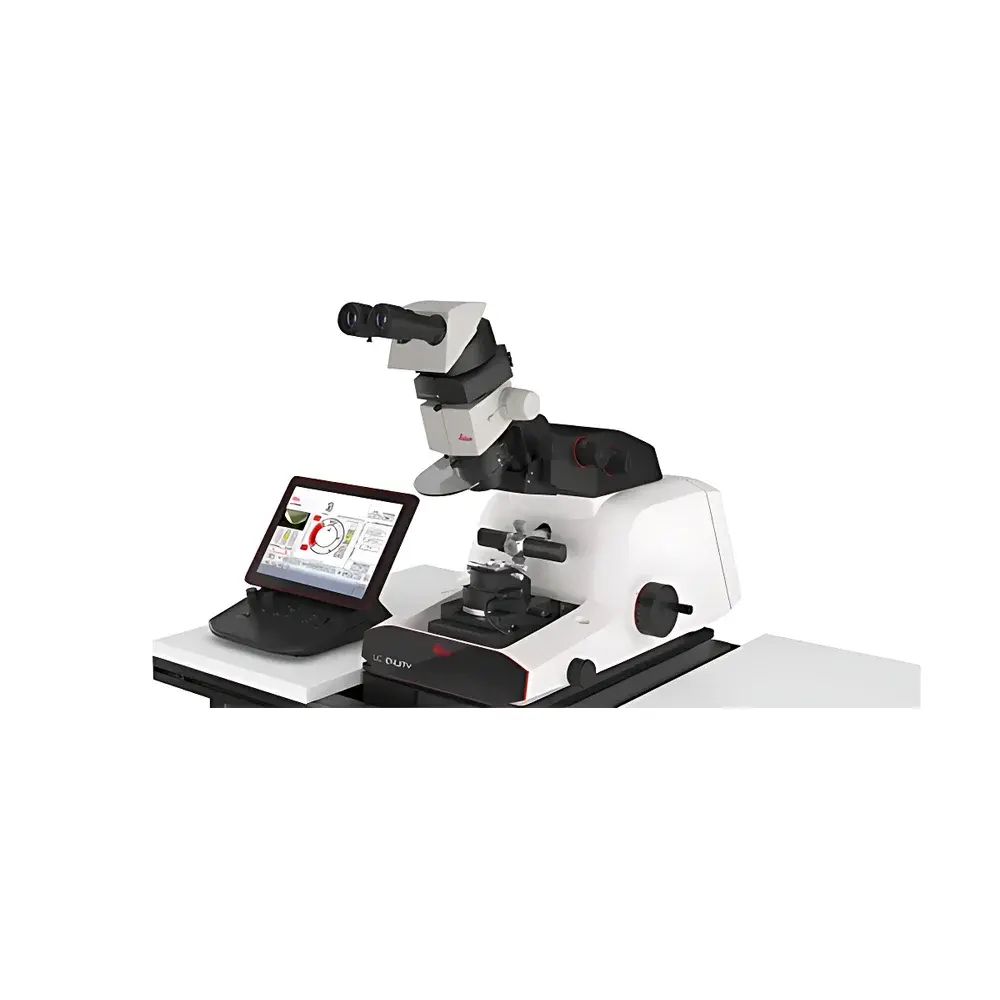
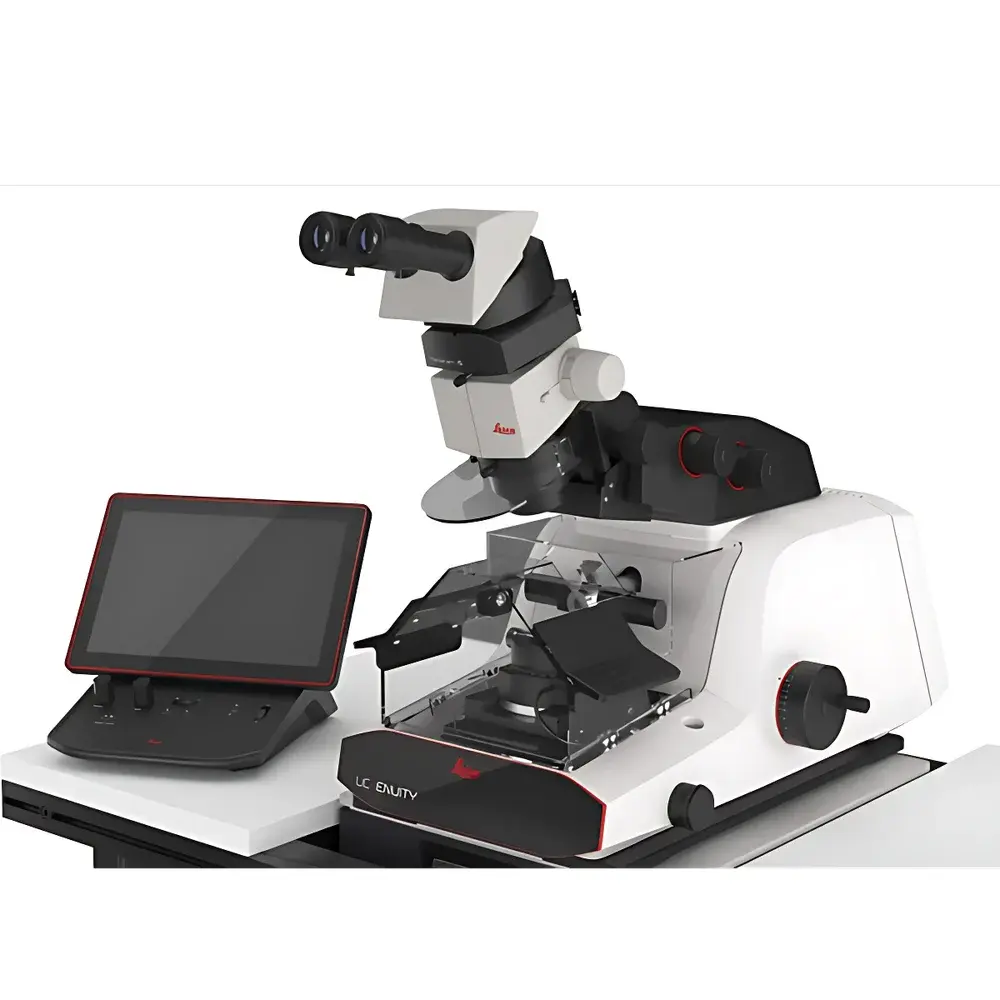
Leica UC Enuity Ultramicrotome
| Brand | Leica |
|---|---|
| Origin | Germany |
| Model | UC Enuity |
| Type | Ultramicrotome for Electron Microscopy Sample Preparation |
| Temperature Control | Integrated Cryo Chamber with Precise Thermal Regulation (Room Temp to −160 °C) |
| Automation | Auto-alignment of Block Face and Knife, Automated Trimming, Fluorescence-Guided Targeting |
| Compatibility | Diamond/Knife Knives, Glass Knives, Silicon Wafers & EM Grids |
| Ergonomics | Fully Adjustable Stereo Microscope Height & Angle, Padded Arm Supports, UV-Blocking Safety Shield |
| Connectivity | RemoteCare™ Diagnostic Platform with Real-time Parameter Monitoring & Error Code Reporting |
| Compliance | Designed for GLP/GMP-adjacent workflows |
Overview
The Leica UC Enuity Ultramicrotome is an advanced, modular ultramicrotome engineered specifically for high-precision sectioning in electron microscopy (EM) sample preparation. It operates on the principle of diamond-knife or glass-knife-based mechanical sectioning under controlled thermal and optical conditions, enabling reproducible production of ultra-thin sections (typically 30–100 nm) for transmission electron microscopy (TEM), scanning electron microscopy (SEM), and volume electron microscopy (vEM) techniques such as array tomography and serial block-face imaging. Unlike conventional ultramicrotomes, the UC Enuity integrates real-time fluorescence monitoring, automated alignment, and a thermally isolated cryo chamber—allowing seamless transitions between room-temperature resin embedding and cryo-ultramicrotomy without hardware reconfiguration. Its architecture is optimized for structural integrity during long-duration serial sectioning, minimizing drift, vibration, and thermal fluctuation that compromise section continuity and knife-edge longevity.
Key Features
- Auto-alignment system synchronizes block face orientation and knife geometry with sub-micron repeatability—eliminating manual calibration and reducing operator dependency.
- Fluorescence-guided trimming: Integrated LED excitation and emission optics enable real-time visualization of fluorescently labeled regions directly within epoxy or acrylic resin blocks at ambient or cryogenic temperatures.
- Cryo chamber with active temperature control (−160 °C minimum) and integrated cryo-manipulator (EM CRION-compatible), ensuring minimal ice contamination during frozen-hydrated or high-pressure frozen (HPF) sample sectioning.
- Modular upgrade path: Base UC Enuity configuration supports add-on modules including cryo-transfer stages, automated tape-collect systems, and grid-loading interfaces for direct silicon wafer or TEM grid deposition.
- Ergonomic workstation design: Motorized stereo microscope height/tilt adjustment, cushioned armrests, and fully articulating console accommodate users across diverse anthropometric profiles—critical for multi-hour vEM workflows.
- RemoteCare™ diagnostic platform provides continuous telemetry of >30 operational parameters (e.g., knife advance precision, chamber vacuum status, stage thermal gradient stability) and delivers immediate alerts for >20 predefined fault conditions.
Sample Compatibility & Compliance
The UC Enuity accommodates standard EM specimen formats—including epoxy-embedded biological tissues, acrylic-resin-infiltrated plant samples, and vitrified cryo-sections—and supports both diamond and glass knives with interchangeable holders. It accepts standard 3 mm TEM grids, slot grids, and silicon wafers for array tomography workflows. The instrument’s closed-cryogen architecture complies with IEC 61000-6-2/6-4 electromagnetic compatibility standards and incorporates UV-blocking shielding certified to ISO 15798 for safe fluorescence acquisition. While not inherently FDA 21 CFR Part 11-compliant, optional software packages support ALCOA+ data integrity principles and generate timestamped, user-attributed audit trails suitable for GLP-regulated preclinical research environments.
Software & Data Management
Control is managed through Leica’s proprietary UC Enuity Control Software, which provides intuitive workflow sequencing—from initial block trimming to final ribbon collection—via graphical interface and scriptable macros. All sectioning parameters (knife angle, feed rate, clearance angle, dwell time, fluorescence exposure duration) are logged with metadata tags (user ID, timestamp, environmental sensor readings). Raw fluorescence image stacks can be exported in TIFF or OME-TIFF format for integration into Fiji/ImageJ or Imaris pipelines. RemoteCare telemetry data is accessible via secure HTTPS portal with role-based access control, supporting remote diagnostics and predictive maintenance scheduling aligned with ISO/IEC 17025 laboratory quality management expectations.
Applications
- Volume EM: Generation of uniform, distortion-free serial sections for FIB-SEM and SBEM reconstruction, with ribbon collection onto conductive silicon substrates enabling direct backscatter signal registration.
- Correlative Light and Electron Microscopy (CLEM): Fluorescence-guided targeting of rare cellular structures prior to ultrastructural analysis—enabling precise registration between confocal z-stacks and TEM tomograms.
- Array Tomography: Production of extended ribbons (>1000 sections) with <2% thickness variation across length, compatible with automated immunolabeling and multispectral EM mapping.
- Cryo-EM Pre-screening: Rapid assessment of vitrified sample quality via thin-section screening before full-grid plunge freezing—reducing resource-intensive grid screening cycles.
- Materials Science: Sectioning of polymer composites, battery electrode cross-sections, and semiconductor heterostructures requiring nanoscale thickness control and minimal charging artifacts.
FAQ
What knife types are compatible with the UC Enuity?
Diamond knives (both wedge and boat geometries) and glass knives are supported via standardized knife holders; custom holders for specialty blades require prior validation by Leica Applications Engineering.
Can the UC Enuity perform cryo-sectioning on high-pressure frozen samples?
Yes—when equipped with the Cryo Chamber Module and EM CRION manipulator, it supports sectioning of HPF samples down to −160 °C with integrated anti-contamination shielding.
Is fluorescence imaging possible during cryo-sectioning?
Yes—the optical path remains functional at cryogenic temperatures; however, excitation efficiency decreases below −120 °C, and users should validate fluorophore photostability under target conditions.
How does the auto-alignment system ensure long-term repeatability?
It uses motorized stage encoders and machine vision algorithms to detect fiducial markers on the block face and knife edge, recalibrating alignment every 24 hours or after manual intervention.
Does the UC Enuity support integration with automated TEM grid loaders?
Direct integration is available via third-party OEM APIs; Leica-certified interfaces for Gatan AutoGrid and Oxford Instruments QuantaGrid are under development and scheduled for Q4 2024 release.





