
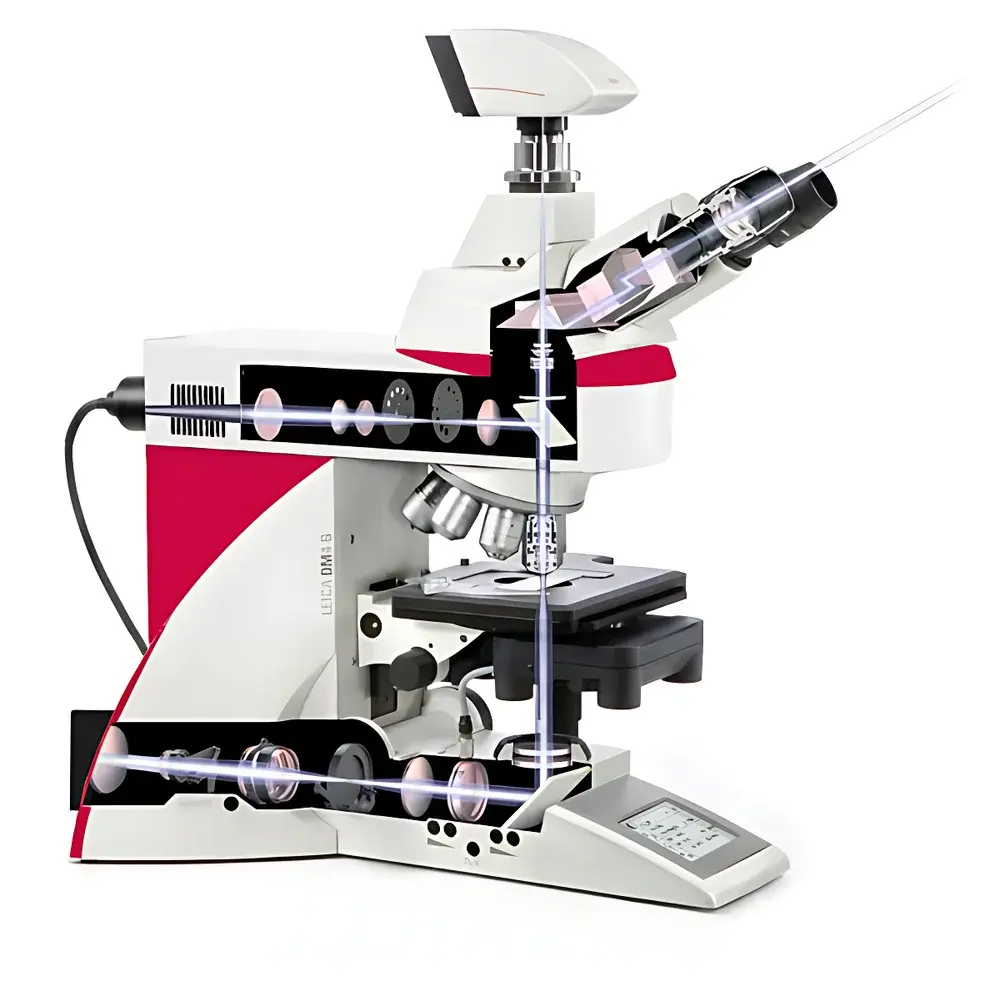
Leica DM4 B Upright Digital Research Microscope (Shanghai-Manufactured)
| Brand | Leica |
|---|---|
| Origin | Shanghai, China |
| Manufacturer Type | Authorized Distributor |
| Regional Classification | Domestic (China) |
| Model | DM4 B |
| Instrument Type | Upright Microscope |
| Eyepiece Configuration | Binocular |
| Imaging Port | 19-mm sCMOS-Compatible |
| Illumination Options | Halogen or LED |
| Software Platform | LAS X |
| Automation Level | Motorized Focus & Illumination Management |
| Compliance | Designed to Support GLP/GMP Workflow Requirements, FDA 21 CFR Part 11–Ready Software Configuration (via LAS X) |
Overview
The Leica DM4 B Upright Digital Research Microscope is an engineered solution for routine and advanced life science applications in academic laboratories, clinical pathology departments, and pharmaceutical quality control environments. Built on Leica Microsystems’ legacy of optical precision and modular design philosophy, the DM4 B integrates core upright microscopy functionality with intelligent automation and digital imaging readiness. Its optical architecture follows Köhler illumination principles, supporting brightfield, phase contrast, and fluorescence modalities through interchangeable condensers and filter cubes. The microscope employs a robust mechanical stage with precise X-Y translation and motorized Z-focus drive—enabling reproducible focusing across multi-slide workflows. Designed and assembled in Shanghai under Leica’s global manufacturing standards, the DM4 B maintains full optical and mechanical compatibility with the broader Leica DM series ecosystem, ensuring seamless integration with existing accessories, objectives, and software platforms.
Key Features
- 19-mm sCMOS-compatible imaging port optimized for high-resolution, low-noise digital acquisition—fully aligned with industry-standard sensor dimensions for minimal vignetting and maximum quantum efficiency.
- Motorized focus system with programmable Z-step resolution, enabling automated z-stacking and focus mapping for quantitative morphological analysis.
- Dual-illumination flexibility: Selectable halogen or LED light source—each managed via Leica’s Illumination Management System (IMS), which includes Fluorescence Intensity Manager (FIM) and Excitation Manager (ExMan) for stable, repeatable excitation conditions.
- Constant Color Intensity Control (CCIC) ensures stable 3200 K color temperature across halogen operation, eliminating manual white-balance recalibration during time-lapse or multi-user sessions.
- Binocular observation tube with ergonomic inclination and interpupillary adjustment, compatible with optional photo-tubes and beam-splitters for simultaneous visual inspection and camera capture.
- Modular turret design supports up to six objective positions; fully compatible with Leica’s portfolio of over 300 research-grade objectives—including the 1.25× overview lens for rapid slide screening and region-of-interest navigation.
Sample Compatibility & Compliance
The DM4 B accommodates standard 1″ × 3″ glass slides, petri dishes (up to 100 mm diameter), and culture flasks with optional stage adapters. Its mechanical stage offers 76 × 52 mm travel range with sub-micron repeatability, suitable for serial section alignment and tissue microarray (TMA) analysis. All optical components meet ISO 10934-1 (microscope terminology) and ISO 8578 (objective lens specifications) standards. When configured with LAS X software and audit-trail-enabled modules, the system supports documentation requirements under GLP (Good Laboratory Practice) and GMP (Good Manufacturing Practice) frameworks. Optional 21 CFR Part 11 compliance packages include electronic signature support, user access control, and immutable acquisition logs—essential for regulated biopharma and clinical diagnostics labs.
Software & Data Management
LAS X is a workflow-driven acquisition and analysis platform that guides users—from novice technicians to experienced researchers—through standardized imaging protocols. It features Sample Overview Mode for rapid macro-to-micro navigation, automatic exposure optimization per channel, and batch acquisition scheduling. Image metadata (objective ID, magnification, illumination settings, timestamp, user ID) is embedded directly into TIFF/OME-TIFF files. LAS X supports DICOM export for PACS integration and includes built-in measurement tools compliant with ASTM E1558 (quantitative microscopy). Raw data export formats include HDF5 for downstream AI training pipelines, while project archives maintain full traceability across instrument configurations and processing steps.
Applications
The DM4 B serves as a primary platform for histopathology screening, hematology smear analysis, microbiology colony characterization, and live-cell observation using environmental chambers. Its phase contrast and differential interference contrast (DIC) capabilities enable label-free assessment of unstained cell cultures and organoids. In preclinical research, it supports longitudinal monitoring of explanted tissues and scaffold-based 3D models. Clinical labs leverage its consistency in IHC scoring workflows and cytogenetic karyotyping. Educational institutions benefit from its intuitive interface and hardware durability—designed for high-throughput undergraduate laboratory instruction.
FAQ
Is the DM4 B manufactured in Germany or China?
The DM4 B model referenced here is produced at Leica Microsystems’ Shanghai facility under strict adherence to global engineering specifications and quality control protocols defined in Wetzlar, Germany.
Does the DM4 B support fluorescence imaging out of the box?
Yes—when equipped with appropriate filter cubes, excitation sources, and a compatible camera (e.g., Leica DFC7000 T), the DM4 B delivers quantitative fluorescence imaging with intensity stabilization and spectral unmixing support via LAS X.
Can I upgrade my existing DM series microscope to DM4 B functionality?
While the DM4 B shares mechanical and optical interfaces with other DM platforms, direct hardware upgrades are not supported; however, many accessories—including objectives, condensers, and cameras—are cross-compatible across the DM family.
What level of regulatory compliance does the LAS X software provide?
LAS X Core meets basic ALCOA+ data integrity principles; optional modules extend functionality to full 21 CFR Part 11 compliance—including role-based access, electronic signatures, and audit trail generation.
How long is the expected lifetime of the LED illumination source?
The integrated LED module is rated for 25,000 hours of continuous operation at nominal output—equivalent to over 10 years of typical lab usage—with negligible lumen depreciation and no warm-up delay.
Related Products



