
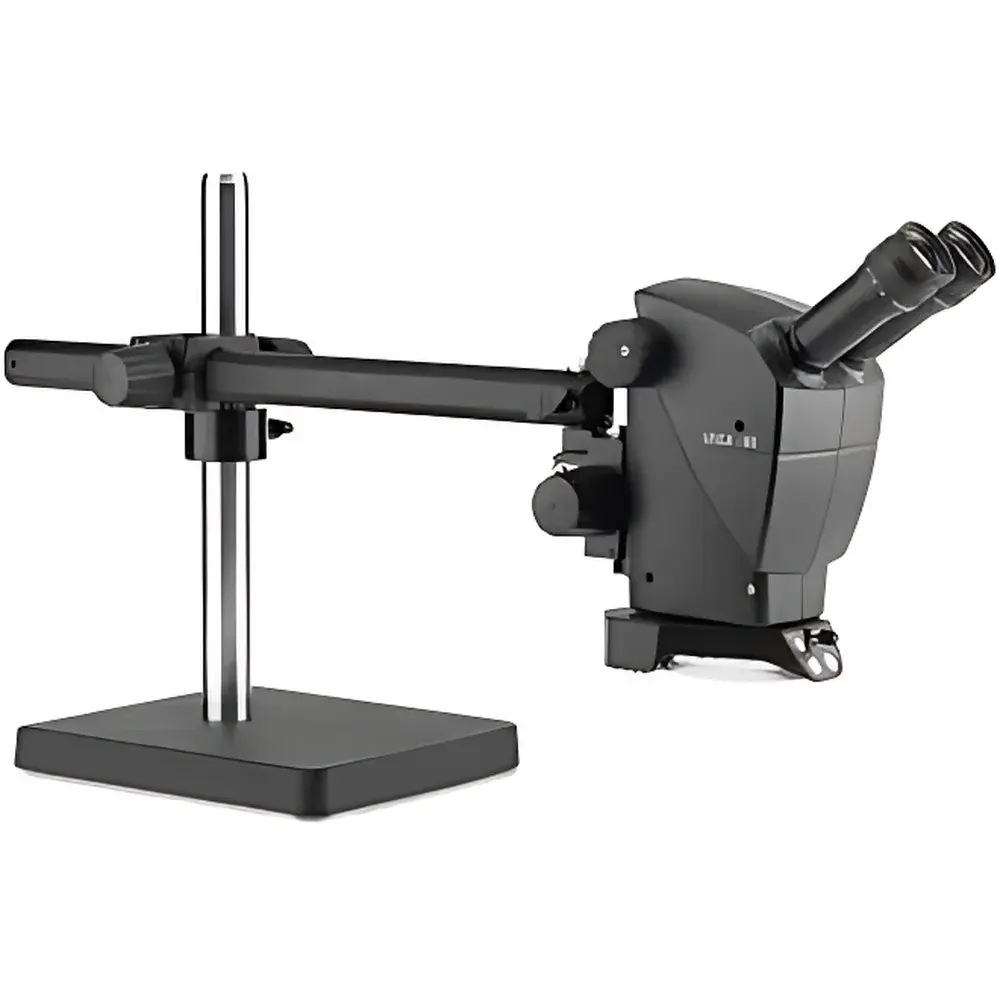
Leica A60 S Stereo Microscope
| Brand | Leica |
|---|---|
| Origin | Germany |
| Model | A60 S |
| Total Magnification Range | 5× to 30× |
| Working Distance | 122 mm |
| Depth of Field | 13.6 mm |
| Optical Technology | Leica Fusion Optics™ |
| Illumination | Adjustable LED Ring Light with Removable Diffuser |
| Field of View | Up to 46 mm |
| Mounting | Universal Cross-Arm Stand |
Overview
The Leica A60 S Stereo Microscope is an industrial-grade stereoscopic imaging system engineered for precision visual inspection, assembly, and quality assurance in regulated manufacturing environments. Utilizing Leica’s proprietary Fusion Optics™ technology—a compound optical design integrating dual-path beam splitting and optimized lens group alignment—the A60 S delivers enhanced depth perception without compromising resolution or contrast. Unlike conventional Greenough or Common Main Objective (CMO) stereo architectures, Fusion Optics™ enables a 100% increase in usable depth of field (13.6 mm at lowest magnification), significantly reducing refocusing frequency during extended manual tasks such as PCB rework, micro-assembly of implantable medical devices, or catheter tip inspection. Its fixed 122 mm working distance provides unobstructed access for soldering irons, tweezers, and automated tooling—critical for ISO 13485-compliant medical device production lines and IPC-A-610-certified electronics assembly workflows.
Key Features
- Fusion Optics™ Architecture: Patented dual-path optical path design delivering simultaneous high-resolution imaging and extended depth of field—validated per ISO 10934-1 for stereomicroscopic performance characterization.
- Ergonomic Cross-Arm Stand: Rigid, vibration-damped universal mounting system compatible with third-party positioning stages, motorized Z-drives, and integration into cleanroom-compatible workstations.
- LED Ring Illumination System: 5,000 K color temperature, CRI >90 LED ring light with removable frosted diffuser for glare-free, spectrally neutral illumination—compliant with ISO 9241-307 requirements for visual display ergonomics.
- Widefield Viewing Capability: Maximum field of view of 46 mm at 5× magnification supports rapid sample screening, component sorting, and large-area defect mapping without stage translation.
- Thermal-Stable Optical Housing: Aluminum-magnesium alloy chassis with passive thermal management ensures optical alignment stability across ambient temperatures from 15°C to 30°C—meeting IEC 61000-4-2 electrostatic discharge immunity standards.
Sample Compatibility & Compliance
The Leica A60 S accommodates samples ranging from sub-millimeter electronic components (e.g., 0201 SMDs, flex circuit traces) to macro-scale biomedical assemblies (e.g., pacemaker housings, hearing aid shells, urinary catheter distal ends). Its open-stage geometry and 122 mm clearance support integration with vacuum chucks, anti-static mats, and glove-box adapters. The system conforms to CE marking directives (2014/30/EU EMC, 2014/35/EU LVD), RoHS 2011/65/EU, and is validated for use in Class 7 (ISO 14644-1) cleanrooms. Documentation packages include Factory Acceptance Test (FAT) reports, optical calibration certificates traceable to PTB (Physikalisch-Technische Bundesanstalt), and IQ/OQ protocols aligned with FDA 21 CFR Part 11 data integrity expectations for instrument qualification.
Software & Data Management
While the A60 S operates as a standalone optical instrument, it is fully compatible with Leica Application Suite (LAS X) v3.4+ via optional USB-C digital camera modules (e.g., Leica DFC7000 T). LAS X supports audit-trail-enabled image capture, measurement annotation (ISO 17025-compliant length/area quantification), multi-focus stacking (Z-stacking), and export to DICOM, TIFF, or PDF/A-1a formats for controlled document management systems. All metadata—including magnification, illumination intensity, timestamp, and operator ID—is embedded in EXIF headers and preserved during archival transfer, satisfying GLP/GMP record retention requirements.
Applications
- Electronics Manufacturing: Visual solder joint inspection (IPC-J-STD-001), counterfeit component identification, BGA underfill void analysis, and flex PCB trace continuity verification.
- Medical Device Production: Final assembly verification of cochlear implants, silicone valve seating in cardiac assist devices, and surface defect assessment of polymer-based catheters per ISO 10993-1 biocompatibility testing protocols.
- Quality Control Laboratories: ASTM E112 grain size evaluation on metal substrates, USP particulate matter examination in injectable packaging, and ISO 14644-1 particle count documentation support.
- Research & Development: Prototyping support for MEMS packaging, microfluidic chip bonding validation, and biomaterial scaffold pore structure documentation.
FAQ
Is the Leica A60 S suitable for ISO 13485-certified medical device manufacturing?
Yes—the optical design, mechanical stability, and documentation package meet key requirements for equipment qualification under ISO 13485:2016 Clause 7.6, including calibration traceability and change control records.
Can the A60 S be integrated with automated focus systems?
Yes—its standardized M42 × 0.75 mounting interface and electrical trigger port support third-party motorized Z-axis controllers compliant with RS-232 or USB HID protocols.
Does the LED illumination comply with photobiological safety standards?
Yes—the ring light is classified as Risk Group 1 (Exempt) per IEC 62471:2006, with no measurable UV or IR emission and luminance below 10 cd/m² at user eye position.
What is the recommended recalibration interval for routine QC use?
Leica recommends annual optical performance verification using NIST-traceable resolution test targets (e.g., USAF 1951) and depth-of-field gauges—documented in accordance with ISO/IEC 17025 Clause 6.6.
Is the cross-arm stand compatible with vibration isolation tables?
Yes—the base features four M6 threaded inserts spaced to match standard optical table hole patterns (25 mm grid), enabling direct bolting to active or passive damping platforms.



