
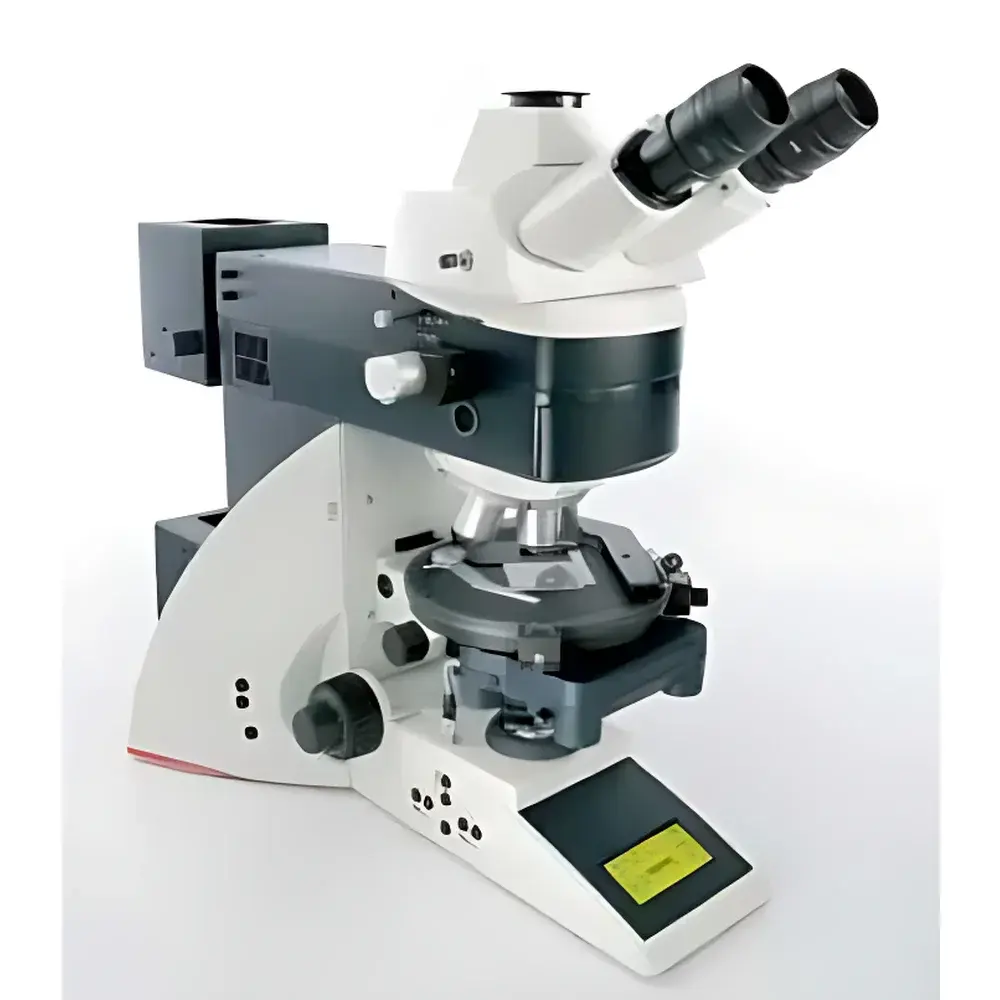
Leica DM4500 P LED Polarizing Microscope
| Brand | Leica |
|---|---|
| Origin | Germany |
| Model | DM4500 P LED |
| Illumination | High-stability white LED (CCT ≈ 5700 K) |
| Lifetime | ≥50,000 h |
| Objective Turret | 6-position encoded and centerable |
| Condenser | Adjustable and centerable polarizing condenser with built-in 1.6× magnification changer |
| Software Integration | Fully compatible with Leica Application Suite (LAS) X |
| Compliance | Conforms to DIN 58879 for polarizing components |
| Focus Drive | Motorized coarse/fine mechanical Z-drive |
| Illumination Management | Intelligent Light & Contrast Management (ILCM) system |
| Encoding | Full module encoding (objectives, condenser, polarizers, analyzers, illumination mode) |
Overview
The Leica DM4500 P LED is a high-precision research-grade polarizing microscope engineered for quantitative birefringence analysis, mineralogical identification, pharmaceutical crystallinity assessment, and advanced materials characterization. It operates on the fundamental principles of transmitted and reflected polarized light microscopy—leveraging controlled linear polarization, precise analyzer rotation, and compensator insertion to quantify optical path differences, retardation, and orientation of anisotropic structures. Its optical architecture adheres to Köhler illumination standards and integrates a fully encoded optical train, ensuring traceable, repeatable alignment across all imaging modalities—including brightfield, darkfield, DIC (with optional modules), and multiple polarized contrast modes (e.g., crossed polars, quartz wedge, λ/4 plate). Designed for laboratories requiring GLP-compliant documentation and long-term measurement stability, the DM4500 P LED eliminates thermal drift and spectral variability inherent in halogen or mercury sources through its solid-state LED illumination system.
Key Features
- Intelligent Light & Contrast Management (ILCM): Automatically adjusts LED intensity and aperture diaphragm position in real time to maintain constant brightness and optimal contrast across all magnifications—eliminating manual recalibration during objective changes.
- Encoded 6-Position Objective Turret: Ensures precise, reproducible positioning of strain-free objectives (5×–100×); each lens is factory-calibrated and digitally registered for seamless LAS X metadata synchronization.
- Adjustable Polarizing Condenser: Features centerable optics and integrated 1.6× magnification changer, enabling extended magnification range without compromising resolution or numerical aperture in transmitted polarized light.
- Modular Polarization System: Supports interchangeable polarizers and analyzers—pre-aligned or rotatable (±180° or full 360°)—all compliant with DIN 58879 tolerances for angular accuracy (10⁵:1).
- Motorized Z-Drive & Optional Automation: Standard mechanical coarse/fine focus with optional motorized fine-focus unit or programmable XY scanning stage for automated tile scanning and multi-location acquisition.
- LED Illumination Engine: Stable 5700 K correlated color temperature across full intensity range (0–100%); no warm-up time, zero UV/IR emission, and ≥50,000 h operational lifetime—reducing maintenance cost and calibration frequency.
Sample Compatibility & Compliance
The DM4500 P LED accommodates standard 24 × 50 mm and 40 × 60 mm petrographic slides, as well as custom-thickness specimens up to 30 mm (with appropriate stage adapters). It supports both transmitted-light applications (e.g., thin sections, polymer films, liquid crystals) and incident-light configurations (via optional epi-polarizer module) for opaque or reflective samples such as metallurgical alloys, ceramics, and coated substrates. All polarizing components—including strain-free objectives, condensers, and compensators—meet DIN 58879 specifications for residual birefringence (<5 nm optical path difference) and wavefront distortion. The system is compatible with ISO 9276-3 (particle shape analysis), ASTM D4126 (polymer crystallinity), and USP (particulate matter in injectables) workflows when paired with calibrated digital cameras and LAS X’s measurement tools.
Software & Data Management
Fully integrated with Leica Application Suite (LAS) X v3.7+, the DM4500 P LED enables automatic metadata capture—including objective ID, condenser settings, polarizer/analyzer angles, LED intensity, exposure time, and stage coordinates—for every acquired image. LAS X supports FDA 21 CFR Part 11–compliant user access control, electronic signatures, and audit trail logging. Measurement modules include retardation quantification (using Michel-Lévy chart interpolation or direct λ-plate calibration), grain boundary mapping, crystal orientation indexing, and birefringence distribution profiling. Export formats include TIFF (with embedded EXIF tags), OME-TIFF (for multidimensional data), and CSV for statistical post-processing in MATLAB or Python-based analytical pipelines.
Applications
- Geosciences: Quantitative mineral identification, optic sign determination, and twinning analysis in thin sections.
- Pharmaceuticals: Polymorph screening, crystallinity assessment of active pharmaceutical ingredients (APIs), and detection of stress-induced birefringence in tablet coatings.
- Materials Science: Characterization of liquid crystal alignment, polymer phase separation, fiber orientation in composites, and residual stress in glass or injection-molded plastics.
- Forensics & Quality Control: Fiber analysis, pigment identification, and counterfeit material verification via refractive index and birefringence fingerprinting.
- Academic Research: Teaching polarized light theory, developing novel compensator-based metrology methods, and correlating optical anisotropy with mechanical properties.
FAQ
Does the DM4500 P LED support both transmitted and reflected polarized light imaging?
Yes—transmitted polarized light is standard; reflected (epi-) polarized light requires the optional Leica EPI-POL module, which includes a strain-free epi-polarizer and analyzer turret.
Can I use third-party digital cameras with this microscope?
Yes, provided the camera interface complies with USB3 Vision or GigE Vision standards; however, full encoding functionality (objective/condenser metadata tagging) is guaranteed only with Leica DFC or ICC series cameras.
Is the LED illumination intensity calibrated traceably to NIST standards?
The LED output is factory-calibrated against photometric reference standards; absolute irradiance values are stored per magnification and can be exported via LAS X for ISO/IEC 17025-compliant lab audits.
How does the ILCM system ensure repeatability between users?
ILCM dynamically links illumination parameters to encoded hardware states—so when User A selects 40× and saves a preset, User B recalls that preset and achieves identical intensity, contrast, and focus geometry without manual intervention.
What is the maximum usable field of view with the 1.6× condenser changer engaged?
With the 1.6× changer and 10× widefield eyepieces (23 mm FOV), the effective field diameter remains ≥18 mm—maintaining sufficient working distance and uniformity for quantitative image analysis across the entire frame.




