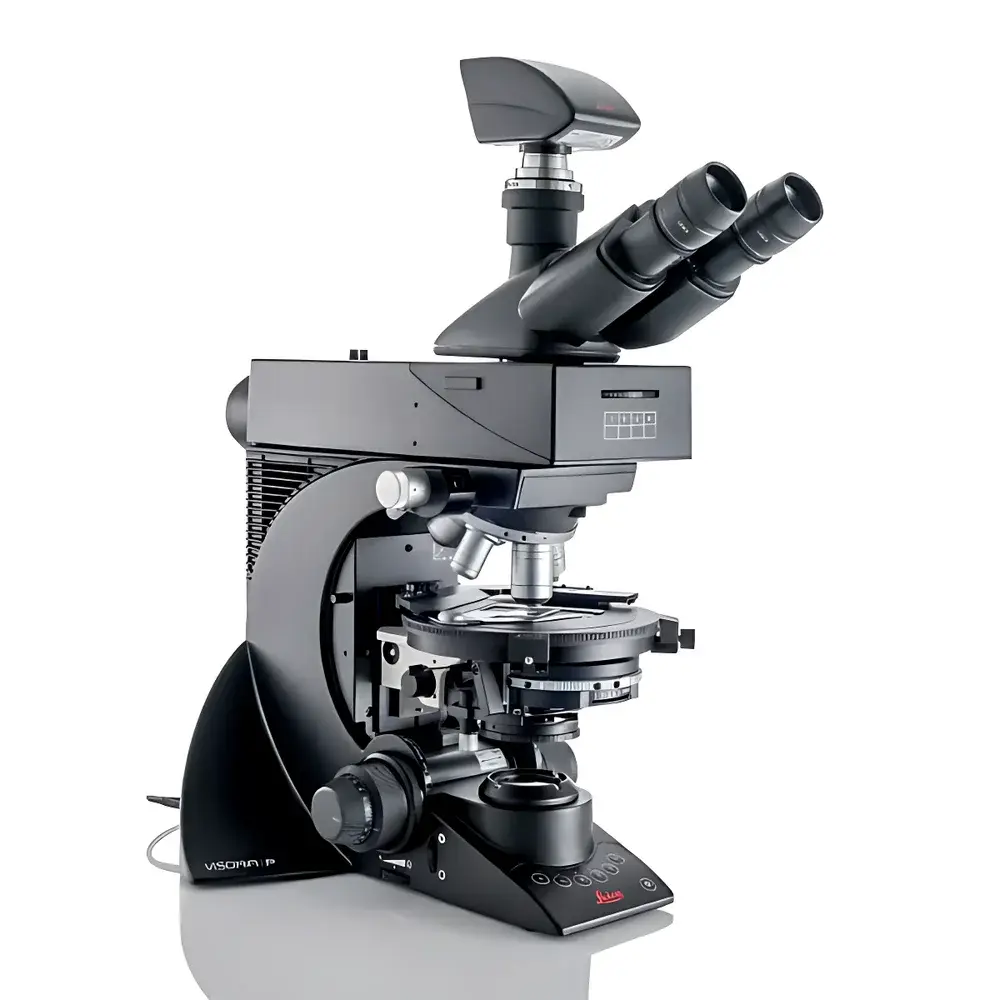
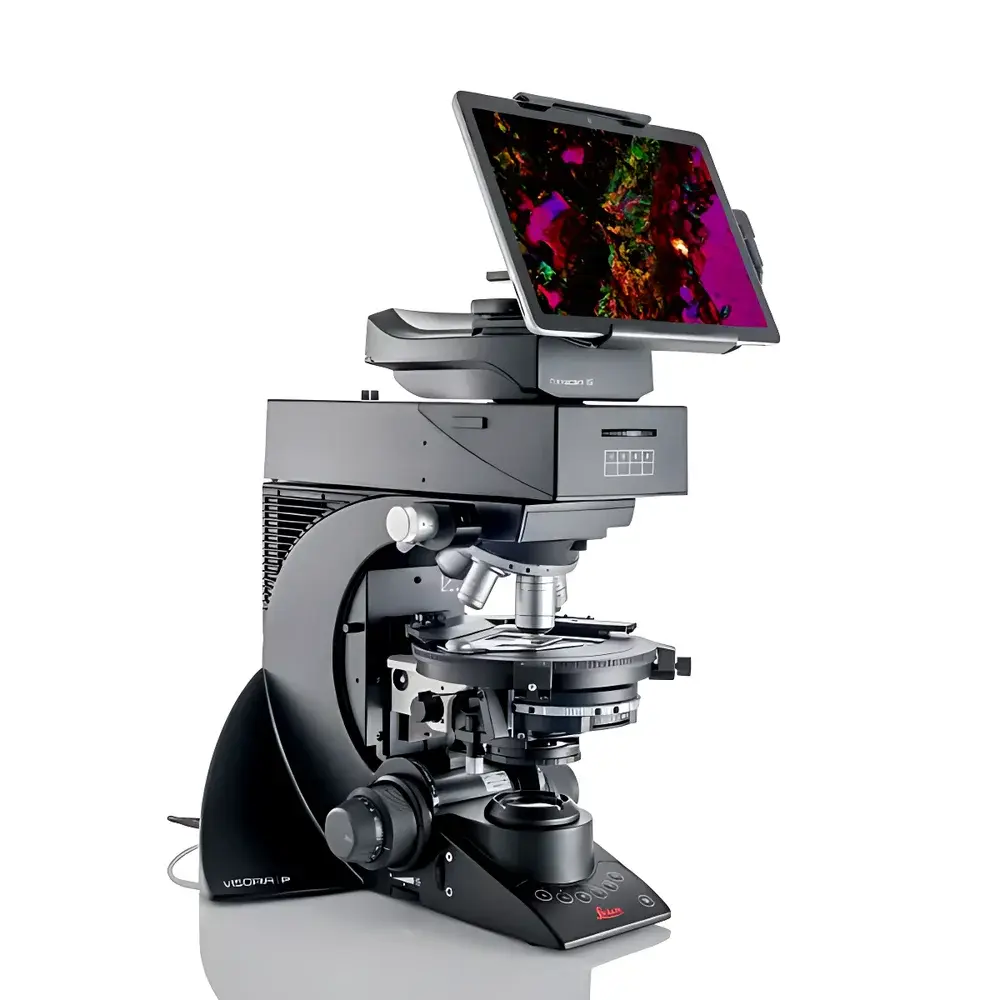
Leica Visoria P Polarizing Microscope
| Brand | Leica |
|---|---|
| Origin | Shanghai, China |
| Manufacturer Type | Authorized Distributor |
| Country of Origin | China |
| Model | Visoria P |
| Pricing | Upon Request |
Overview
The Leica Visoria P Polarizing Microscope is a high-performance, ergonomically engineered instrument designed for routine and advanced polarized light microscopy in materials science, geology, polymer research, and industrial quality control. It operates on the fundamental principles of birefringence analysis using precisely controlled linear, circular, and conoscopy (conoscopic) illumination pathways. The system integrates stress-free optical components—including low-stress polarizing objectives, a centerable revolver turret with individual objective alignment, a 360° rotating mechanical stage, and interchangeable compensators—to enable quantitative evaluation of optical anisotropy, retardation, extinction angles, and crystal symmetry. Unlike conventional brightfield microscopes, the Visoria P reveals structural features invisible under unpolarized light—such as molecular orientation in polymers, cleavage planes in minerals, stress-induced birefringence in glasses and composites, and liquid crystalline domain arrangements—making it indispensable for both routine inspection and regulatory-compliant material characterization.
Key Features
- Ergonomic, eyepiece-free digital workflow: Direct image acquisition and real-time analysis on tablet devices—eliminating neck strain and enabling seated or standing observation postures.
- Encoded illumination management: Automatic brightness adjustment synchronized with objective magnification and observation mode (e.g., crossed polars, circular polars, conoscopy), reducing manual recalibration and improving inter-operator reproducibility.
- Conoscopy-ready optical path: Supports three dedicated conoscopy modules—Berek-type Bertrand lens block (A/B), Advanced Conoscopy Module, and Coal & Asbestos Analysis Module—enabling interference figure acquisition for optic axis determination, uniaxial/biaxial classification, and symmetry analysis.
- Stress-optimized optics: Low-birefringence objectives and strain-free prism assemblies ensure minimal instrumental polarization artifacts, critical for accurate retardation measurements per ISO 10110-6 and ASTM D4127.
- Dedicated coal and asbestos analysis capability: Includes high-NA oil immersion objectives optimized for dispersion staining protocols per EPA Method 600/R-93/116 and NIOSH 9002.
Sample Compatibility & Compliance
The Visoria P accommodates standard 25 mm and 32 mm diameter thin sections, polished blocks, and bulk specimens up to 50 mm in height. Its modular stage design supports both manual XY translation and motorized scanning for large-area mosaicking. All optical configurations comply with ISO 8578 (microscope nomenclature), ISO 10110-6 (polarization specifications), and ASTM E1558 (polarized light microscopy for mineral identification). For regulated environments, the Enersight software platform supports audit trails, user access levels, and electronic signatures aligned with FDA 21 CFR Part 11 requirements when deployed in GLP/GMP laboratories.
Software & Data Management
Powered by the Leica Enersight software platform, the Visoria P delivers integrated image acquisition, measurement, and reporting without requiring external PCs. Key capabilities include: layer thickness quantification via calibrated retardation mapping; extended depth-of-field (EDOF) reconstruction for volumetric clarity; dynamic illumination uniformity correction (shading compensation); multi-mode image fusion (e.g., overlaying brightfield, darkfield, and polarized channels); and automated stitching of large-area scans using the manual stage’s encoded position feedback. Data export adheres to TIFF, JPEG2000, and OME-TIFF standards for interoperability with LIMS and ELN systems.
Applications
- Geoscience: Identification of mineral species, assessment of crystallographic orientation in thin sections, detection of microfractures and fluid inclusions, and coal maceral analysis per ASTM D2798.
- Materials Science: Evaluation of polymer crystallinity, phase segregation in blends, residual stress mapping in injection-molded parts, and birefringence profiling in optical films and laminates.
- Industrial QA/QC: Verification of coating uniformity, detection of delamination in composites, asbestos fiber identification in building materials, and quality screening of liquid crystal displays (LCDs).
- Pharmaceuticals & Biomaterials: Characterization of chiral crystals, polymorphic form differentiation, and collagen fiber alignment in tissue-engineered scaffolds.
FAQ
Does the Visoria P support quantitative retardation measurement?
Yes—when used with calibrated compensators (e.g., quartz wedge, gypsum plate) and Enersight’s retardation analysis module, it enables semi-quantitative to quantitative retardation mapping in nanometers, traceable to NIST-traceable standards.
Can the system be upgraded for motorized stage control or automated conoscopy?
The Visoria P platform is compatible with Leica’s optional motorized XY stage and conoscopy automation kits, allowing future expansion into high-throughput thin-section scanning workflows.
Is the Enersight software validated for use in regulated pharmaceutical environments?
Enersight supports 21 CFR Part 11 compliance features—including electronic signatures, audit trails, and role-based permissions—when configured with appropriate IT infrastructure and documented validation protocols.
What sample preparation standards does the Visoria P align with?
It supports ASTM D5434 (geological thin section preparation), ISO 13783 (polymer microstructure analysis), and EN 10204 (metallographic documentation requirements) through standardized imaging and annotation workflows.