
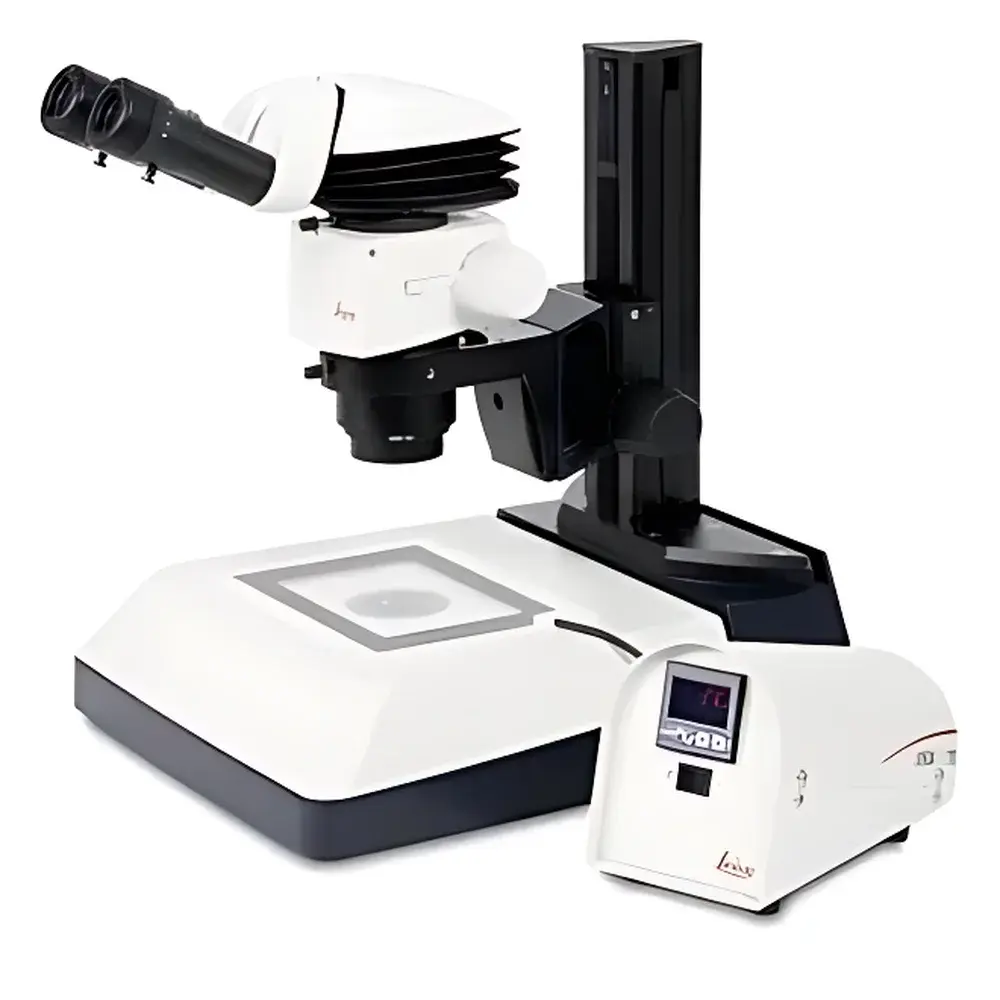
Leica MATS Precision Temperature-Controlled Microscopy Stage for Thermosensitive Samples
| Brand | Leica |
|---|---|
| Origin | Germany |
| Model | MATS |
| Temperature Range | Up to 50 °C |
| Temperature Resolution | 0.1 °C |
| Thermal Uniformity | ±0.3 °C across surface |
| Stability Duration | ≥5 h at setpoint |
| Sensor Integration | Integrated high-accuracy PT100 sensor |
| Compatibility | Standard stereo and upright optical microscopes (C-mount, dovetail, and custom adapter support) |
Overview
The Leica MATS is a precision-engineered temperature-controlled microscopy stage designed specifically for thermosensitive biological and material science specimens requiring stable, repeatable thermal environments during observation. Unlike generic heated stages, the MATS employs active closed-loop temperature regulation based on proportional-integral-derivative (PID) control architecture, coupled with a calibrated platinum resistance thermometer (PT100) embedded directly within the aluminum alloy stage plate. This configuration enables real-time feedback and dynamic power modulation to maintain thermal equilibrium across the entire working surface—critical for live-cell imaging, developmental biology assays, polymer phase-transition studies, and time-lapse microscopy where even sub-degree fluctuations induce morphological or kinetic artifacts. The system operates independently of microscope illumination heat load and is compatible with both transmitted and reflected light modalities, ensuring minimal thermal interference from external optical components.
Key Features
- High-resolution temperature control with 0.1 °C programmable increments and ≤±0.3 °C spatial uniformity across the full 120 × 90 mm active area
- Stable thermal maintenance for ≥5 hours at any setpoint between ambient and 50 °C—validated under continuous monitoring per ISO/IEC 17025 traceable protocols
- Low-thermal-mass aluminum stage plate with optimized thermal conductivity profile, minimizing radial gradients and edge cooling effects
- Dedicated mounting interface supporting Leica M-series, Z-series, and third-party stereo microscopes via standardized dovetail rails or C-mount adapters
- Integrated safety circuitry including overtemperature cutoff (55 °C hardware limit), open-sensor detection, and automatic power-down upon disconnection
- Front-panel LED display with intuitive push-button interface; no external PC required for basic operation
Sample Compatibility & Compliance
The MATS accommodates standard Petri dishes (35–100 mm), multi-well plates (6–96-well), glass-bottom culture dishes, and custom sample holders with flat-bottom geometry. Its non-magnetic, corrosion-resistant surface supports compatibility with CO2 incubator workflows and routine sterilization using 70% ethanol or UV-C exposure (254 nm). The device conforms to IEC 61010-1:2010 for laboratory electrical equipment safety and carries CE marking under the EU Machinery Directive. While not classified as a medical device, its thermal performance characteristics meet typical requirements for GLP-compliant cell culture monitoring and ISO 13485-aligned preclinical assay staging. Documentation includes factory calibration certificate (NIST-traceable reference standard), RoHS compliance statement, and EMC test report (EN 61326-1).
Software & Data Management
For advanced integration, the optional MATS-Link USB interface enables bidirectional communication with Leica Application Suite X (LAS X) v3.7+, allowing synchronized temperature logging alongside image acquisition metadata. All thermal events—including ramp rates, dwell times, and deviation alerts—are timestamped and exported in CSV or HDF5 format for audit-ready traceability. When used in regulated environments, the system supports FDA 21 CFR Part 11-compliant user access controls (via LAS X Enterprise), electronic signatures, and immutable audit trails when paired with validated network storage. Firmware updates are delivered through Leica’s secure firmware portal and require dual-authentication verification prior to installation.
Applications
- Long-term time-lapse imaging of embryonic development, neuronal outgrowth, or wound-healing assays under physiologically relevant temperatures
- In situ thermal characterization of hydrogels, liquid crystals, and shape-memory polymers during phase transitions
- Controlled-temperature electrophysiology preparations requiring stable bath temperature without convective disturbance
- Quality assurance of temperature-sensitive reagents and diagnostic slides during microscopic QC inspection
- Materials science workflows involving thermal expansion coefficient measurement or solder joint integrity assessment under thermal stress
FAQ
Is the MATS compatible with inverted microscopes?
Yes—when used with Leica’s optional inverted-stage adapter kit (P/N MATS-INV-KIT), the MATS integrates seamlessly with DMi8 and DMI6000 series inverted platforms while preserving focus stability and Köhler illumination alignment.
Can the stage be used inside a CO2 incubator?
The MATS is rated for operation in ambient humidity up to 80% RH non-condensing; however, direct placement inside a CO2 incubator is not recommended due to potential corrosion from humidified gas mixtures. Instead, use with external CO2 perfusion systems routed via gas-tight tubing to the specimen chamber.
Does the system support gradient temperature profiles?
No—the MATS maintains a single uniform setpoint across the entire surface. For thermal gradient applications, consider pairing it with an external Peltier-based gradient generator (e.g., Linkam TS1500) mounted upstream of the stage.
What is the maximum permissible load weight?
The stage supports static loads up to 1.2 kg distributed evenly across the surface; exceeding this may compromise thermal uniformity and mechanical longevity.
How often does the integrated sensor require recalibration?
Leica recommends annual recalibration against a certified reference thermometer (e.g., Fluke 1523 with dry-block calibrator) in accordance with ISO/IEC 17025-accredited laboratories. Factory calibration remains valid for 12 months post-delivery under normal operating conditions.




