
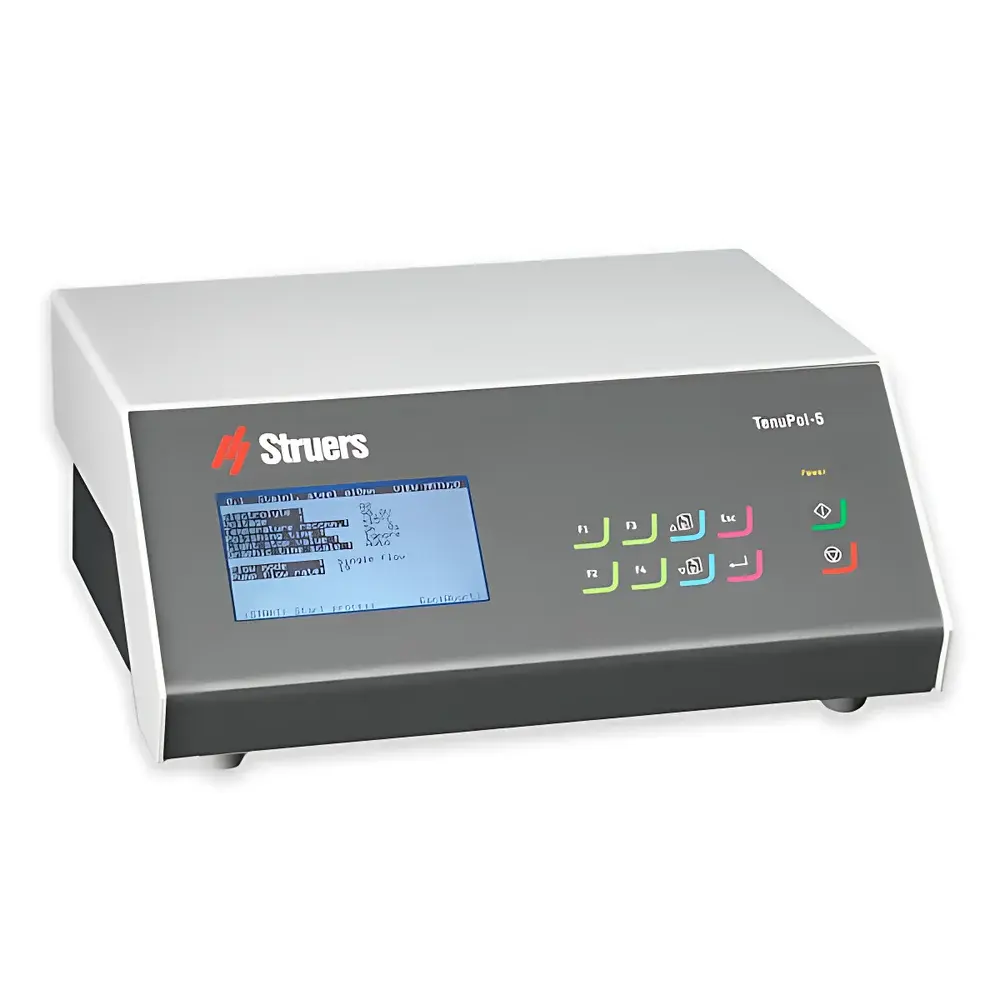
Struers TenuPol-5 Electrolytic Thin-Sectioning System
| Brand | Struers |
|---|---|
| Model | TenuPol-5 |
| Origin | Denmark (Imported) |
| Dimensions (L×W×D) | 276 × 270 × 180 mm |
| Unit Configuration | Dual-module system (Control Unit + Thinning/Polishing Unit) |
| Sample Diameter | 2.3 mm or 3.0 mm |
| Automatic Perforation Detection | Infrared sensor-based endpoint detection |
| Method Storage Capacity | Up to 200 user-defined methods + 18 preloaded Struers methods |
| Voltage Scanning Function | Automated voltage sweep for current density curve acquisition |
| Compliance | Designed for GLP-compliant TEM sample preparation workflows |
Overview
The Struers TenuPol-5 Electrolytic Thin-Sectioning System is a precision-engineered instrument designed for the automated electrolytic thinning of bulk metallic and intermetallic specimens prior to transmission electron microscopy (TEM) analysis. Operating on the principle of controlled anodic dissolution in a cryogenically cooled electrolyte bath, the TenuPol-5 enables reproducible, artifact-minimized thinning of site-specific regions—particularly critical for electron-transparent foil preparation in materials science, metallurgy, and failure analysis laboratories. Unlike mechanical polishing or ion milling, electrolytic thinning preserves near-bulk microstructural integrity by minimizing plastic deformation, thermal damage, and surface amorphization. The system’s dual-unit architecture separates electrical control logic from electrochemical processing, enhancing operational safety, thermal stability, and long-term calibration consistency. Its design adheres to fundamental requirements for TEM specimen preparation as outlined in ASTM E1558 and ISO 22232-1, supporting traceable, repeatable outcomes essential for quantitative microstructural characterization.
Key Features
- Dual-module configuration: Independent control unit and thinning unit ensure electromagnetic isolation, stable power delivery, and simplified maintenance.
- Automated voltage scanning function: Performs real-time current density profiling across a user-defined voltage range to empirically determine optimal thinning voltage—eliminating reliance on literature values or iterative trial-and-error.
- Infrared perforation detection: High-sensitivity IR sensor monitors optical transmission through the specimen in real time; automatically terminates thinning upon first detection of electron transparency (i.e., hole formation), preventing over-thinning and edge artifacts.
- Comprehensive method database: Includes 18 factory-validated Struers methods—8 for pre-thinning and 10 for final thinning across common alloys (e.g., Al, Cu, Fe, Ni, Ti, stainless steels, and superalloys)—plus capacity for up to 200 user-customized protocols with full parameter logging (voltage, current limit, time, electrolyte temperature, agitation rate).
- Cryogenic compatibility: Integrated cooling interface supports connection to external recirculating chillers (–20 °C to –40 °C), enabling low-temperature electrolyte operation required for high-strength alloys and radiation-sensitive phases.
- Operator-independent operation: Intuitive touchscreen interface guides users through method selection, parameter review, and run initiation—no specialized electrochemistry training required.
Sample Compatibility & Compliance
The TenuPol-5 accommodates standard TEM disc specimens of 2.3 mm and 3.0 mm diameter, compatible with Struers’ proprietary specimen holders and transfer systems. It supports a broad spectrum of conductive materials—including single-phase metals, multiphase alloys, weldments, and layered composites—provided they exhibit sufficient electrochemical stability in common electrolytes such as perchloric acid–ethanol mixtures, nitric acid–methanol, or acetic acid–perchloric acid solutions. All operational parameters—including voltage ramp profiles, current cutoff thresholds, and endpoint detection sensitivity—are fully configurable and auditable. The system supports ALCOA-compliant documentation practices and can be integrated into laboratory information management systems (LIMS) via RS-232 or USB serial output. While not inherently 21 CFR Part 11 compliant out-of-the-box, its method storage, timestamped run logs, and parameter versioning align with core GLP/GMP data integrity principles for regulated R&D environments.
Software & Data Management
The embedded firmware provides a graphical user interface (GUI) optimized for rapid method deployment and parameter validation. Each executed run generates a timestamped log file containing method ID, start/stop times, applied voltage profile, measured current response, IR detection event timing, and operator ID (if network-authenticated). Logs are exportable in CSV format for post-processing in Excel or statistical software (e.g., JMP, Minitab). User methods may be backed up externally or synchronized across multiple TenuPol-5 units using encrypted USB drives. Firmware updates are delivered via Struers’ secure customer portal and include revision-controlled release notes referencing ISO/IEC 17025 calibration traceability statements where applicable.
Applications
- Preparation of electron-transparent foils from turbine blade superalloys for dislocation density mapping and phase identification.
- Routine thinning of aluminum-lithium aerospace alloys for precipitate morphology analysis via high-resolution TEM.
- Site-specific thinning of cross-sectioned battery electrode interfaces to characterize solid-electrolyte interphase (SEI) layer structure.
- Microstructural assessment of irradiated nuclear fuel cladding materials under strict QA/QC protocols.
- Failure analysis of solder joint intermetallic growth in electronic packaging assemblies.
FAQ
What electrolytes are compatible with the TenuPol-5?
Common electrolytes include 10% perchloric acid in ethanol (for Al, Mg), 20% nitric acid in methanol (for Cu, brass), and 5% perchloric acid in acetic acid (for stainless steels). Electrolyte selection must consider material reactivity, passivation behavior, and safety handling requirements.
Can the TenuPol-5 be used for non-metallic samples?
No—it is specifically engineered for electrically conductive specimens. Ceramic, polymer, or semiconductor samples require alternative preparation techniques such as focused ion beam (FIB) milling or ultramicrotomy.
Is remote monitoring or network connectivity supported?
The system features RS-232 and USB serial ports for local data export and basic command-line control; Ethernet or Wi-Fi connectivity is not natively integrated but may be enabled via third-party serial-to-Ethernet converters compatible with Modbus RTU protocols.
How often does the system require calibration verification?
Voltage and current measurement circuits are factory-calibrated to ±0.5% accuracy. Struers recommends annual verification using NIST-traceable multimeters per ISO/IEC 17025 guidelines—documentation templates are available in the service manual.
Does the TenuPol-5 meet CE or UL safety standards?
Yes—the system complies with IEC 61010-1:2010 for electrical safety in laboratory equipment and carries CE marking for EMC Directive 2014/30/EU and Low Voltage Directive 2014/35/EU. UL certification is available upon request for North American installations.



