
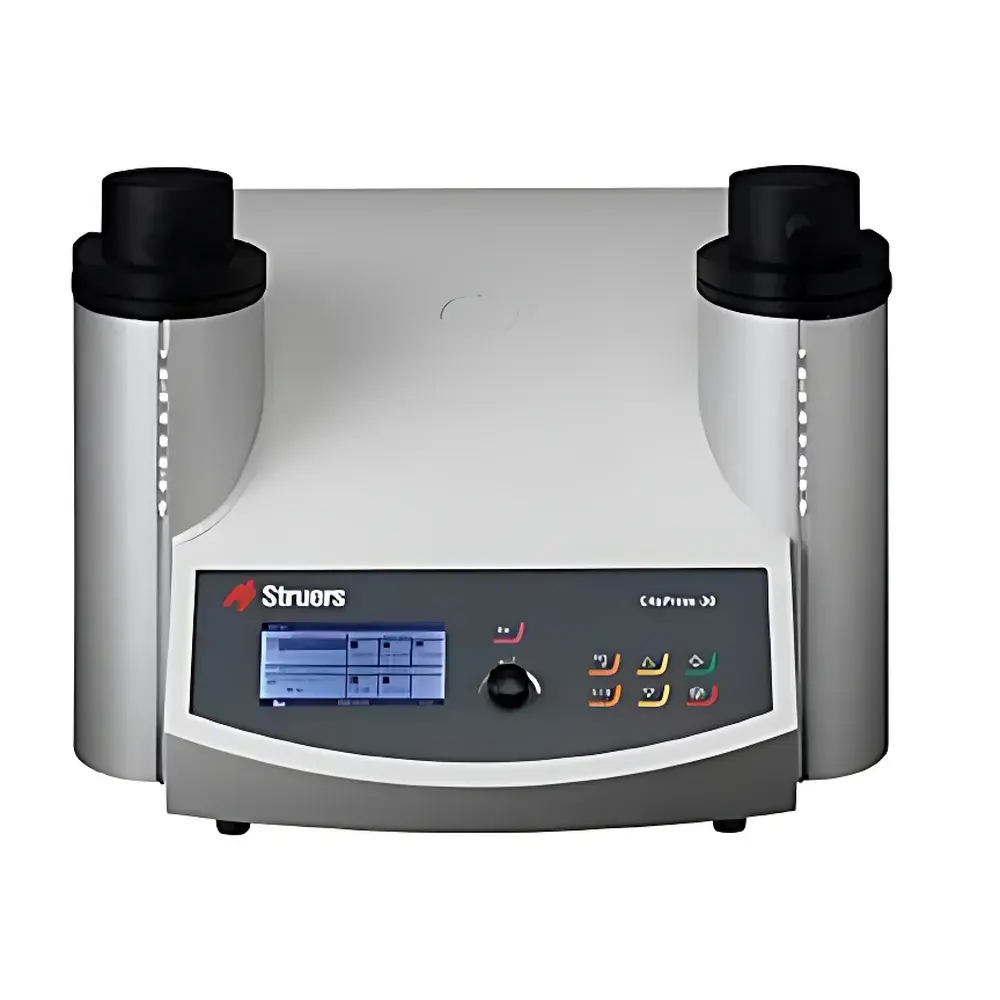
Struers CitoPress-30 Automated Hot Mounting Press
| Brand | Struers |
|---|---|
| Origin | Denmark |
| Model | CitoPress-30 |
| Type | Hot Mounting Press |
| Automation Level | Electric-hydraulic, dual-chamber, programmable |
| Control Interface | Intuitive rotary knob with graphical display |
| Integrated Guidance | Built-in “Hot Mounting Application Guide” |
| Optional Accessory | CitoDoser automatic dosing system |
| Power Consumption | Up to 50% lower than conventional hot presses |
| Cooling Modes | Three selectable levels (High/Medium/Low) |
| Mounting Cycle Time | Reduced by ~30% vs. conventional systems |
| Compliance | Designed for GLP/GMP-aligned workflows |
Overview
The Struers CitoPress-30 is an electric-hydraulic, dual-chamber hot mounting press engineered for precision, repeatability, and operational efficiency in metallurgical and materials science laboratories. It operates on the principle of thermosetting resin compression molding under controlled temperature, pressure, and time parameters—enabling robust embedding of metallic, ceramic, polymer, or composite specimens for subsequent sectioning, grinding, and polishing. Unlike manual or semi-automated systems, the CitoPress-30 integrates full process control across two independent or synchronized mounting chambers, allowing parallel preparation of heterogeneous samples without cross-contamination or scheduling conflict. Its compact, thermally optimized pressing unit reduces thermal mass, accelerating heat-up and stabilization—critical for high-throughput QA/QC labs and R&D facilities where cycle time directly impacts throughput and resource allocation.
Key Features
- Electric-hydraulic actuation ensures precise, stable pressure application (up to 30 kN nominal force) with minimal mechanical drift over extended operation.
- Dual independent mounting chambers (Ø25–32 mm and Ø30–40 mm) support simultaneous processing of different sample types or resin systems—each chamber fully programmable with separate temperature, pressure, heating duration, and cooling profiles.
- Intuitive multifunctional rotary knob interface enables rapid parameter adjustment without menu navigation; all settings are displayed in real time with visual feedback on thermal and pressure status.
- Built-in Hot Mounting Application Guide provides context-aware method selection: users select a Struers resin (e.g., Epofix®, Technovit® 5071, or Phenolite®), and the system automatically validates compatible mold diameters, loads optimal preset parameters, and confirms readiness—reducing operator-dependent variability.
- Energy-efficient thermal architecture consumes up to 50% less power during heating phases compared to legacy hot presses, verified per IEC 60068-3-5 thermal performance benchmarks.
- Three-stage water-cooling intensity control (High/Medium/Low) allows alignment with resin-specific solidification kinetics—Medium mode suffices for >85% of standard epoxy and phenolic formulations, significantly reducing facility water demand.
Sample Compatibility & Compliance
The CitoPress-30 accommodates specimens ranging from small electronic components (e.g., solder joints, PCB traces) to coarse-grained cast alloys and brittle ceramics. Compatible molds include standard aluminum, steel, and non-conductive phenolic inserts. All resin-specific methods are traceable via internal database logging—including timestamped execution records, operator ID (if integrated with network authentication), and parameter versioning. The system supports GLP and GMP environments through secure method storage, password-protected editing, and exportable CSV logs compliant with FDA 21 CFR Part 11 requirements when deployed with Struers LabManager™ software. No external calibration certificates are required for routine operation, though annual verification against ISO 14644-1 cleanroom-compatible thermal uniformity standards is recommended for accredited labs.
Software & Data Management
While the CitoPress-30 operates as a standalone instrument, it is natively interoperable with Struers LabManager™—a centralized laboratory informatics platform for method distribution, equipment monitoring, and digital workflow documentation. All executed cycles are stored locally with metadata (start/stop time, resin type, mold size, deviation alerts). Methods can be exported/imported via USB or network share, enabling lab-wide standardization and revision-controlled SOP deployment. Optional CitoDoser integration adds automated resin dispensing with volumetric accuracy ±1.5%, and auto-recall of last-used dosing configuration upon placement—eliminating manual resin measurement and minimizing batch-to-batch viscosity variation due to inconsistent filler ratios.
Applications
- Metallurgical quality control: Embedding cross-sections of welds, heat-affected zones, and coated substrates for microstructural analysis (ASTM E3, ISO 13009).
- Failure analysis labs: Securing fragile fracture surfaces or delaminated composites without edge rounding or resin pull-out.
- Electronics manufacturing: Mounting SMT components, wire bonds, and die-attach interfaces prior to cross-sectioning per IPC-TM-650 2.1.1.
- Aerospace & automotive R&D: High-reproducibility mounting of turbine blade coatings, brake pad composites, and additive-manufactured metal parts for porosity and interfacial integrity assessment.
- Academic materials research: Rapid method iteration across resin chemistries (epoxy, acrylic, phenolic) to correlate embedding conditions with final polish quality and artifact generation.
FAQ
Does the CitoPress-30 require external water chilling or can it operate with tap water?
It is designed for direct connection to standard municipal water supply (5–30°C inlet); no chiller is needed. The three-level cooling control optimizes flow rate and thermal exchange efficiency—Medium setting typically maintains ≤35°C mold surface temperature within 90 seconds post-pressurization.
Can non-Struers resins be used with the built-in Application Guide?
The guide is calibrated exclusively for Struers-certified resins. Third-party resins may be manually programmed, but method validation (cure time, exotherm management, shrinkage compensation) remains the user’s responsibility.
Is remote monitoring or IoT connectivity supported?
Native Ethernet port enables basic status polling and log export. Full IIoT integration (e.g., OPC UA, MQTT) requires LabManager™ v5.2 or later with optional Struers Connect Gateway module.
What maintenance intervals are recommended for hydraulic and thermal subsystems?
Hydraulic oil inspection every 12 months; heating element resistance check annually; mold cavity cleaning after each use with ethanol or acetone—no scheduled replacement parts within first 5 years under typical lab usage (≤20 cycles/day).



