
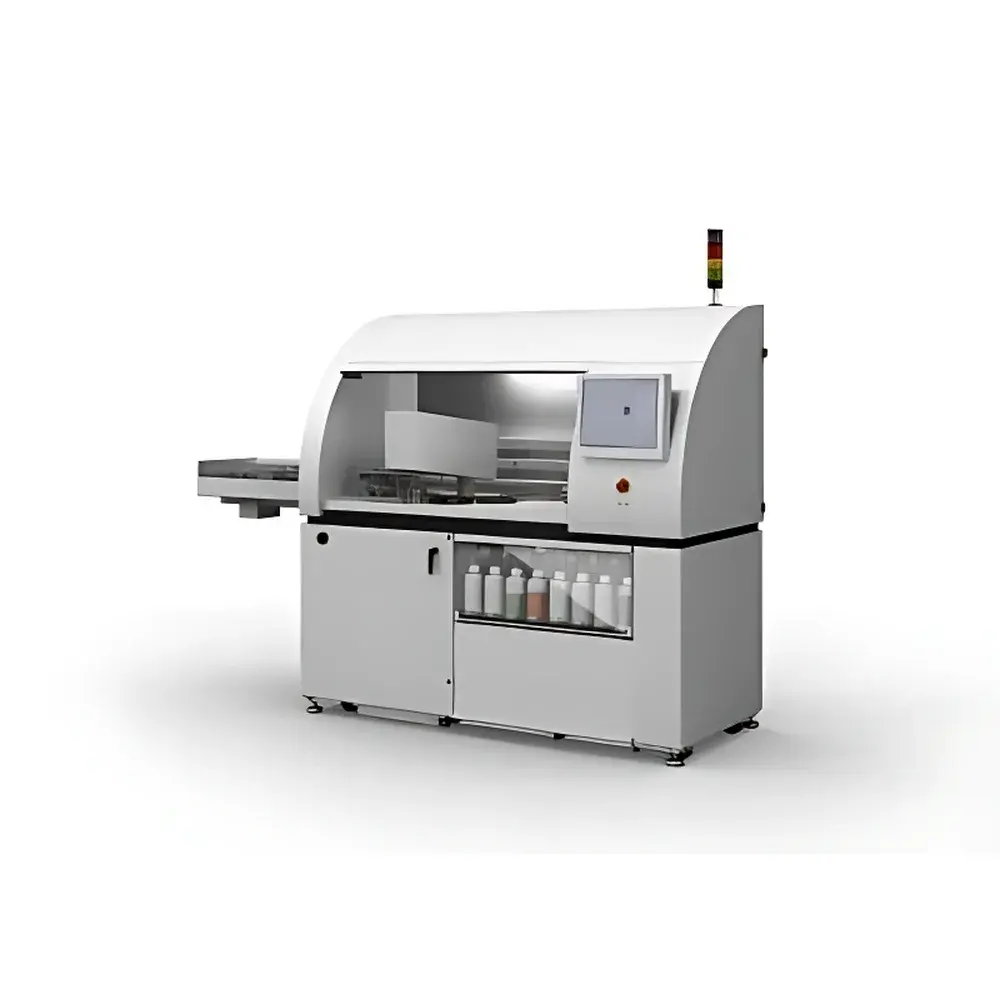
Struers Hexamatic Automated Sample Preparation System
| Brand | Struers |
|---|---|
| Origin | Denmark |
| Model | Hexamatic |
| Dimensions (L×W×D) | 1911 × 2981 × 879 mm |
| Number of Grinding/Polishing Discs | 8 |
| Disc Diameter | 250 mm |
| Rotational Speed Range | 50–300 rpm |
Overview
The Struers Hexamatic Automated Sample Preparation System is an integrated, fully programmable platform engineered for precision metallographic and materials science laboratories requiring high reproducibility in specimen preparation. Based on a dual-station architecture—comprising a planar grinding station and a fine-grinding/polishing station—the system implements sequential, force-controlled material removal using standardized abrasive media and precisely regulated rotational and translational motion. Its core operational principle relies on closed-loop force application (via servo-controlled loading arms), real-time disc exchange under vacuum-assisted clamping, and synchronized coolant delivery via eight independent peristaltic pumps. Designed for ISO/IEC 17025-compliant environments and aligned with ASTM E3, ISO 14577, and EN 1071-3 standards for microstructural sample conditioning, the Hexamatic eliminates manual variability inherent in conventional grinding and polishing workflows while maintaining full traceability of process parameters.
Key Features
- Eight-position interchangeable disc carousel enabling automated switching between grinding, lapping, fine-grinding, and polishing surfaces—all 250 mm in diameter—with sub-second positional repeatability.
- Programmable central force application (up to 50 N) for specimen holders and individual force control (1–50 N per specimen) for moving specimen carriers—supporting irregular geometries including cylindrical, rectangular, and irregular cross-sections.
- Integrated conveyor-based specimen handling system (optional) supporting continuous batch processing of up to 48 specimens per cycle; standalone operation mode accommodates space-constrained labs without conveyor integration.
- Dual built-in cleaning chambers with programmable spray cycles, heated air drying (up to 60 °C), and residue detection sensors ensuring contamination-free transition between preparation steps.
- Embedded industrial PC with 15-inch capacitive touchscreen interface running Struers’ LaboSystem™ software—supporting multi-user role-based access, audit trail logging, and export of raw parameter logs compliant with FDA 21 CFR Part 11 requirements.
- Circulating cooling unit with temperature stabilization (±0.5 °C) and flow monitoring, coupled with eight independent peristaltic pumps for precise, pulse-free delivery of slurries, lubricants, and cleaning agents.
Sample Compatibility & Compliance
The Hexamatic accommodates both individual specimens mounted in standard metallographic夹具 (e.g., 30 mm and 40 mm diameter holders) and multi-specimen carriers (up to 8 positions per carrier). It supports hard metals (e.g., tool steels, carbides), soft alloys (Al, Cu, Mg), ceramics, composites, geological samples, and polymer-reinforced materials. All mechanical and software functions comply with CE Machinery Directive 2006/42/EC, EMC Directive 2014/30/EU, and RoHS 2011/65/EU. Process documentation meets GLP and GMP traceability expectations, with timestamped parameter records—including applied force, rotational speed, dwell time, disc type, coolant flow rate, and chamber status—for each specimen or batch.
Software & Data Management
LaboSystem™ software provides hierarchical workflow configuration: method templates (grinding → rough polish → final polish) are defined once and deployed across multiple users. Each method stores >30 configurable parameters, including rotational speed ramp profiles, dwell time per step, dynamic load adjustment logic, and automatic disc identification via RFID tags embedded in each 250 mm disc mount. All user actions—including login, method selection, start/stop commands, and error acknowledgments—are logged with digital signatures. Data exports support CSV, PDF, and XML formats; optional integration with LIMS via OPC UA or RESTful API enables direct ingestion into enterprise quality management systems.
Applications
The Hexamatic is routinely deployed in R&D laboratories validating new alloy compositions, in foundry QC departments performing routine microstructure verification per ASTM E112, in failure analysis centers preparing fracture surfaces for SEM-EDS examination, and in academic materials science facilities conducting comparative wear or corrosion studies. Its ability to maintain constant pressure-to-area ratios across variable specimen geometries ensures statistically valid grain size measurements (per ASTM E112 or ISO 643) and consistent scratch depth profiles for hardness testing specimen prep (ISO 6506-1). In additive manufacturing labs, it enables repeatable surface conditioning of as-built Ti-6Al-4V or Inconel 718 coupons prior to porosity analysis.
FAQ
Is the conveyor system mandatory for full automation?
No—the Hexamatic operates in both conveyor-integrated and standalone modes. Conveyor use is required only for unattended, high-throughput batch processing (>20 specimens/day); all core automation functions—including disc exchange, force control, and cleaning—remain fully operational without it.
Can the system be validated for regulated pharmaceutical or medical device applications?
Yes—its embedded audit trail, electronic signature support, and configurable user roles align with FDA 21 CFR Part 11 and EU Annex 11 requirements. IQ/OQ documentation packages are available upon request.
What maintenance intervals are recommended for the peristaltic pump tubing?
Tubing replacement is scheduled every 6 months under standard usage (8 h/day, 5 days/week); wear monitoring is integrated into the software dashboard with predictive alerts based on cumulative pump revolutions.
Does the system support third-party abrasive discs?
Only Struers-certified 250 mm discs with embedded RFID tags are recognized by the disc carousel’s identification system; non-certified discs will not initiate automated mounting sequences.
How is calibration traceability maintained for applied force and rotational speed?
Force transducers are factory-calibrated against NIST-traceable deadweight standards; speed encoders are verified annually using laser tachometry per ISO 17025-accredited procedures—calibration certificates are stored within the system’s secure archive.



