
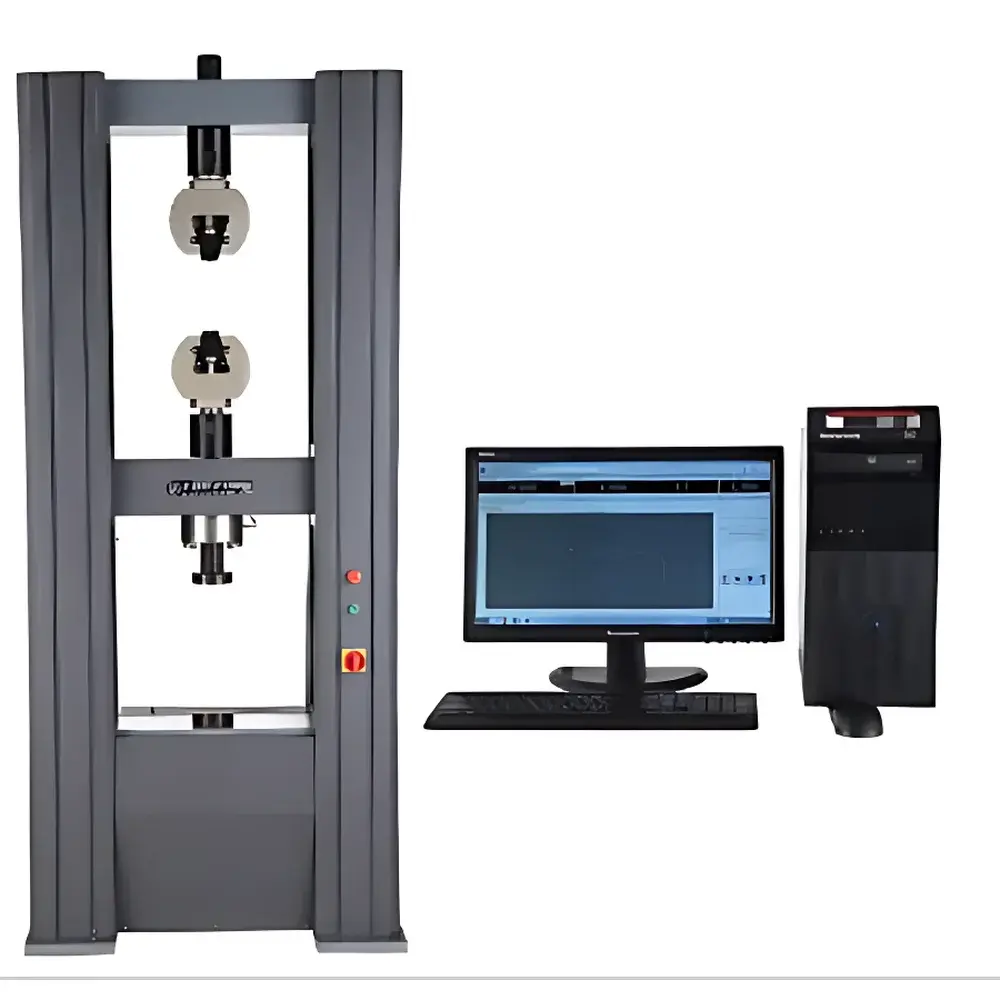
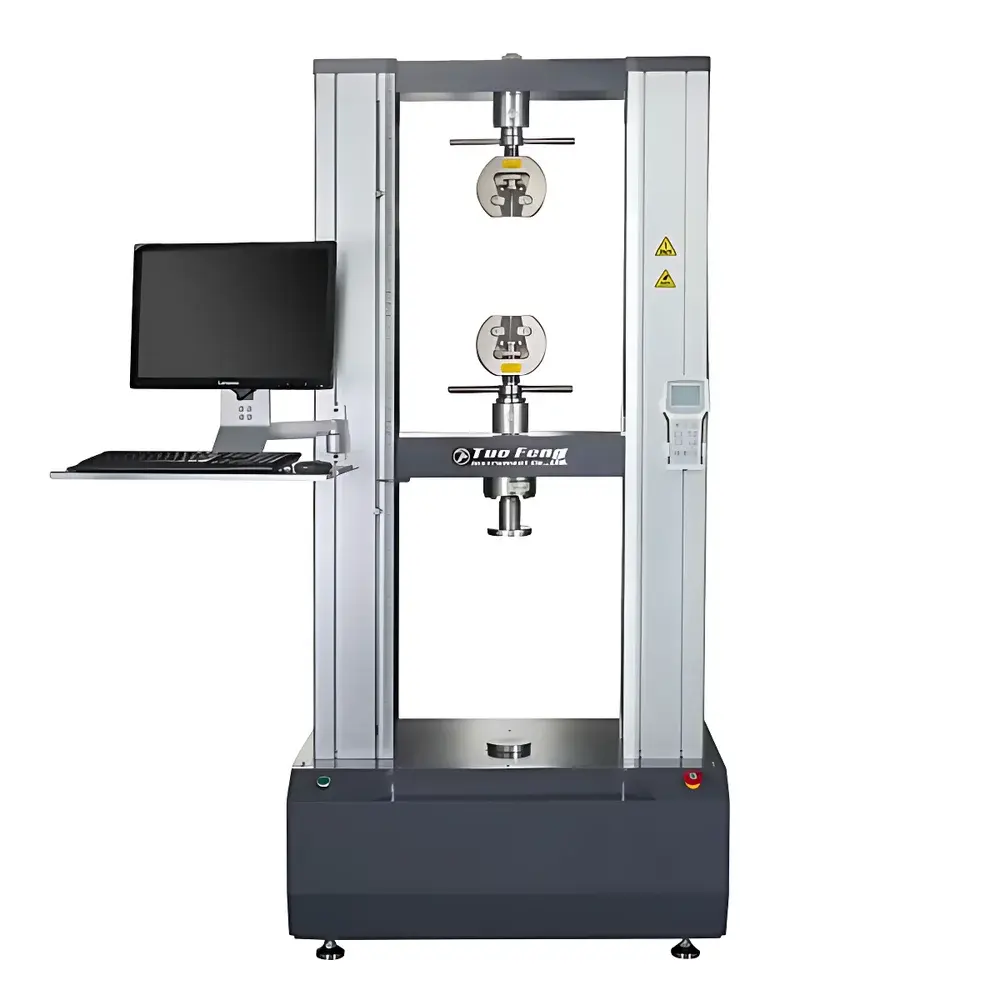
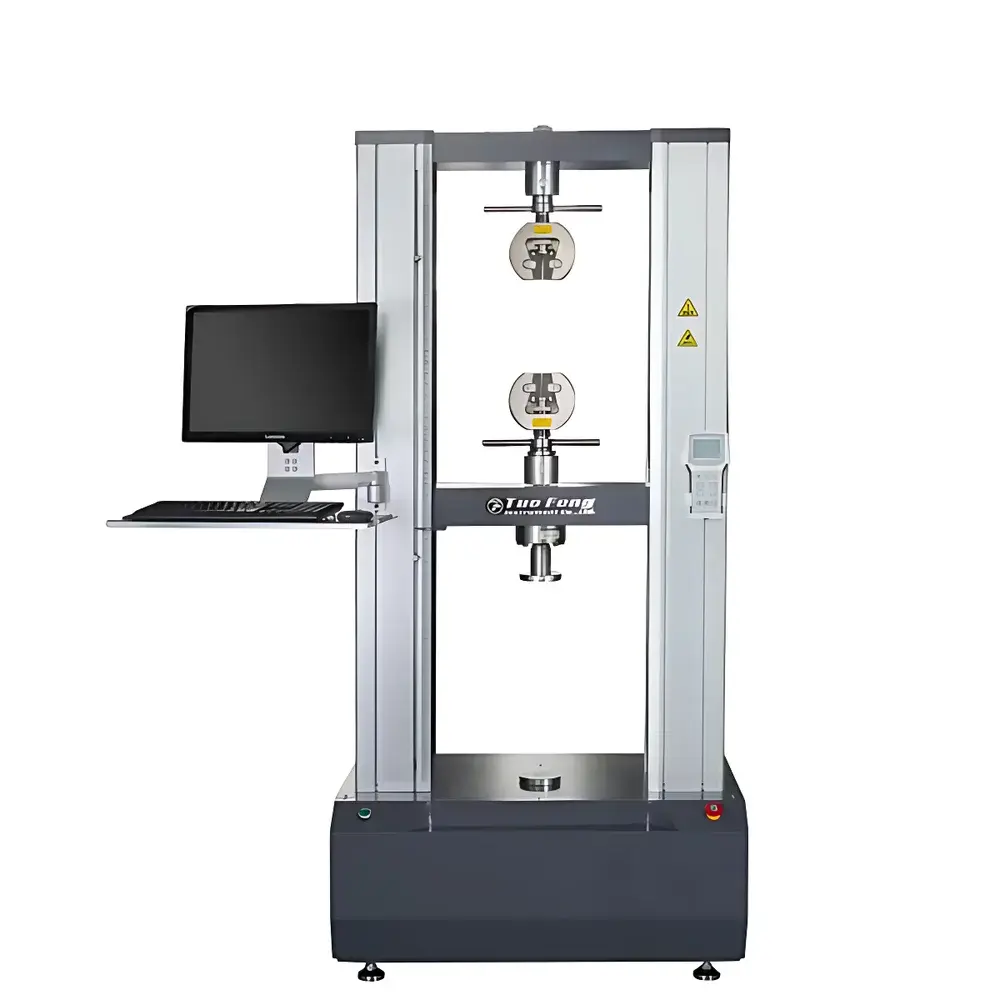
Tuofeng TFW-129 Microcomputer-Controlled Electromechanical Tensile Testing Machine for Photovoltaic Ribbon
| Brand | Tuofeng |
|---|---|
| Origin | Shanghai, China |
| Manufacturer Type | Direct Manufacturer |
| Instrument Type | Electromechanical Tensile Testing Machine |
| Model | TFW-129 |
| Max Test Load | 200 kN |
| Force Measurement Range | 0.2%–100% FS |
| Force Accuracy | ±0.5% of reading |
| Crosshead Travel | 1000 mm |
| Displacement Resolution | 0.001 mm |
Overview
The Tuofeng TFW-129 is a high-precision, microcomputer-controlled electromechanical tensile testing machine engineered specifically for mechanical characterization of photovoltaic (PV) interconnect ribbons—including tinned copper, silver-coated copper, and multi-layer composite ribbons—under standardized uniaxial loading conditions. Based on servo-motor-driven precision ball-screw actuation and real-time closed-loop force/position control, the system complies with fundamental principles of quasi-static mechanical testing per ISO 6892-1, ASTM E8/E21, and GB/T 228.1. Its robust architecture supports both tensile and compression modes, enabling evaluation of yield behavior, ultimate tensile strength (UTS), elongation at break, elastic modulus, and load-displacement hysteresis—critical parameters for ribbon integrity in module lamination, thermal cycling, and long-term field reliability.
Key Features
- High-capacity load frame rated for 200 kN maximum static force, with structural rigidity optimized to minimize deflection during high-load ribbon pull tests.
- Force transducer calibrated to ±0.5% accuracy across full range (0.2–100% FS), traceable to national metrological standards; no internal range switching ensures consistent resolution.
- Precision ground ball-screw drive system coupled with imported servo motor and worm-gear reducer, delivering smooth motion control from 0.001 to 500 mm/min (infinitely variable).
- Optical encoder-based displacement measurement with 0.001 mm resolution and ±0.005% accuracy, independent of load cell calibration.
- Dual-speed crosshead adjustment (fast/slow) with programmable return-to-start function and emergency stop, electronic limit switches, and overload protection (>110% full scale).
- Modular fixture interface supporting custom-designed clamping jaws for flat, embossed, or pre-tinned PV ribbons (0.1–5 mm width, up to 0.5 mm thickness), minimizing slippage and stress concentration.
Sample Compatibility & Compliance
The TFW-129 accommodates standard PV ribbon specimens per IEC 61215-2 (MQT 14: Ribbon Pull Test), UL 1703 Annex D, and JIS C 8992. It accepts specimens mounted on rigid substrate carriers or free-hanging configurations, with optional extensometer integration for strain-controlled protocols. All mechanical and software functions conform to ISO/IEC 17025 requirements for testing laboratories. The system meets GB/T 16491–2008 (Chinese national standard for electronic universal testing machines) and JJG 475–2008 (verification regulation). Calibration certificates include uncertainty budgets aligned with ISO/IEC 17025 Annex A, and hardware design supports GLP/GMP audit readiness through configurable user access levels and event logging.
Software & Data Management
The embedded Windows-based test software provides ISO-compliant test sequence definition, including force-controlled ramping, displacement-controlled holding, and cyclic loading profiles. Users may select among multiple display modes: load–time, load–displacement, stress–strain, and displacement–time curves—all rendered in real time with auto-scaling and overlay capability. The software supports multilingual UI (English, Simplified/Traditional Chinese), customizable unit systems (N/kN/MPa, mm/inch), and automatic derivation of mechanical properties—including tensile strength, yield point (0.2% offset), elongation (%), Young’s modulus, and rupture energy. Test data are stored in encrypted binary format with timestamped metadata; export options include CSV, PDF reports, and XML for LIMS integration. Audit trail functionality records all operator actions, parameter changes, and calibration events—fully compliant with FDA 21 CFR Part 11 requirements when configured with digital signature and role-based authentication.
Applications
- Quantitative assessment of solder bond strength between PV ribbon and solar cell busbars.
- Evaluation of tensile ductility and necking behavior in annealed vs. as-drawn copper ribbons.
- Interfacial adhesion testing of coated ribbons under thermal preconditioning (e.g., after 200°C reflow simulation).
- Comparative analysis of ribbon performance across supplier batches or alloy compositions (e.g., Sn96.5/Ag3.0/Cu0.5 vs. Pb-free alternatives).
- Supporting R&D validation for new ribbon geometries (e.g., flat, rounded-edge, or micro-textured surfaces) per IEC TS 63209.
- Quality assurance in PV module manufacturing lines where ribbon pull resistance directly correlates with module-level PID resistance and hot-spot resilience.
FAQ
What standards does the TFW-129 support for PV ribbon testing?
It supports IEC 61215-2 (MQT 14), UL 1703 Annex D, JIS C 8992, and GB/T 228.1 for metallic materials—configurable via preset test templates.
Can the system be integrated into an automated production line?
Yes—RS-232, Ethernet, and optional PLC-compatible I/O ports enable synchronization with conveyor systems and MES platforms.
Is third-party calibration certification available?
Yes—factory calibration includes NIST-traceable certificates; on-site recalibration services are offered globally with ISO/IEC 17025 accreditation.
Does the software support multi-user environments with permission tiers?
Yes—administrator, operator, and viewer roles can be assigned with password protection and session logging enabled.
What is the warranty and service coverage?
Standard 24-month parts-and-labor warranty; extended service contracts include remote diagnostics, annual preventive maintenance, and software update support.



