
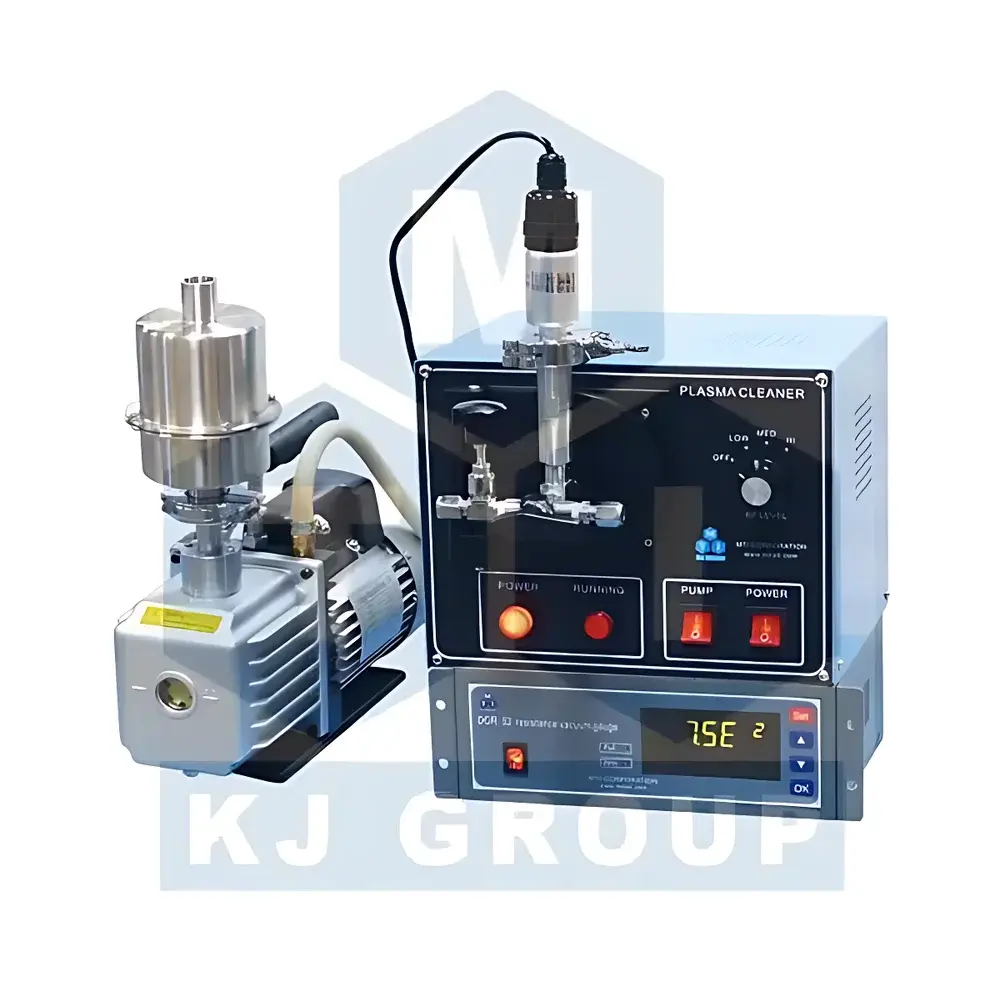
Plasma Etch PDC-36G Benchtop Plasma Cleaner
| [Brand | Hefei Kejing |
|---|---|
| Origin | Anhui, China |
| Model | PDC-36G |
| Input Voltage | 110/220 V, 50/60 Hz |
| Power Consumption | <100 W |
| RF Output Frequency | 13.56 MHz |
| DC Bias Settings | Low (680 V / 10 mA / 6.8 W), Medium (700 V / 15 mA / 10.5 W), High (720 V / 25 mA / 18 W) |
| Chamber Dimensions | Ø75 mm × 165 mm (borosilicate glass) |
| Vacuum Requirement | ≥160 L/min pumping speed, ultimate pressure ≤200 mtorr (0.27 mbar) |
| Gas Compatibility | Air, O₂, Ar, N₂, or mixed non-flammable gases |
| External Vacuum Gauge Option | Pirani-based resistive gauge (range: atmospheric to 0.1 Pa, non-corrosive gases only) |
| Dimensions (W×D×H) | 200 × 250 × 210 mm |
| Net Weight (excl. pump) | 8 kg |
| Warranty | 12 months standard, lifetime technical support] |
Overview
The Plasma Etch PDC-36G is a compact, benchtop-capable plasma cleaner engineered for low-cost, high-reproducibility surface activation and nanoscale organic contaminant removal in academic, R&D, and pilot-scale production laboratories. It operates on the principle of low-pressure radiofrequency (RF) plasma generation at 13.56 MHz — a frequency allocated globally for industrial, scientific, and medical (ISM) applications — enabling stable, capacitively coupled plasma discharge in gases such as air, oxygen, argon, or nitrogen. The system utilizes a grounded glass chamber with a removable front cover, allowing rapid sample loading and visual process monitoring. Under optimized conditions, the PDC-36G achieves typical organic layer removal rates up to 10 nm/min — sufficient for pre-deposition cleaning of single-crystal substrates prior to epitaxial thin-film growth (e.g., MBE or sputtering), oxide passivation removal, hydrophilicity enhancement of polymers, and residue-free debonding of microfabricated devices. Its design emphasizes operational safety, minimal infrastructure requirements, and compatibility with standard rotary vane vacuum pumps.
Key Features
- Benchtop form factor (200 × 250 × 210 mm) with lightweight aluminum chassis and borosilicate glass plasma chamber (Ø75 mm × 165 mm)
- Adjustable 13.56 MHz RF power supply with three discrete DC bias output levels (6.8 W / 10.5 W / 18 W) for precise process control across diverse material classes
- No external water cooling required; thermally stable operation under continuous duty at <100 W total system power draw
- Integrated gas inlet with needle valve for fine-tuned flow regulation and optional three-way solenoid valve for automated sequence control (pump-down → gas fill → plasma ignition → vent)
- Front-access chamber with quick-release clamping mechanism — enables tool-free inspection and cleaning of electrodes and chamber walls
- Compatible with standard non-flammable process gases (O₂, Ar, N₂, dry air, or custom blends); explicitly excludes flammable or corrosive gases per IEC 61000-6-3 EMC and UL 61010-1 safety compliance frameworks
Sample Compatibility & Compliance
The PDC-36G accommodates substrates up to Ø70 mm × 5 mm thickness, including silicon wafers, quartz slides, sapphire, fused silica, PET/PDMS films, ceramic MEMS carriers, and metal foils. Surface treatment uniformity is validated via XPS and contact angle measurements across central 90% of the electrode area. The system meets essential electrical safety requirements per IEC 61010-1 (Edition 3.1) and electromagnetic compatibility standards per CISPR 11 Group 1, Class B. While not certified to ISO 14644 cleanroom classifications, its closed-loop gas handling and absence of oil-based pump lubricants minimize particulate and hydrocarbon backstreaming — supporting GLP-aligned surface preparation workflows in QC/QA labs. Vacuum interface conforms to KF-16 (NW16) standard for seamless integration with compatible pumps and gauges.
Software & Data Management
The PDC-36G operates via manual analog controls (power level selector, exposure timer, gas flow knob) — intentionally omitting embedded microcontrollers to ensure deterministic behavior, eliminate firmware update dependencies, and maximize long-term serviceability. All operational parameters are directly observable: RF power level (via front-panel LED indicators), chamber pressure (when equipped with optional digital Pirani vacuum gauge), and gas flow rate (via calibrated rotameter). For traceable process documentation, users may log settings manually or integrate external data acquisition systems via analog voltage outputs (0–5 V) available on select gauge models. This architecture supports 21 CFR Part 11-compliant audit trails when paired with validated LIMS or ELN platforms using timestamped operator logs and calibrated external sensors.
Applications
- Pre-epitaxy substrate cleaning for III–V and II–VI compound semiconductor growth (removal of adventitious carbon ≤1 nm, native oxides)
- Surface activation of PDMS, PMMA, and cyclic olefin copolymers prior to plasma bonding or microfluidic channel sealing
- Removal of photoresist residues and developer contaminants from mask blanks and reticles
- Enhancement of adhesion in printed electronics — e.g., improving silver nanoparticle ink wetting on PET substrates
- Decontamination of TEM grids and AFM tips without thermal or mechanical damage
- Controlled surface oxidation of graphene and transition metal dichalcogenides for bandgap tuning studies
FAQ
What vacuum pump specifications are mandatory for reliable operation?
A two-stage rotary vane pump with ≥160 L/min free-air displacement and ultimate pressure ≤200 mtorr (0.27 mbar) is required. Oil-free diaphragm pumps are not recommended due to insufficient pumping speed and potential outgassing interference.
Can the PDC-36G perform plasma etching, or is it limited to cleaning?
While primarily configured for isotropic cleaning and surface functionalization, controlled etch rates (e.g., ~0.5–2 nm/min in SF₆/O₂ mixtures on Si) can be achieved with appropriate gas selection and extended exposure — however, anisotropic profile control is not supported due to absence of bias electrode modulation.
Is the optional Pirani vacuum gauge calibrated and NIST-traceable?
The standard gauge is factory-calibrated against reference manometers in dry air/N₂; full NIST-traceable calibration certificates are available upon request at time of order.
Does the system include RF shielding to prevent electromagnetic interference with nearby instrumentation?
Yes — the aluminum chassis provides >40 dB attenuation at 13.56 MHz, and the glass chamber incorporates conductive edge gasketing to maintain Faraday cage integrity during operation.
What maintenance intervals are recommended for sustained performance?
Chamber cleaning every 20–30 operating hours; electrode inspection every 100 hours; RF connector torque verification annually; vacuum seal replacement every 2 years or after 500 cycles — all procedures documented in the English-language service manual included with shipment.



