
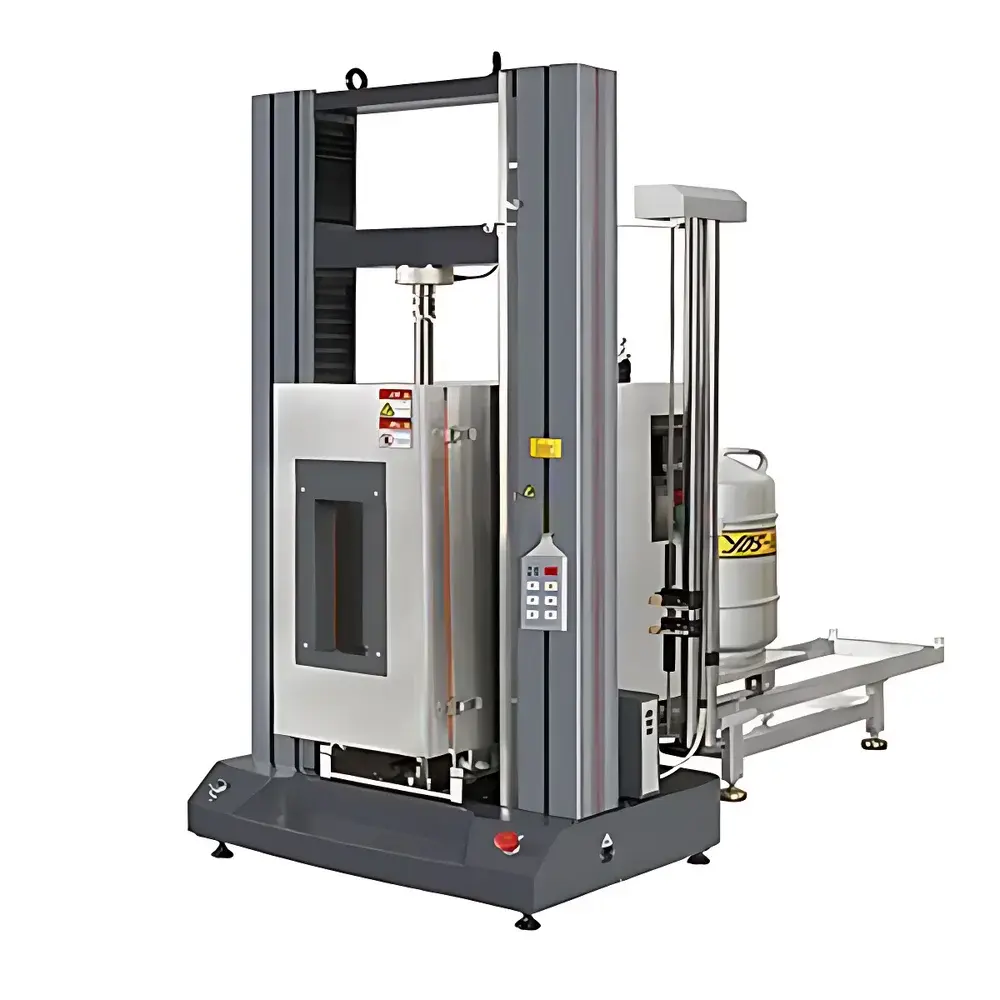
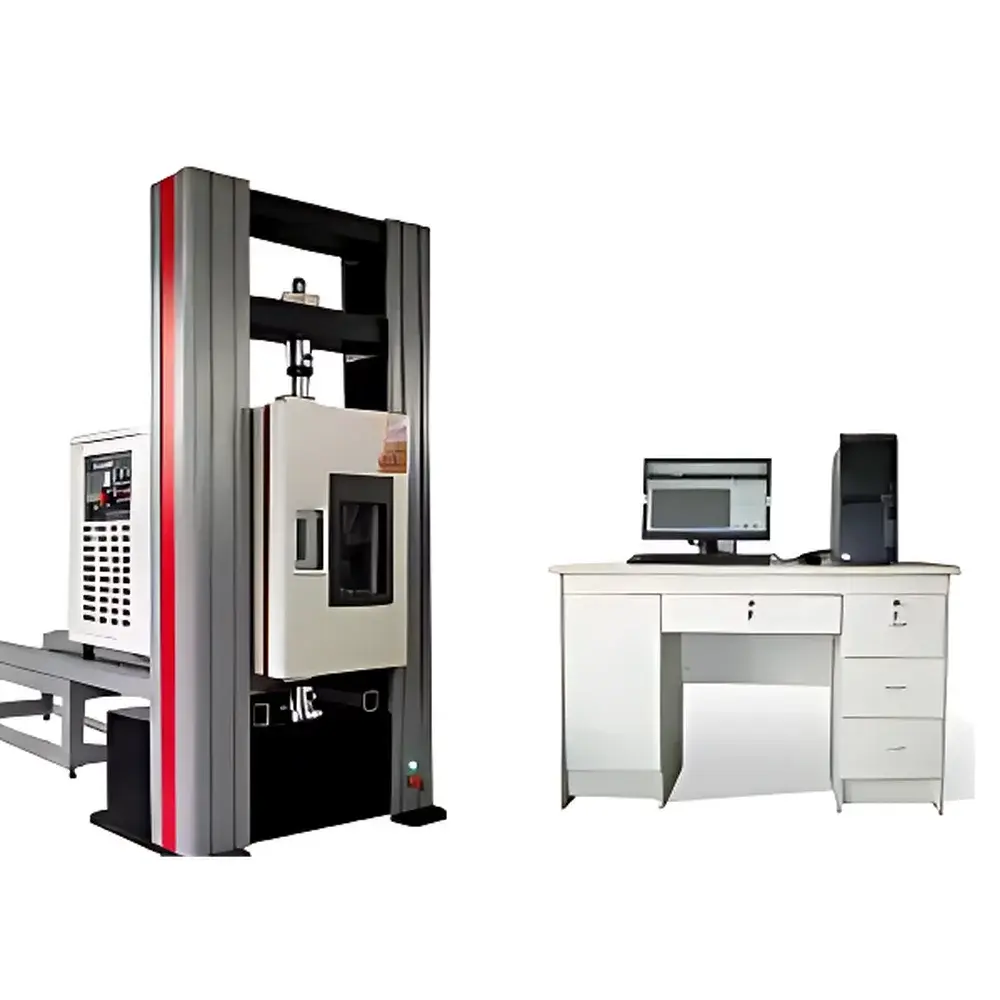
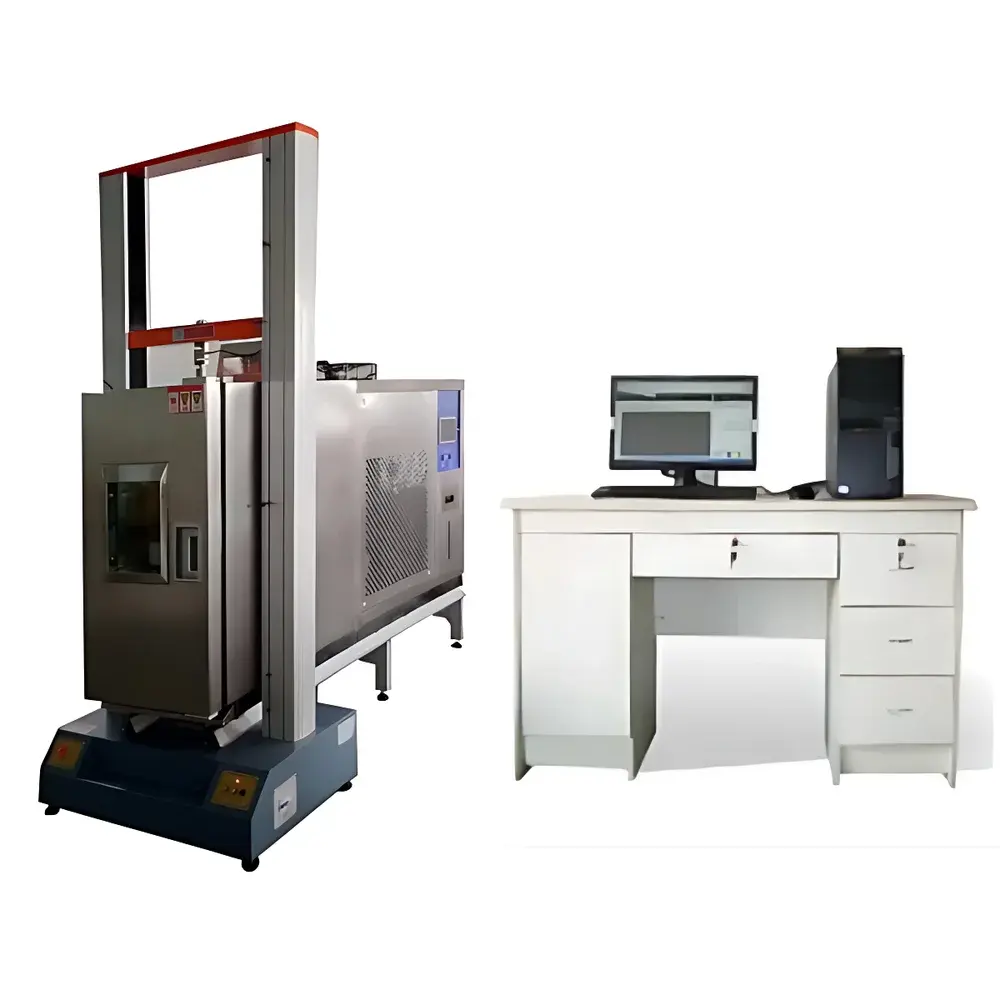
Tuofeng TFW-169 High-Low Temperature Universal Testing Machine
| Brand | Tuofeng |
|---|---|
| Origin | Shanghai, China |
| Manufacturer Type | Direct Manufacturer |
| Country of Origin | China |
| Model | TFW-169 |
| Instrument Type | Electromechanical Universal Testing Machine |
| Max Test Load | 5–100 kN (configurable) |
| Accuracy Class | 0.5 |
| Force Measurement Range | 0.4–100% FS |
| Force Indication Error | ±0.5% of reading |
| Force Resolution | 1/500,000 of full scale, unsegmented |
| Deformation Measurement Range | 0.2–100% FS |
| Deformation Error | ±0.5% of reading |
| Deformation Resolution | up to 1/300,000 |
| Displacement Error | ±0.5% of reading |
| Column Spacing | 840 mm |
| Crosshead Travel (standard) | 1000 mm |
| Host Dimensions | 1250 × 560 × 2400 mm (W×D×H) |
| Power Supply | AC 220 V / 50 Hz ±10%, 750 W |
| Host Weight | ~380 kg |
| Environmental Chamber Temp Range | −40 °C to +100 °C |
| Chamber Heating Power | 1500 W |
| Chamber Internal Dimensions | 360 × 300 × 500 mm (W×D×H) |
| Chamber Ramp Rate | ≤30 min to +100 °C from ambient |
| Temperature Uniformity | ±2 °C over 100 mm vertical zone |
| Control System | Programmable PID with Pt100 sensors |
| Safety Features | Leakage protection, overcurrent circuit breaker |
| Compliance | GB/T 228.1, ISO 6892-1, ASTM E8/E21, ASTM D638/D790/D1043, JIS Z2241, DIN 50125 |
Overview
The Tuofeng TFW-169 High-Low Temperature Universal Testing Machine is an electromechanical materials testing system engineered for precision mechanical property evaluation under controlled thermal conditions. It integrates a high-stiffness dual-column universal testing frame with a programmable environmental chamber capable of stable operation from −40 °C to +100 °C. The system operates on the principle of servo-controlled load application and displacement measurement, enabling accurate determination of tensile, compressive, flexural, shear, peel, and tear behaviors across temperature extremes. Unlike ambient-only testers, this platform maintains metrological integrity throughout thermal cycling—critical for characterizing thermally sensitive polymers, elastomers, composites, metallic alloys, ceramics, and adhesives where modulus, yield strength, elongation at break, and transition temperatures exhibit strong thermal dependence.
Key Features
- Modular architecture supporting interchangeable load cells (5 kN to 100 kN) with 0.5-class accuracy per ISO 7500-1 and ASTM E4.
- Unsegmented force resolution of 1 part in 500,000 full scale ensures high-fidelity detection of low-force events such as initial yield or micro-crack propagation.
- High-resolution extensometry support: deformation measurement range 0.2–100% FS with ±0.5% indication error and resolution up to 1/300,000 FS.
- Integrated environmental chamber constructed from 304 stainless steel exterior and 316 mirror-finish interior, insulated with high-density alumina-silica fiber for thermal stability and minimal gradient drift.
- Pt100 platinum resistance thermometers mounted at top/bottom zones ensure real-time monitoring and closed-loop PID control; uniformity maintained within ±2 °C over 100 mm vertical span.
- Programmable temperature profiles with ramp rates configurable up to 10 °C/min (within chamber limits); stabilization time ≤5 minutes across entire operating range.
- Robust mechanical design: 840 mm column spacing accommodates wide specimens and fixtures; 1000 mm crosshead travel allows extended elongation testing—even with large thermal enclosures installed.
Sample Compatibility & Compliance
The TFW-169 supports standardized specimen geometries per ISO 527, ASTM D638, ASTM E8, and GB/T 228.1—including dog-bone, rectangular, and circular cross-sections up to 50 mm in width. Its dual-port chamber (50 mm diameter upper/lower openings) permits axial loading through insulated feedthroughs while preserving thermal isolation. Optional accessories include wedge-action grips, compression platens, three/four-point bending fixtures, and pneumatic clamps compatible with elevated or sub-zero conditions. The system complies with international standards for test method validation and data traceability, including ISO/IEC 17025 requirements for calibration uncertainty reporting. All force, displacement, and temperature channels are timestamped and logged with audit-trail capability, meeting GLP and GMP documentation expectations for regulated laboratories.
Software & Data Management
Control and analysis are executed via Windows-based software featuring real-time multi-channel acquisition (load, displacement, strain, temperature), synchronized at ≥1 kHz sampling rate. The interface supports automated parameter extraction—including ultimate tensile strength, Young’s modulus, yield point (0.2% offset), elongation at break, Poisson’s ratio, and fracture energy—and exports results to CSV, PDF, or XML formats. Customizable test sequences allow conditional branching (e.g., hold at peak load for creep assessment, then ramp to failure). Raw data files retain full metadata: instrument ID, operator login, calibration certificate IDs, environmental chamber setpoints, and firmware versions. Software conforms to FDA 21 CFR Part 11 requirements when configured with electronic signatures, role-based access control, and immutable audit logs—essential for pharmaceutical packaging or medical device material qualification.
Applications
- Evaluation of polymer glass transition (Tg) and cold crystallization behavior via tensile modulus vs. temperature sweeps.
- Qualification of aerospace-grade aluminum and titanium alloys under cryogenic service conditions (−40 °C).
- Adhesive bond strength assessment across automotive thermal cycles (e.g., −30 °C to +85 °C).
- Mechanical aging studies of rubber compounds exposed to accelerated thermal oxidation protocols.
- Validation of ceramic matrix composite performance in turbine blade applications requiring high-temperature compressive integrity.
- Academic research into shape-memory alloy hysteresis loops under thermomechanical coupling.
FAQ
What temperature ranges does the environmental chamber support, and how quickly can it reach extreme setpoints?
The chamber operates from −40 °C to +100 °C. It achieves +100 °C from ambient in less than 30 minutes; stabilization time is ≤5 minutes across all setpoints.
Is the system compliant with ISO/IEC 17025 for accredited testing laboratories?
Yes—the force transducers, displacement encoders, and temperature sensors are calibrated traceably to national standards (e.g., NIM, NIST), and uncertainty budgets are documented per ISO/IEC 17025 Annex A.3.
Can I use third-party extensometers or video-based strain measurement systems?
Yes. The controller provides analog and digital I/O interfaces (±10 V, TTL, RS-422), enabling synchronization with non-contact DIC systems or clip-on extensometers meeting ASTM E83 Class B2 specifications.
Does the software support multi-step thermomechanical tests, such as stress relaxation after thermal equilibration?
Yes. Users define time-temperature-load profiles with dwell, ramp, and hold segments—including simultaneous temperature ramping and load control modes.
What safety certifications apply to the environmental chamber?
The chamber meets IEC 61000-6-2 (immunity) and IEC 61000-6-3 (emissions), and includes dual redundant safety circuits: leakage current protection and thermal cut-off fuses rated for continuous operation at 100 °C.



