
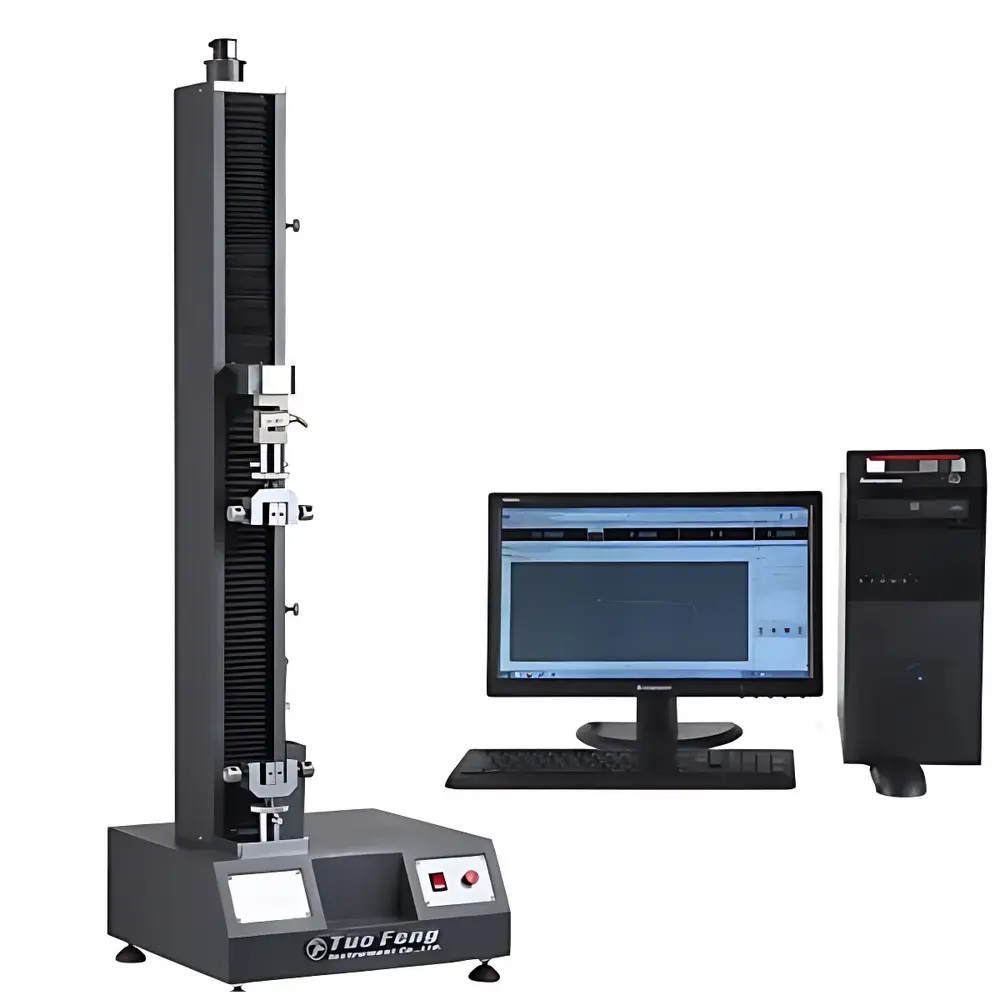
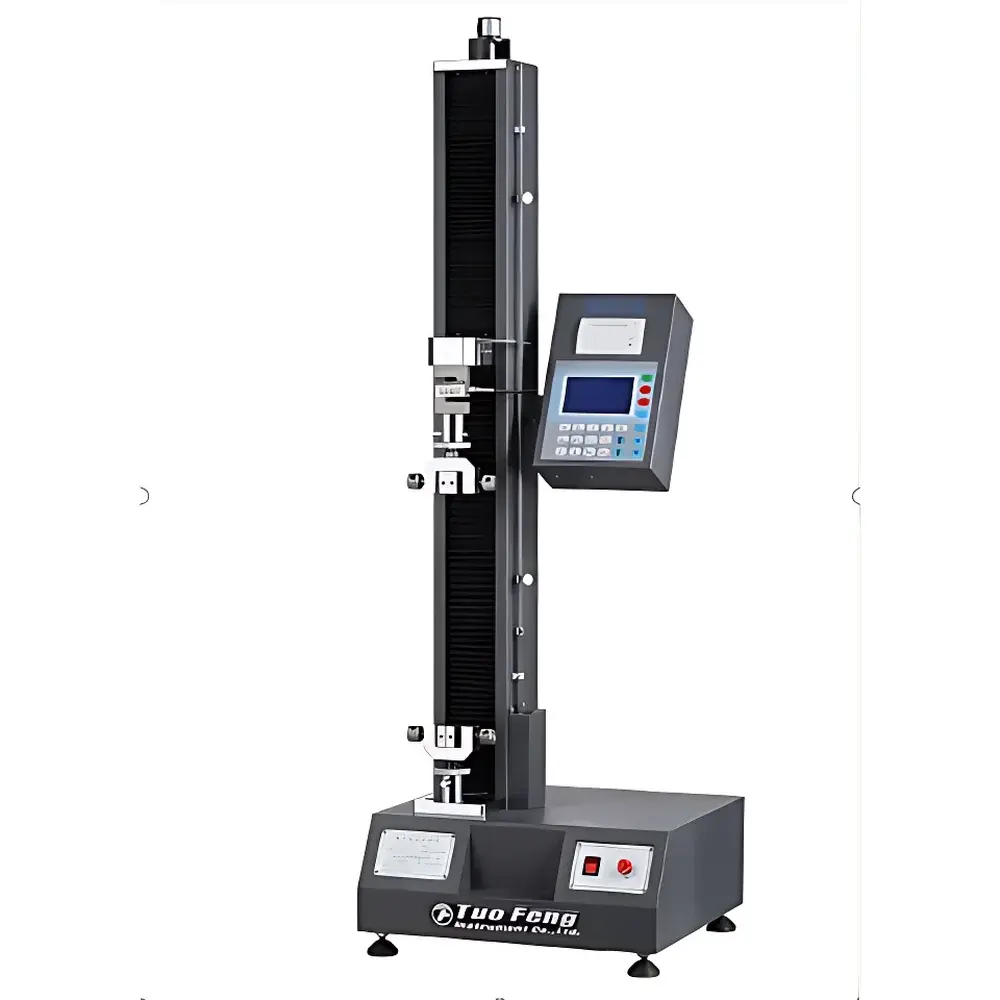
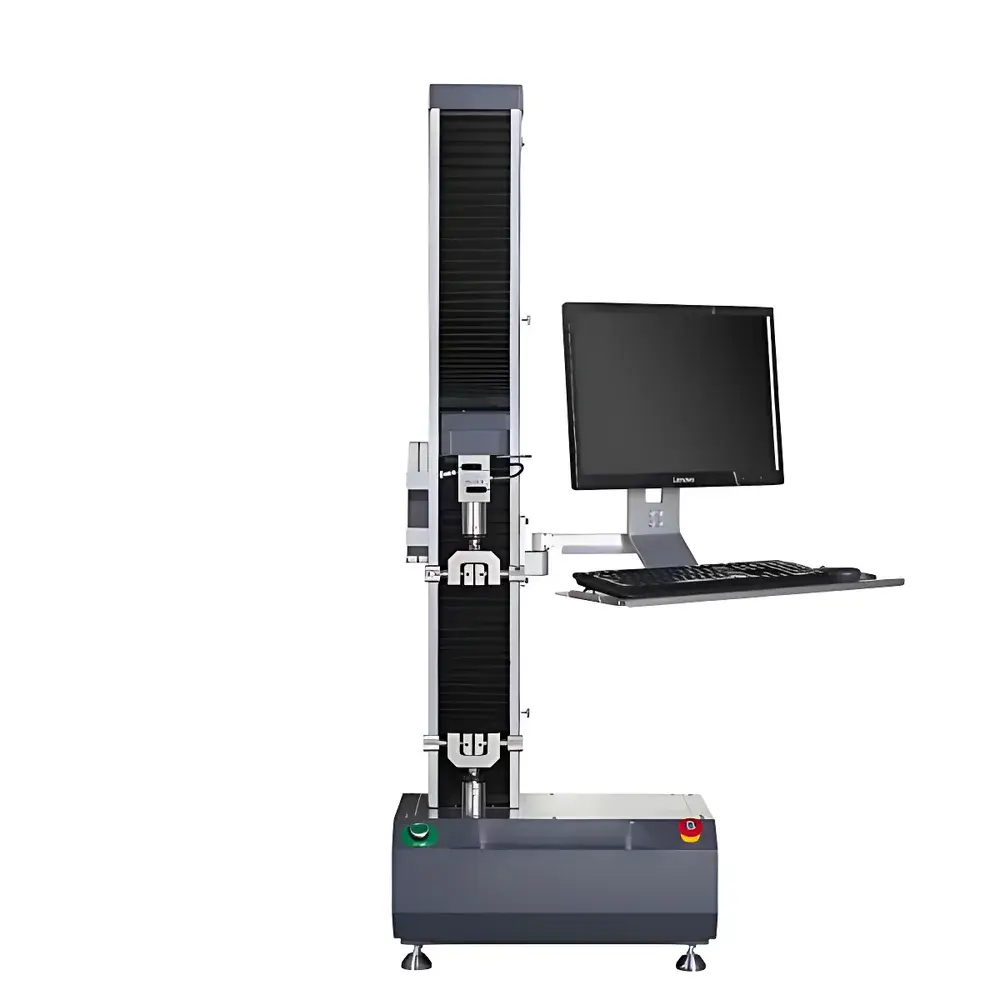
Tuofeng TFL-32S Computer-Controlled Tensile Testing Machine for Leather and Flexible Materials
| Brand | Tuofeng |
|---|---|
| Origin | Shanghai, China |
| Manufacturer | Yes |
| Type | Electromechanical Tensile Tester |
| Model | TFL-32S |
| Max Test Load | 5 kN |
| Force Measurement Range | 0.4–100% FS |
| Force Accuracy | ±0.5% of reading |
| Crosshead Travel | 700 mm |
| Displacement Resolution | ±0.5% of reading |
| Test Speed Range | 0.01–500 mm/min (infinitely variable) |
| Position Sensing | Optical encoder |
| Load Cell Resolution | 1 part in 300,000 full scale (single-range, no auto-ranging) |
| Protection Features | Electronic limit switches, emergency stop, overload cutoff at 110% of max load |
| Compliance Standards | GB/T 228.1, ISO 6892-1, ASTM D638, ASTM D882, ASTM D3330, DIN 53455, JIS Z0237 |
Overview
The Tuofeng TFL-32S is a precision-engineered electromechanical tensile testing machine designed specifically for the mechanical characterization of flexible and heterogeneous materials—including leather, coated textiles, synthetic membranes, paperboard, thin metal foils, polymer films, adhesives, and composite laminates. It operates on the principle of uniaxial force application under controlled displacement or load rate, measuring fundamental mechanical properties such as tensile strength, yield point, elongation at break, modulus of elasticity, tear resistance, peel adhesion, and bond strength. The system conforms to internationally recognized static mechanical testing protocols and is calibrated traceably to national metrological standards. Its rigid dual-column frame, high-resolution load cell, and synchronized optical encoder-based motion control ensure repeatable, low-noise data acquisition across the full 5 kN capacity range—making it suitable for both routine quality control and R&D-grade material evaluation in regulated industrial laboratories.
Key Features
- High-fidelity force measurement with ±0.5% accuracy over 0.4–100% of full scale (5 kN), enabled by a temperature-compensated, sealed strain-gauge load cell with 1:300,000 internal resolution.
- Adjustable crosshead travel of 700 mm (extendable upon request), supporting standardized specimen geometries per ISO 527-2 and ASTM D638 Type I–V.
- Precise displacement tracking via quadrature optical encoder, delivering ±0.5% positional accuracy and enabling reliable strain calculation when paired with extensometer-compatible fixtures.
- Infinitely variable test speed control from 0.01 to 500 mm/min, programmable in closed-loop mode for constant-rate, ramp-hold, or multi-step profiles.
- Dual-mode operation: load-controlled (e.g., for creep or stress-relaxation) and displacement-controlled (e.g., for tensile or peel tests), with real-time switching capability.
- Integrated safety architecture including electronic end-of-travel limits, hardware-triggered emergency stop, and automatic overload shutdown at 110% of rated capacity.
- Motorized crosshead with three-speed preset (fast/medium/slow) and programmable return-to-start functionality—reducing operator intervention and cycle time variability.
Sample Compatibility & Compliance
The TFL-32S accommodates specimens ranging from narrow leather strips (3–25 mm width) to wide film sheets (up to 100 mm), with customizable pneumatic, wedge, or roller-clamp fixtures to prevent slippage and premature failure at grips. It supports standard test configurations including tensile (ASTM D638, ISO 527), peel (ASTM D903, ISO 8510-2), tear (ASTM D1938, ISO 34-1), and puncture (ISO 3377-2). All mechanical and software outputs are fully compatible with GLP/GMP documentation workflows, supporting audit-ready test reports with embedded metadata (operator ID, timestamp, calibration certificate ID, environmental conditions). The instrument meets essential requirements of ISO/IEC 17025 for testing laboratories and supports optional 21 CFR Part 11-compliant electronic signature modules for regulated environments.
Software & Data Management
The Windows-based TensilePro™ v4.2 software provides comprehensive test definition, execution, and post-processing capabilities. It supports multilingual UI (English, Simplified/Traditional Chinese), customizable unit systems (N/kN/lbf, mm/inch, MPa/psi), and dynamic curve visualization—including real-time overlays of load vs. time, load vs. displacement, stress vs. strain, and extension vs. time. Automated calculations include ultimate tensile strength, yield strength (0.2% offset), elongation at break (%), Young’s modulus (secant/tangent), peel adhesion energy (N/mm), and tear propagation resistance (kN/m). Raw data exports to CSV, Excel, and XML formats; graphical reports include annotated peak markers, statistical summaries (mean, SD, CV%), and comparative overlay of up to 12 curves. Data integrity is ensured through encrypted local storage, version-stamped backups, and optional cloud synchronization with role-based access control.
Applications
- Leather goods manufacturing: Quantifying tensile integrity of bovine, ovine, and synthetic leathers across tanning batches and finishing treatments.
- Footwear R&D: Evaluating sole bonding strength, upper fabric elongation, and welt seam durability under simulated wear loads.
- Packaging validation: Measuring seal peel strength of laminated pouches, puncture resistance of corrugated board, and burst pressure of flexible films.
- Automotive interiors: Characterizing trim material elongation, stitching pull-out force, and adhesive shear strength in dashboards and door panels.
- Medical device substrates: Assessing mechanical stability of biodegradable films, hydrogel membranes, and textile-reinforced composites under physiological strain rates.
- Academic materials science: Supporting structure–property correlation studies in elastomers, thermoplastics, and natural fiber composites.
FAQ
What standards does the TFL-32S support out of the box?
It natively implements test method templates for ASTM D638, D882, D3330, D903, ISO 6892-1, ISO 527-2, ISO 8510-2, GB/T 228.1, and JIS Z0237—with user-definable parameters for custom protocols.
Can the system be upgraded to meet FDA 21 CFR Part 11 requirements?
Yes—optional audit trail logging, electronic signatures, and user access tiering are available via validated firmware and software add-ons compliant with Part 11 Annex 11 guidelines.
Is extensometer integration supported?
Yes—the machine features dedicated analog and digital I/O ports for third-party clip-on or non-contact extensometers, enabling high-accuracy strain measurement below 1% deformation.
What maintenance is required to sustain measurement accuracy?
Annual recalibration against NIST-traceable deadweight standards is recommended; load cell and encoder diagnostics are accessible via built-in self-test routines and logged in the system event history.
How is data integrity preserved during long-duration tests (e.g., creep)?
Continuous sampling at ≥100 Hz ensures no data loss; all raw values are timestamped with microsecond resolution and stored redundantly in volatile and non-volatile memory buffers.



