
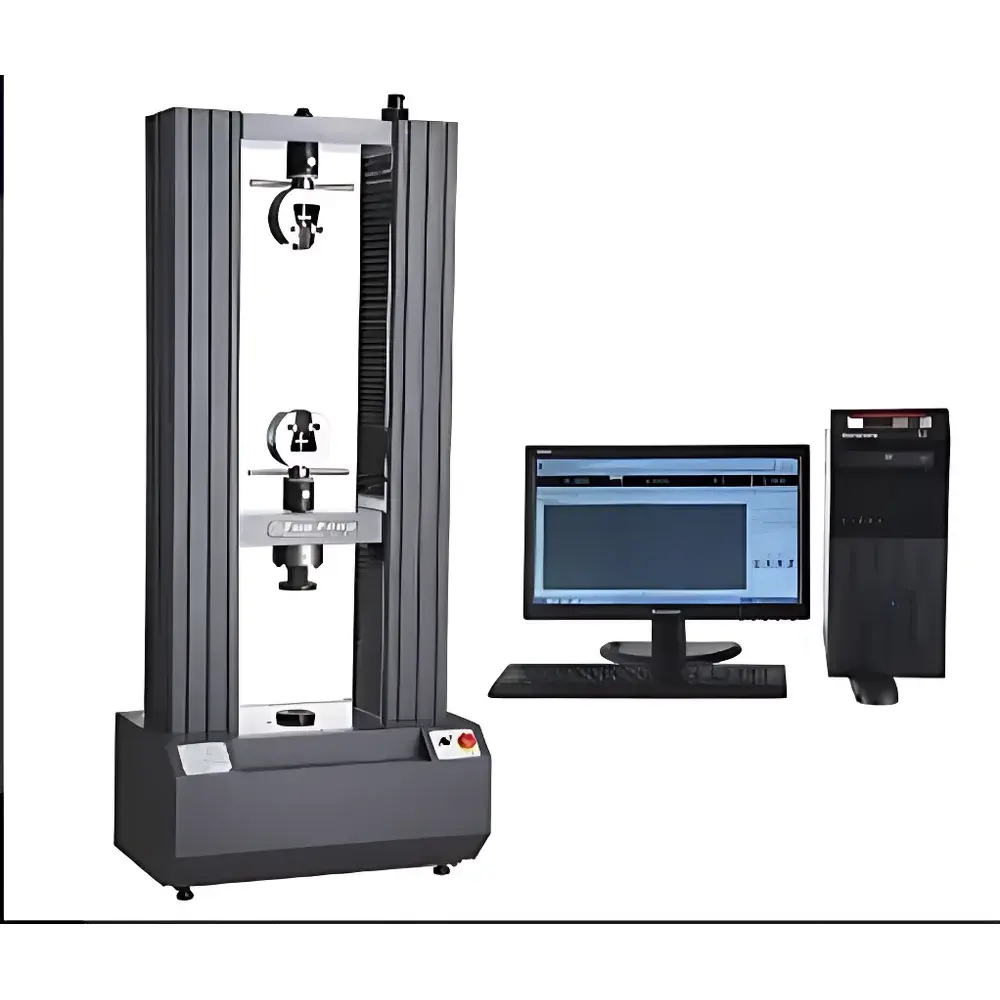
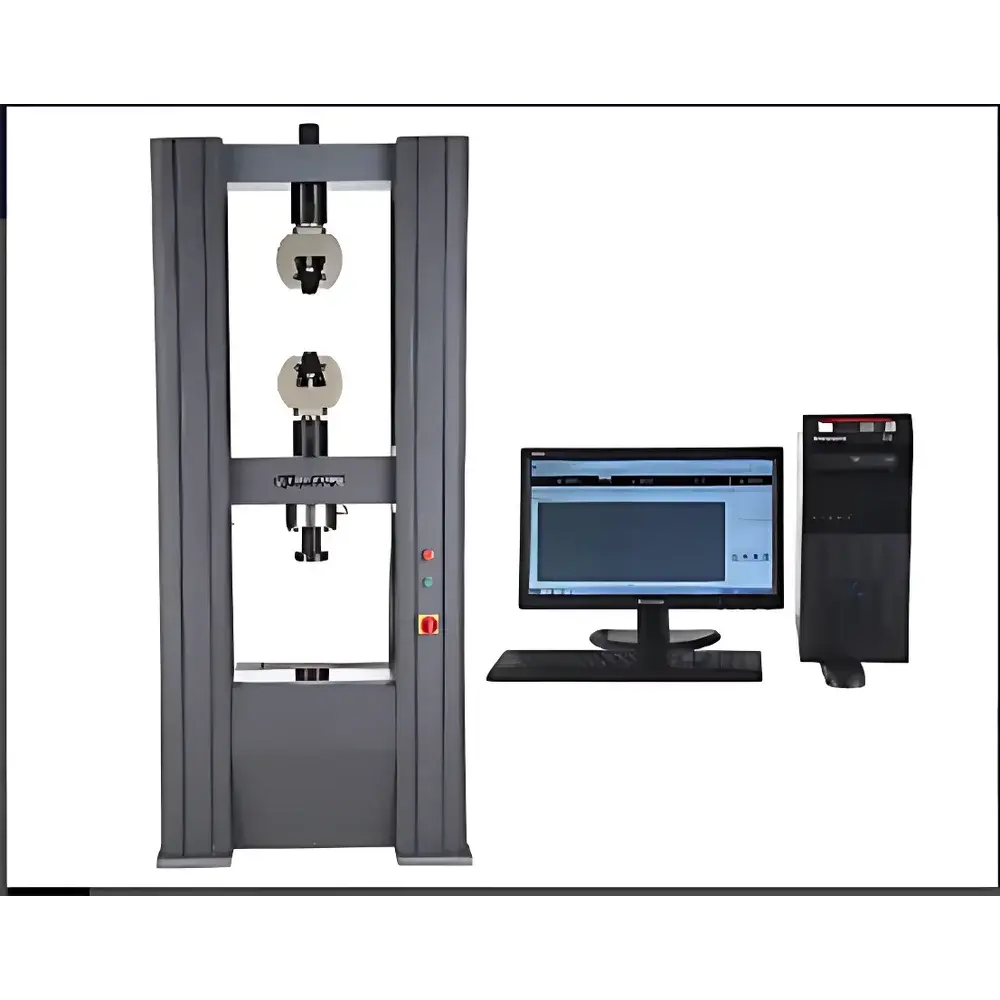
Tuofeng TFW-64 Microcomputer-Controlled Electromechanical Universal Testing Machine for Composite Materials
| Brand | Tuofeng |
|---|---|
| Origin | Shanghai, China |
| Manufacturer Type | Direct Manufacturer |
| Instrument Type | Electromechanical Universal Testing Machine |
| Model | TFW-64 |
| Max Test Load | 100 kN |
| Force Range | 1 kg to 100 kN (0.2%–100% FS) |
| Force Accuracy | ±0.5% of reading |
| Crosshead Travel | 1000 mm |
| Displacement Resolution | 0.001 mm |
| Speed Range | 0.001–500 mm/min (infinitely variable) |
| Effective Test Width | 400 mm (customizable up to 600 mm) |
| Load Frame Precision Class | ISO 7500-1 / ASTM E4 Class 0.5 |
| Displacement Measurement Accuracy | ±0.005% of reading |
| Force Resolution | 1 part in 500,000 full-scale codes, single-range, constant resolution across entire range |
Overview
The Tuofeng TFW-64 is a high-precision, microcomputer-controlled electromechanical universal testing machine engineered for static mechanical characterization of composite materials, metals, polymers, elastomers, and advanced engineering components. It operates on the principle of controlled displacement actuation via a servo-motor-driven precision ball screw system, enabling accurate application and measurement of axial tensile, compressive, flexural, shear, tear, peel, and puncture loads. Designed in strict compliance with ISO 7500-1, ASTM E4, and GB/T 16491–2008 standards, the TFW-64 delivers traceable force metrology and repeatable kinematic control essential for R&D validation, quality assurance, and regulatory submissions. Its robust dual-column load frame—constructed from high-rigidity cast iron and reinforced steel—minimizes deflection under peak 100 kN loading, ensuring minimal compliance error during high-stiffness material testing (e.g., carbon-fiber-reinforced polymer laminates or metal matrix composites). The system integrates real-time closed-loop control of load, displacement, and strain, supporting both open-loop rate control and closed-loop feedback modes per ISO 6892-1 and ASTM D3039 protocols.
Key Features
- High-resolution force measurement system with ±0.5% accuracy over 0.2–100% full scale, certified to ISO 7500-1 Class 0.5
- Precision ground ball screw transmission paired with imported servo motor and worm-gear reduction gearbox for smooth, low-noise, backlash-free motion
- Constant-resolution displacement encoder (0.001 mm) and dual-mode extensometry support (clip-on electronic extensometer or video-based large-strain system)
- Dual-speed crosshead control: rapid positioning (up to 500 mm/min) and fine-tuning (<0.01 mm/min) for optimal specimen alignment and fracture capture
- Comprehensive safety architecture: programmable electronic limit switches, emergency stop circuitry, overload protection (auto-shutdown at >110% FS), and mechanical overload buffers
- Modular fixture interface compatible with standardized wedge-action grips, compression platens, bend fixtures, peel jigs, and custom-designed tooling per ASTM D1876, D638, D790, and ISO 527
Sample Compatibility & Compliance
The TFW-64 accommodates specimens ranging from thin films (≥0.05 mm thickness) to structural composite panels (up to 600 mm wide × 1000 mm gauge length). It supports standardized test geometries per ISO 527-2 (plastics), ASTM D3039 (polymer matrix composites), ASTM D6641 (compression after impact), and EN 2561 (aerospace carbon fiber laminates). All mechanical and software functions comply with GLP/GMP documentation requirements, including audit-trail-enabled test logging, user-access controls, and electronic signature readiness per FDA 21 CFR Part 11. Calibration certificates are traceable to NIM (China National Institute of Metrology) and optionally to NIST or PTB upon request. Full conformity with JJG 475–2008 verification procedures ensures metrological validity for Chinese national laboratory accreditation (CNAS) and third-party inspection bodies.
Software & Data Management
The embedded Windows-based testing software provides ISO/ASTM-compliant test method templates (e.g., tensile, compression, flexure, peel) with configurable control modes: load-controlled, displacement-controlled, strain-controlled, hold-at-load, hold-at-displacement, and ramp-hold sequences. Real-time plotting includes synchronized force–time, stress–strain, displacement–time, and force–extension curves, with overlay capability for inter-lot or inter-material comparison. All raw data—including time-stamped force, displacement, and extensometer signals—is stored in ASCII CSV and proprietary binary formats, supporting post-test reanalysis and export to MATLAB, Excel, or LIMS platforms. The software enforces data integrity through automatic timestamping, operator ID logging, version-controlled method files, and encrypted database backups. Optional modules include fatigue waveform generation (sinusoidal, triangular, block loading), creep/stress-relaxation analysis per ISO 899, and automated report generation compliant with ISO 17025 technical records.
Applications
The TFW-64 serves as a core mechanical characterization platform across multiple regulated and industrial domains: aerospace (matrix-dominated failure analysis of CFRP skins and honeycomb cores), automotive (crash-relevant energy absorption of thermoplastic composites), biomedical (tensile strength and suture retention testing of resorbable polymer scaffolds), construction (bond strength evaluation of FRP-to-concrete interfaces), and renewable energy (fatigue life assessment of wind turbine blade spar cap laminates). Its adaptability to multi-axis accessory integration—including environmental chambers (−70°C to +300°C), digital image correlation (DIC) systems, and acoustic emission sensors—enables coupled thermo-mechanical and damage-mechanics investigations. Universities and national labs utilize it for fundamental studies on rate-dependent viscoelasticity, interfacial debonding kinetics, and progressive failure modeling in heterogeneous materials.
FAQ
Does the TFW-64 support ASTM D3039 and ISO 527-4 testing standards for composite tensile properties?
Yes—preconfigured test methods, calibration routines, and reporting templates fully align with these standards, including modulus calculation via secant and tangent methods, Poisson’s ratio determination, and failure mode classification.
Can the system be integrated with external devices such as environmental chambers or DIC systems?
Yes—the controller features analog I/O ports and Ethernet-based API access for synchronized triggering, data streaming, and hardware handshake with third-party instrumentation.
Is the software compliant with FDA 21 CFR Part 11 for regulated pharmaceutical or medical device testing?
Yes—audit trail, electronic signatures, role-based access control, and immutable data archiving are enabled by default and validated upon installation.
What is the warranty coverage and service response time for international customers?
Tuofeng provides a 24-month parts-and-labor warranty; global technical support is available via remote diagnostics, and field service engineers are deployed within 5 business days for critical issues in EMEA and APAC regions.
Are calibration certificates provided with NIST or PTB traceability?
Standard delivery includes NIM-traceable certificates; optional NIST/PTB-certified calibration kits and on-site verification services are available upon order specification.



