
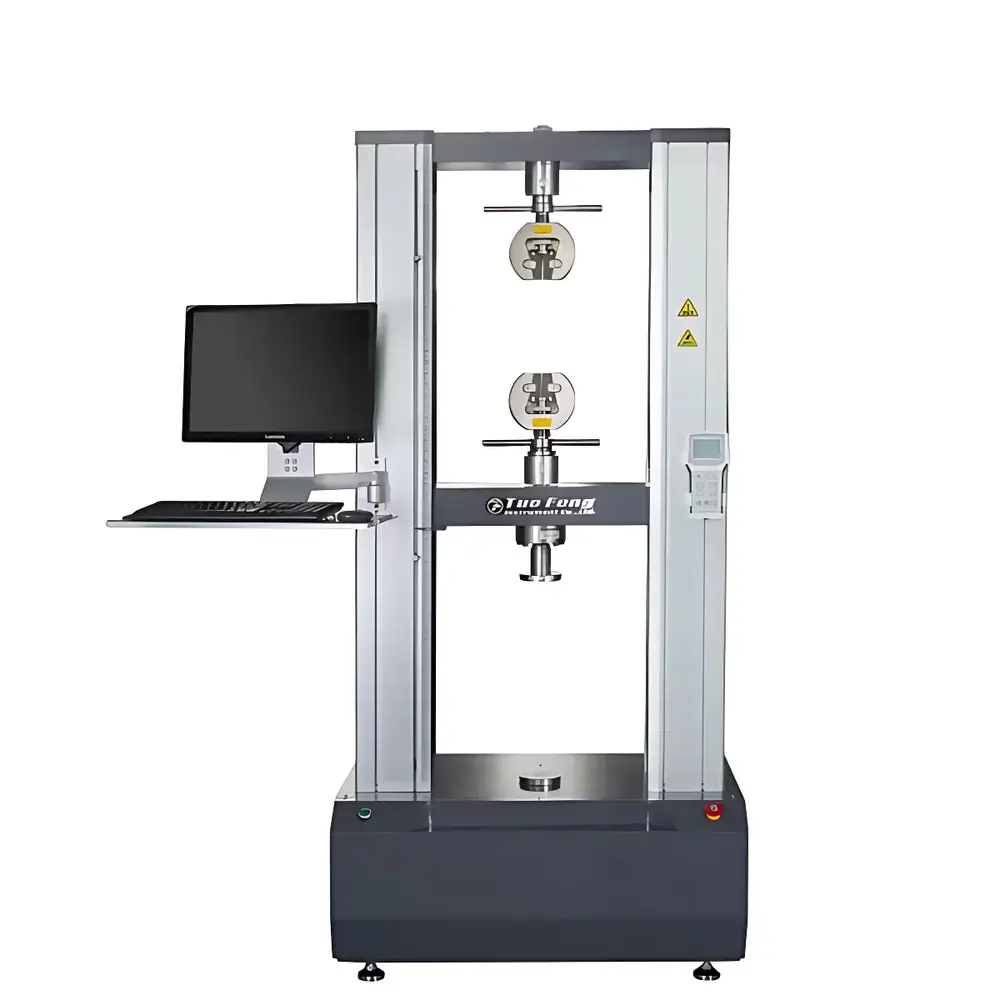
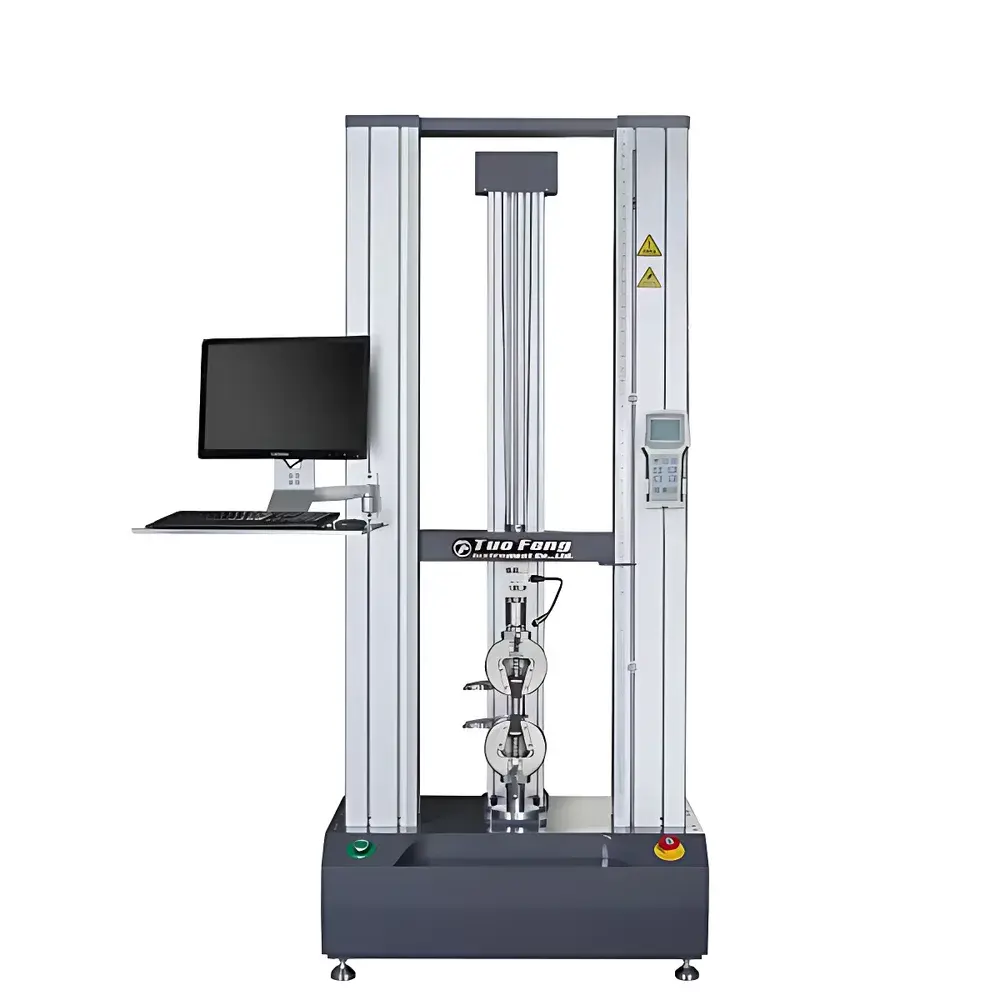
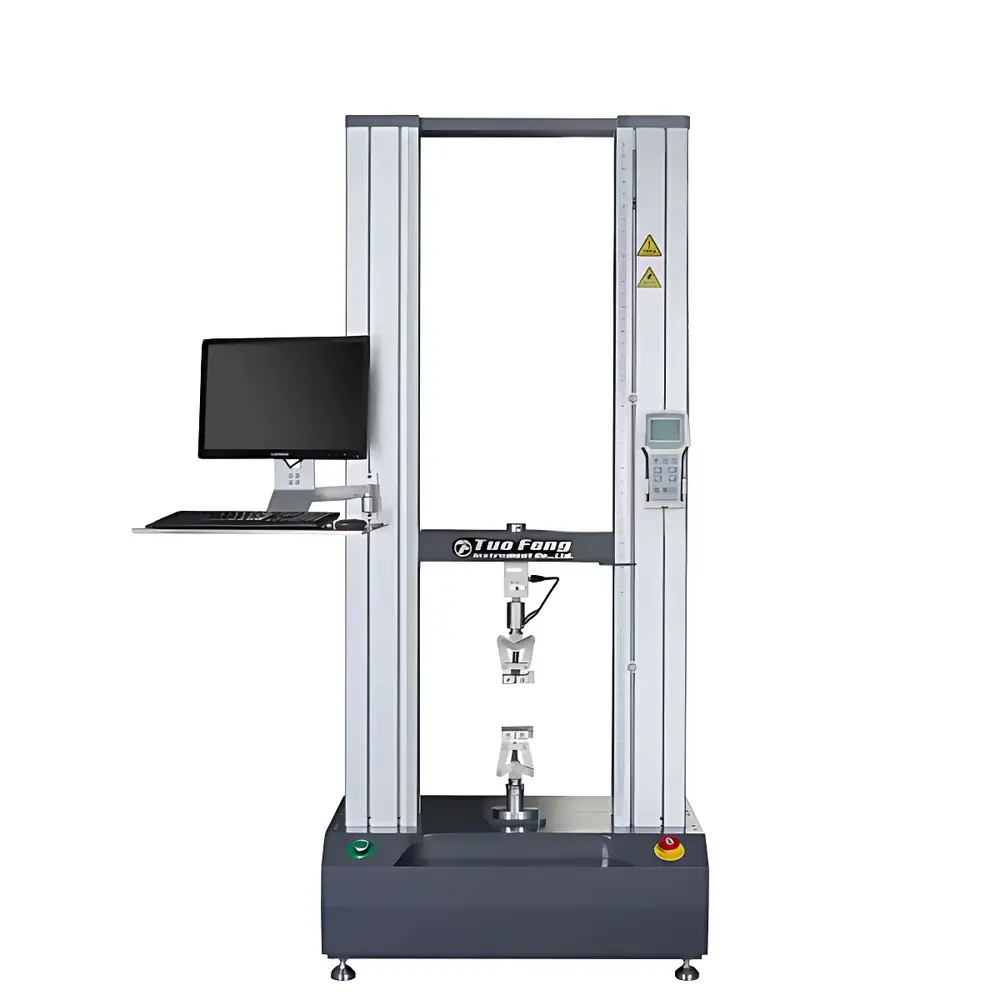
Tuofeng TFW-161 Microcomputer-Controlled Electronic Universal Testing Machine
| Brand | Tuofeng |
|---|---|
| Origin | Shanghai, China |
| Manufacturer Type | Direct Manufacturer |
| Instrument Type | Electronic Universal Testing Machine |
| Model | TFW-161 |
| Max Test Load | 160 kN (derived from TFW-161 nomenclature and series context: TFW-100S = 100 kN, TFW-200S = 200 kN) |
| Accuracy Class | 0.5 |
| Effective Force Range | 0.2–100% of full scale |
| Force Measurement Accuracy | ±0.005% of reading |
| Force Resolution | 1 part in ±500,000 full-scale codes, auto-ranging-free, constant resolution across entire range |
| Drive System | Imported servo motor with precision worm-gear reducer |
| Lead Screw | High-precision preloaded ball screw |
| Effective Test Width | 600 mm (customizable) |
| Stroke | 800 mm (extendable) |
| Speed Range | 0.001–500 mm/min, infinitely variable |
| Displacement Measurement | Optical encoder |
| Displacement Accuracy | ±0.005% of reading |
| Strain Measurement | Optional clip-on extensometer or large-deformation extensometer |
| Strain Accuracy | ±0.005% of reading |
| Safety Protection | Dual electronic limit switches, emergency stop button, overload protection (>110% FS), mechanical hard stops |
| Crosshead Control | Dual-speed (fast/slow) motorized vertical adjustment with jog function |
| Return Function | Programmable automatic return to initial position at maximum speed post-test |
| Overload Protection | Automatic shutdown at >110% of rated load |
| Fixture Customization | Application-specific grips and fixtures available per ASTM/ISO/GB standards |
| Dimensions (W×D×H) | 1000 × 700 × 2000 mm |
| Power Supply | 220 V AC, 1.5 kW |
| Net Weight | ~450 kg |
| Compliance | GB/T 16491–2008, JJG 475–2008, ASTM E4, ASTM E8, ASTM D638, ASTM D790, ISO 6892-1, ISO 178, ISO 527, DIN 53455, JIS Z2241 |
Overview
The Tuofeng TFW-161 Microcomputer-Controlled Electronic Universal Testing Machine is a high-precision electromechanical system engineered for static mechanical property characterization of metallic, polymeric, ceramic, composite, and elastomeric materials. Based on closed-loop servo-controlled force and displacement actuation, the instrument implements fundamental uniaxial testing principles defined in ISO 6892-1 (tensile), ISO 178 (flexural), and ASTM E8/E4 (metallic mechanical testing). Its rigid C-frame architecture, coupled with preloaded high-accuracy ball screws and low-backlash gear reduction, ensures minimal compliance and high reproducibility—critical for generating data compliant with GLP, GMP, and regulatory submission requirements. Designed for laboratory and industrial QA/QC environments, the TFW-161 delivers traceable, repeatable measurements under controlled environmental conditions and supports full auditability of test parameters, raw data, and operator actions.
Key Features
- 0.5-class accuracy certified per GB/T 16491–2008 and verified against JJG 475–2008 metrological verification procedures
- Constant-resolution force transduction: 1 part in ±500,000 full-scale codes, eliminating range-switching artifacts and enabling seamless transition from sub-newton preload to 160 kN rupture
- Wide dynamic speed range: 0.001–500 mm/min, programmable in 0.001 mm/min increments for creep, relaxation, and quasi-static protocols
- Dual-mode crosshead control: fast positioning (up to 200 mm/min) for setup and slow, precise testing motion (0.001 mm/min) for high-fidelity strain control
- Integrated safety architecture: redundant electronic limit switches, hardware-based emergency stop circuitry, real-time overload cutoff (>110% FS), and mechanical end-stop buffers
- Modular fixture interface supporting standardized wedge, pin, compression platens, bend fixtures, peel grips, and custom tooling per ASTM D638, D790, D1876, and ISO 11339
Sample Compatibility & Compliance
The TFW-161 accommodates specimens ranging from thin films (≥0.05 mm thick) to structural metal coupons (up to 40 mm thickness), rods, tubes, and molded composites. With a 600 mm effective test width and 800 mm vertical stroke, it supports standard and non-standard geometries—including dog-bone tensile bars, I-beam flexure samples, and layered laminates. All mechanical and software functions comply with ISO/IEC 17025 calibration traceability requirements. Test execution adheres to international material standards including ASTM E4 (load verification), ASTM E8/E21 (tensile/yield properties), ISO 6892-1 (metal tensile), ISO 527 (plastics tensile), ISO 178 (flexural), and GB/T 228.1 (Chinese national tensile standard). The system meets essential requirements for FDA 21 CFR Part 11 readiness when configured with electronic signature and audit-trail modules.
Software & Data Management
The Windows-based Tuofeng TestSuite v5.2 provides ISO 17025-aligned test configuration, execution, and reporting. It supports multi-mode control: force-controlled ramp, displacement-controlled rate, strain-controlled feedback (with extensometer input), and hold-step sequences (e.g., load holding, stress relaxation). Real-time plotting includes synchronized force–time, force–displacement, stress–strain, and displacement–time overlays. Units are fully configurable (N/kN/lbf, mm/in, MPa/psi), and language support includes English, Simplified Chinese, Traditional Chinese, and German. Raw ASCII data export (CSV/TXT), PDF report generation with embedded metadata (operator ID, timestamp, calibration certificate ID), and automated folder-based archiving ensure long-term data integrity. The software architecture permits third-party API integration for LIMS connectivity and includes built-in validation documentation templates for IQ/OQ/PQ protocols.
Applications
The TFW-161 serves as a primary mechanical characterization platform across R&D, production QA, and regulatory testing workflows. In aerospace, it validates tensile strength and elongation of Ti-6Al-4V sheet and carbon fiber prepreg laminates per AMS 2750 and NADCAP requirements. In automotive, it performs peel strength testing of adhesive bonds (ASTM D1876), compressive yield of polymer foams (ISO 844), and tensile modulus of injection-molded PP/EPDM blends. For medical device manufacturers, it verifies tensile properties of silicone tubing (ISO 5840-3) and suture breaking strength (ISO 10555-1). In construction materials, it determines flexural strength of reinforced concrete beams (ASTM C78) and compressive performance of AAC blocks (EN 772-1). Academic users apply it to fundamental viscoelastic modeling, fracture mechanics parameter extraction (KIc, J-integral), and interfacial adhesion studies in multilayer systems.
FAQ
What international standards does the TFW-161 support out-of-the-box?
The system is preconfigured with test methods aligned to ASTM E8, ASTM D638, ISO 6892-1, ISO 527, ISO 178, GB/T 228.1, and JJG 475–2008. Custom method templates can be created for proprietary or emerging standards.
Is the force sensor calibrated and traceable to national standards?
Yes—each load cell is supplied with a UKAS-accredited calibration certificate traceable to NIM (China National Institute of Metrology) or NIST (upon request), with recalibration intervals recommended every 12 months or after 10,000 cycles.
Can the system perform closed-loop strain control using an external extensometer?
Yes—the controller accepts analog inputs from ASTM E83-compliant clip-on or video extensometers, enabling true strain-controlled testing with feedback update rates up to 1 kHz.
Does the software meet FDA 21 CFR Part 11 requirements for electronic records?
Out-of-the-box functionality supports ALCOA+ principles; full Part 11 compliance requires optional audit trail, electronic signature, and role-based access modules—available as validated add-ons.
What is the warranty coverage and service response time?
Standard warranty is 24 months parts-and-labor; extended service plans include on-site preventive maintenance, remote diagnostics, and priority 48-hour technician dispatch within major industrial zones in APAC, EMEA, and North America.



