
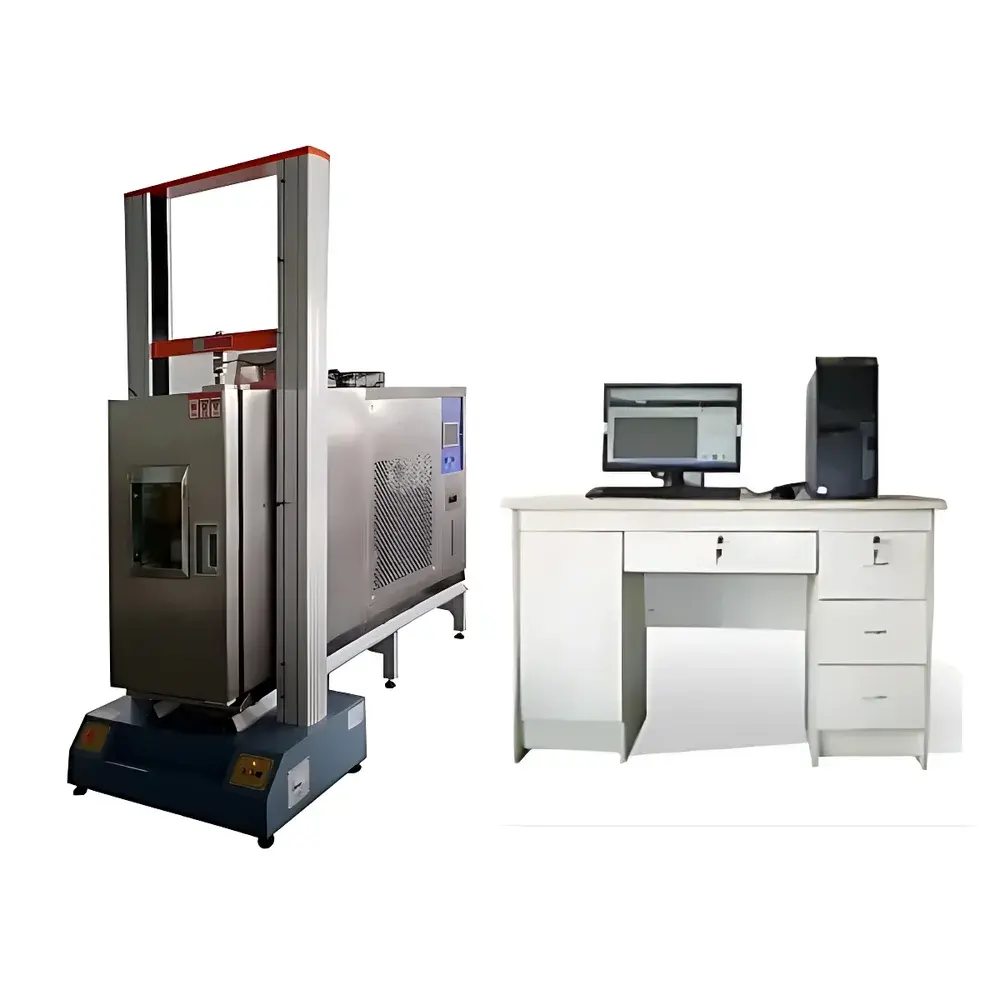
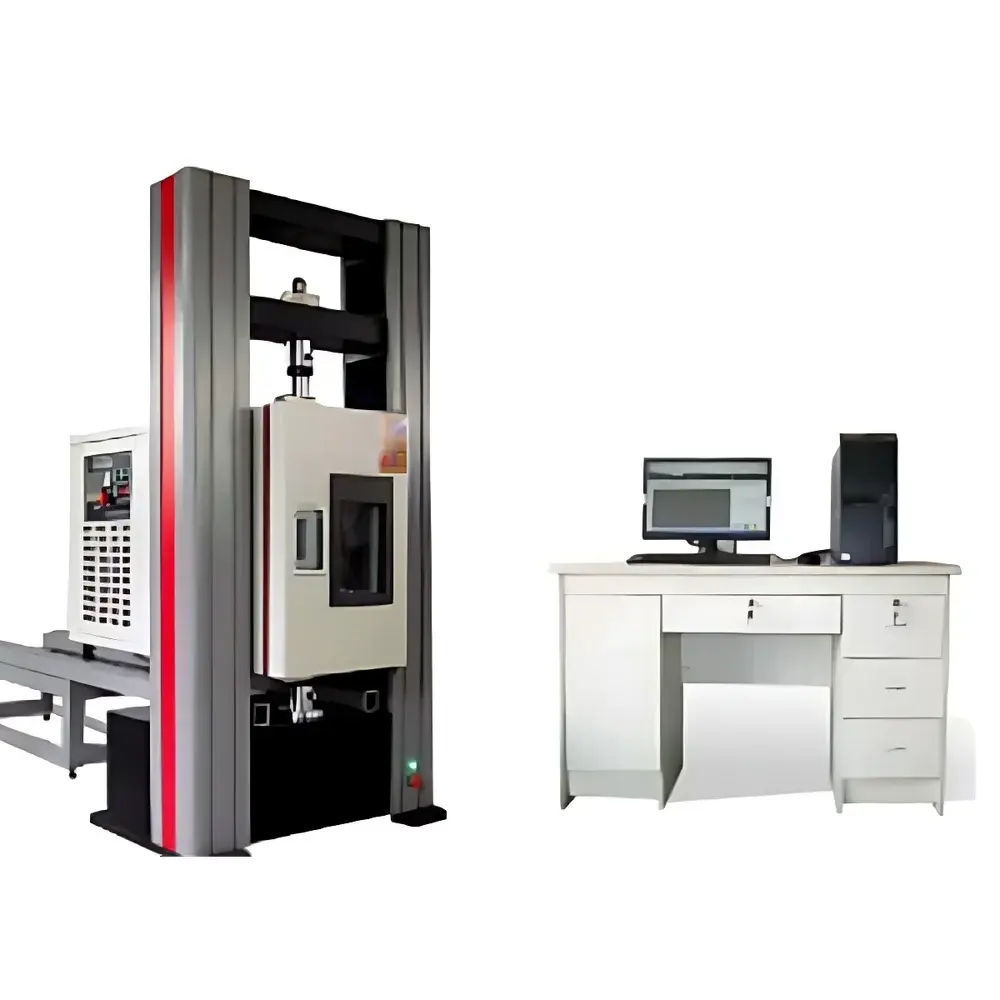
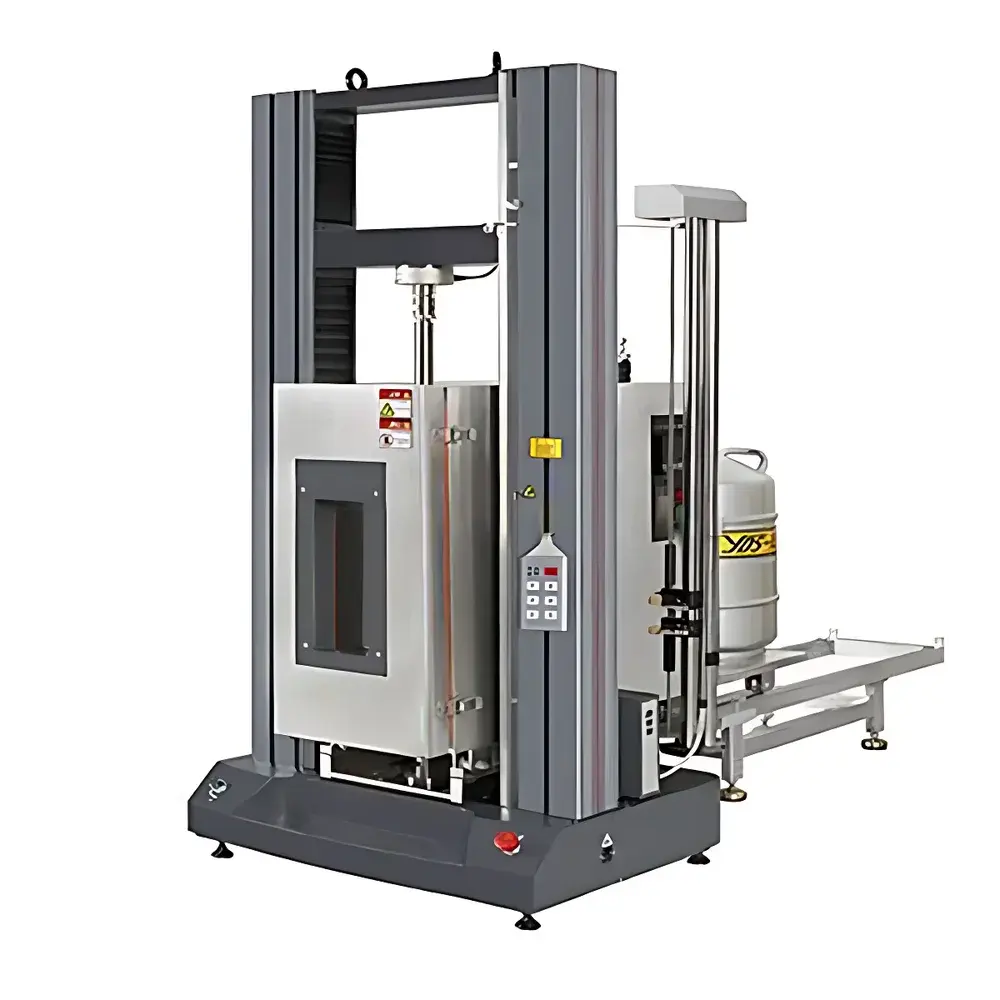
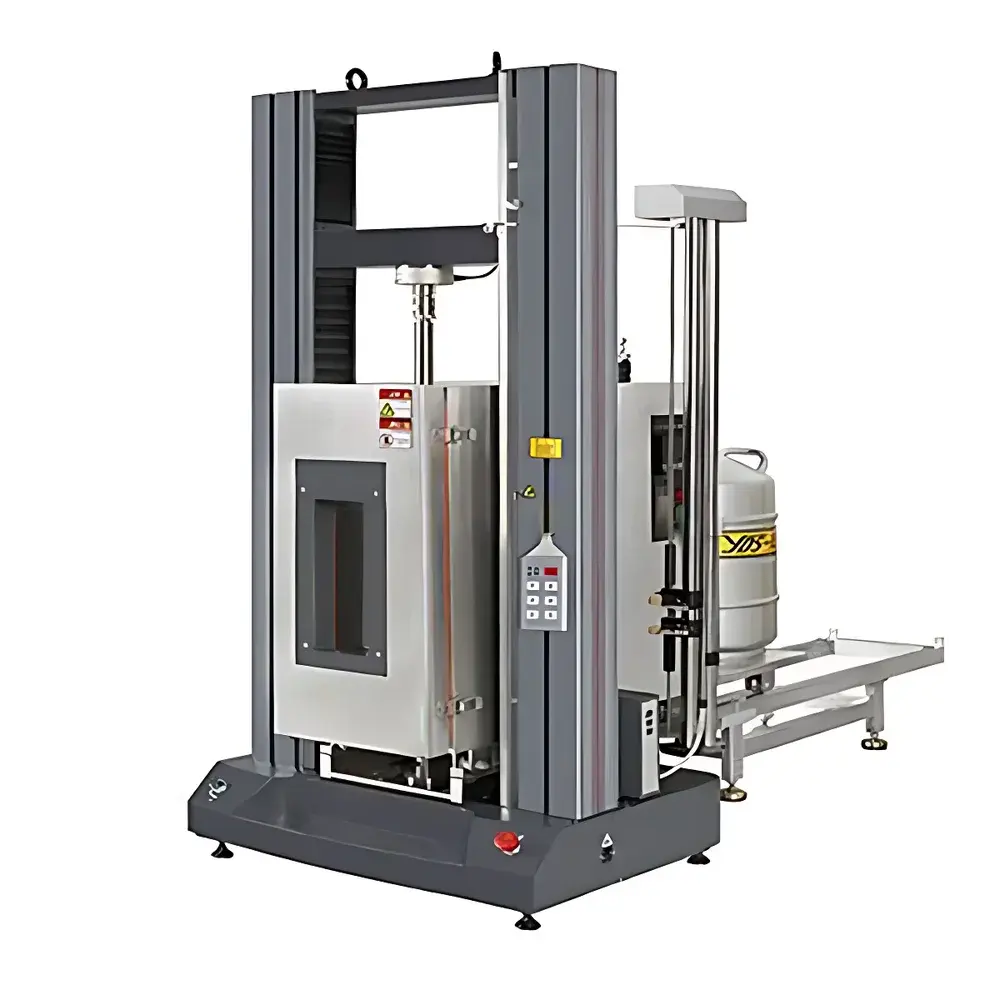
Tuofeng TFW-281 Low-Temperature Tensile Testing Machine
| Brand | Tuofeng |
|---|---|
| Origin | Shanghai, China |
| Manufacturer Type | Direct Manufacturer |
| Product Origin | Domestic (China) |
| Model | TFW-281 |
| Price Range | USD 1,400 – 28,500 |
| Instrument Type | Electromechanical Universal Testing Machine |
| Max Test Load | 5–300 kN |
| Accuracy Class | 0.5 |
| Force Measurement Range | 0.4–100% FS |
| Force Indication Error | ±0.5% of reading |
| Force Resolution | 1/500,000 of full scale, constant across entire range |
| Deformation Measurement Range | 0.2–100% FS |
| Deformation Error | ±0.5% of reading |
| Deformation Resolution | up to 1/300,000 |
| Displacement Error | ±0.5% of reading |
| Column Spacing | 840 mm |
| Crosshead Travel | 1000 mm (subject to environmental chamber dimensions) |
| Dimensions (W×D×H) | 1250 × 560 × 2400 mm |
| Power Supply | AC 220 V / 50 Hz ±10%, 750 W |
| Weight | ~380 kg |
| Environmental Chamber Temp Range | −40 °C to +100 °C |
| Chamber Heating Power | 1500 W |
| Chamber Internal Dimensions | 360 × 300 × 500 mm (W×D×H) |
| Temperature Uniformity | ±2 °C over 100 mm vertical zone |
| Temperature Stabilization Time | ≤5 min (both below and above 0 °C) |
| Chamber Control | Programmable PID controller with Pt100 sensors |
| Safety Features | Leakage current protection, overcurrent circuit breaker |
Overview
The Tuofeng TFW-281 Low-Temperature Tensile Testing Machine is an electromechanical universal testing system engineered for high-fidelity mechanical property characterization of metallic and non-metallic materials under controlled thermal conditions. Integrated with a programmable environmental chamber, the system enables standardized tensile, compression, bending, tear, peel, and shear testing at temperatures ranging from −40 °C to +100 °C—while maintaining full compliance with ISO 6892-1, ASTM E8/E21, GB/T 228.1, JIS Z 2241, and DIN 50125. The machine employs a precision ball-screw-driven crosshead actuation system coupled with high-stiffness dual-column load frame architecture, ensuring minimal deflection and excellent axial alignment during low-temperature loading. Force transduction is achieved via a hermetically sealed, temperature-compensated load cell calibrated to Class 0.5 accuracy per ISO 376, enabling traceable measurement across 0.4–100% of full scale with resolution down to 1/500,000 FS. Strain acquisition utilizes extensometry-compatible deformation measurement with resolution up to 1/300,000 FS and error bounded within ±0.5% of reading—critical for evaluating brittle fracture behavior and yield onset in cryogenic polymers or aerospace alloys.
Key Features
- Integrated −40 °C to +100 °C programmable environmental chamber with rapid thermal response (≤30 min to +100 °C), uniformity ±2 °C over 100 mm vertical zone, and dual-point Pt100 sensing
- Electromechanical drive system with zero-backlash ball screw, servo motor control, and real-time position feedback for precise displacement control (±0.5% error)
- Modular load cell options spanning 5 kN to 300 kN, all certified to ISO 376 Class 0.5 with temperature compensation algorithms embedded in firmware
- Full-range force and deformation resolution maintained without range switching—eliminating step discontinuities during dynamic or creep testing
- Stainless steel (304 outer, 316 inner) chamber construction with multi-layer ceramic fiber insulation for thermal stability and condensation resistance
- Front-access test zone with 50 mm diameter top/bottom apertures, slide-in thermal barrier blocks, and ergonomic right-hinged door with silicone gasket sealing
- Comprehensive safety suite including earth leakage protection, thermal cutoffs, overcurrent breakers, and emergency stop interlocks compliant with IEC 61000-6-2/6-4
Sample Compatibility & Compliance
The TFW-281 accommodates standard tensile specimens per ASTM E8 (flat/round), ISO 6892-1 (Type 1A/2A), GB/T 228.1 (P1/P2), and JIS Z 2241 (No. 5/13), as well as custom geometries up to 840 mm wide and 1000 mm active gauge length. Its environmental chamber supports both immersed and through-chamber gripping configurations, with optional cryogenic grips featuring low-conductivity composite jaws and integrated thermal isolation. All test protocols are fully auditable and support GLP/GMP workflows: software enforces user authentication, electronic signatures, audit trails for parameter changes, and raw data immutability per FDA 21 CFR Part 11 requirements. Calibration certificates are NIST-traceable and include uncertainty budgets aligned with ISO/IEC 17025.
Software & Data Management
The Windows-based test control and analysis platform provides real-time synchronization of force, displacement, deformation, and chamber temperature data at ≥1 kHz sampling rate. Automated test sequences execute pre-defined ramp-hold cycles, stress-relaxation profiles, or cyclic loading per ISO 6892-2 Annex A. Post-test processing includes automatic calculation of Rp0.2, Rm, A%, Z%, E-modulus, and n-value; curve smoothing via Savitzky-Golay filtering; and export of ASCII, CSV, XML, or PDF reports with embedded metadata (operator ID, calibration date, chamber log). Custom scripting (VB.NET API) enables integration with LIMS or MES systems. Raw binary data files (.tdf) retain full sensor resolution and timestamp fidelity for retrospective reanalysis.
Applications
This system serves critical roles in materials qualification for aerospace (Ti-6Al-4V, Inconel 718 at sub-zero service temperatures), cryogenic storage vessels (304L stainless ductility at −196 °C), polymer packaging integrity (PE/PP seal strength at −20 °C), battery electrode adhesion (NMC cathode delamination under thermal cycling), and biomedical implant validation (PEEK spinal cages per ISO 5833). It is routinely deployed in QC labs of automotive suppliers (e.g., brake hose elastomers), national metrology institutes (NMIs), and university research centers studying phase-transition effects on mechanical hysteresis.
FAQ
Does the system support simultaneous force, displacement, and temperature logging during ramp-hold tests?
Yes—synchronized acquisition at configurable rates up to 1 kHz ensures temporal correlation between mechanical response and thermal state.
Can the environmental chamber be used independently of mechanical testing?
Yes—the chamber operates as a standalone programmable thermal unit with full PID control, data logging, and alarm outputs.
What documentation is provided for regulatory audits?
Includes IQ/OQ protocols, calibration certificates with uncertainty statements, software validation summary, and 21 CFR Part 11 compliance report.
Is extensometer compatibility available for low-temperature strain measurement?
Yes—supports clip-on, video, and laser extensometers rated for operation down to −40 °C, with dedicated mounting interfaces and thermal drift compensation.
How is thermal gradient management handled across the specimen gauge length?
The chamber’s dual-zone heating/cooling, forced convection design, and 100 mm uniformity specification ensure ΔT < 1.5 °C across typical gauge lengths (50–200 mm).



