
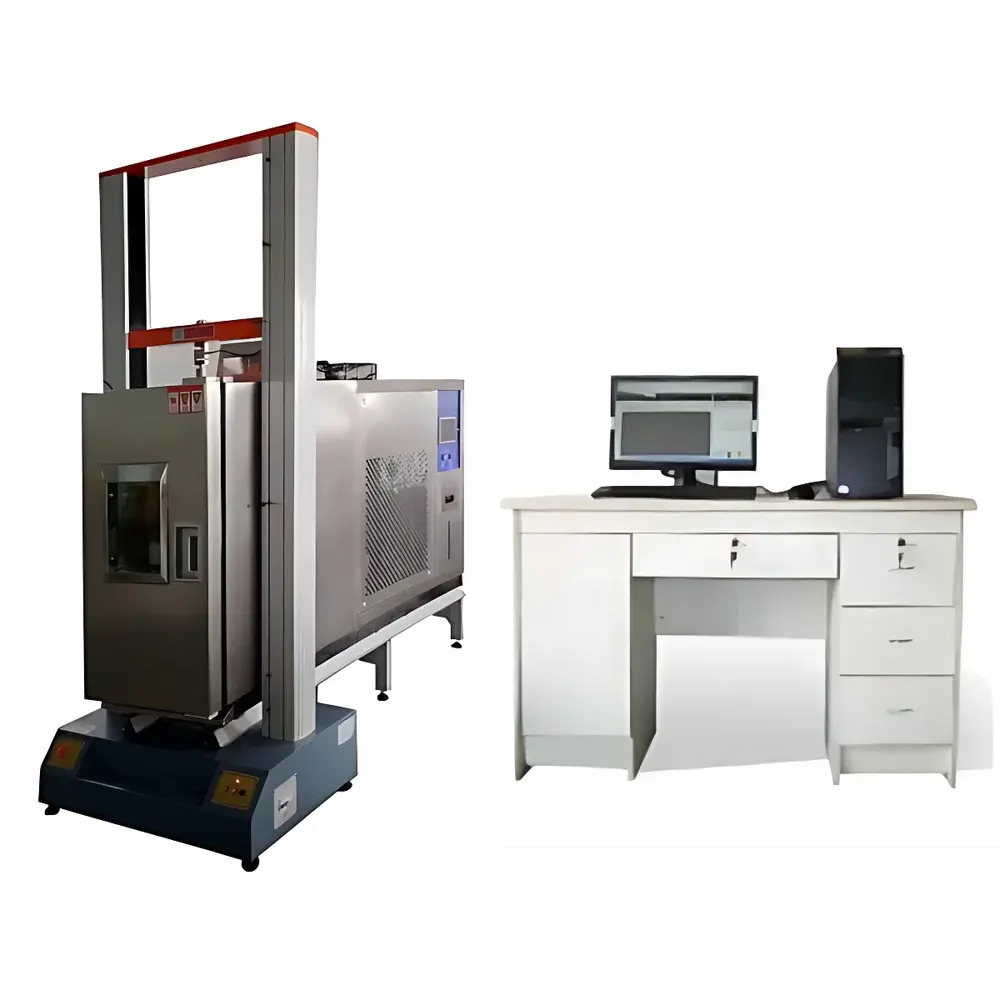
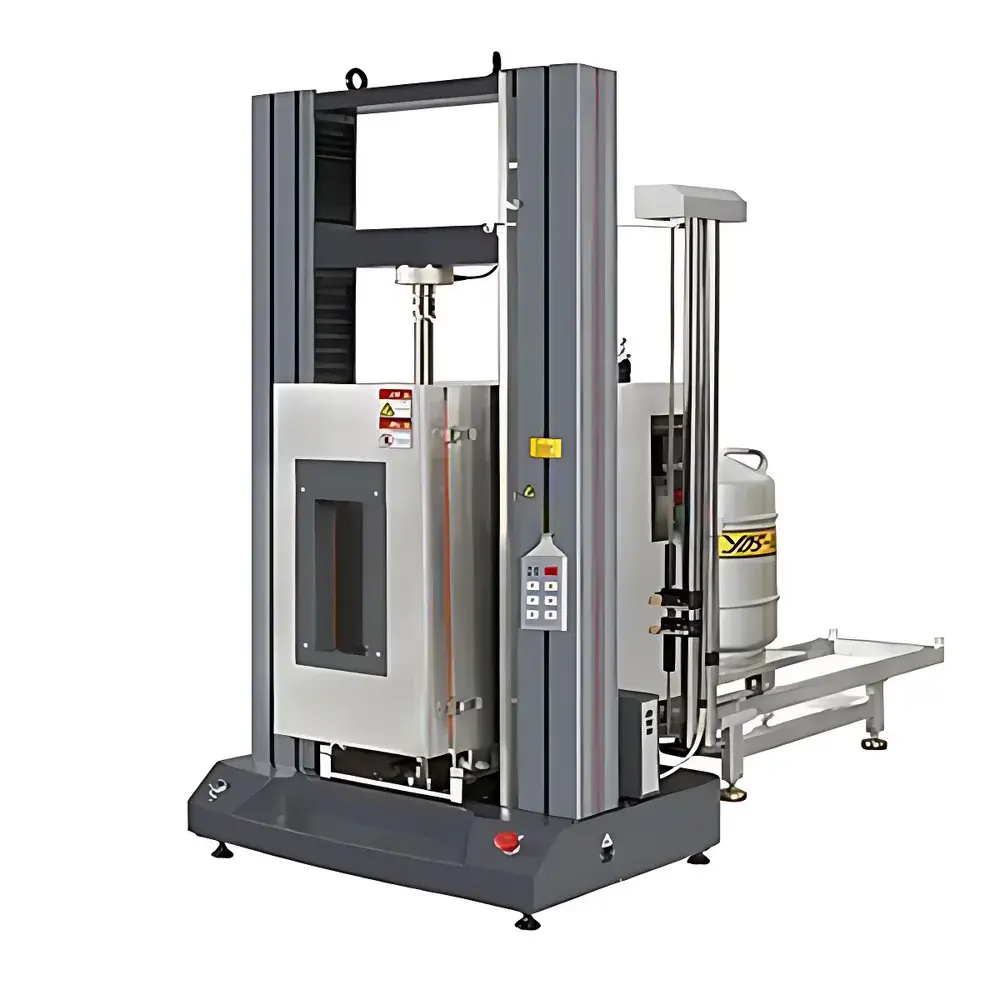
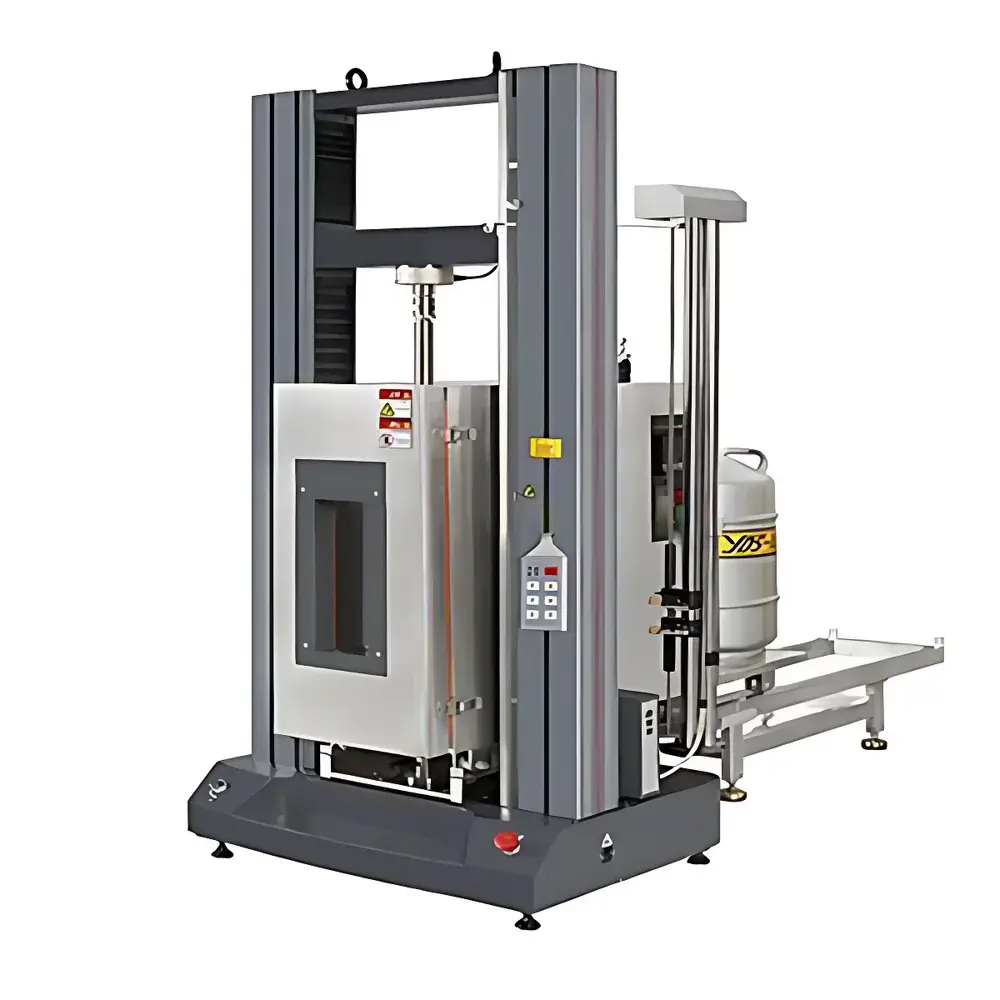
Tuofeng TFW-173 High-Low Temperature Universal Testing Machine
| Brand | Tuofeng |
|---|---|
| Origin | Shanghai, China |
| Manufacturer Type | Direct Manufacturer |
| Country of Origin | China |
| Model | TFW-173 |
| Instrument Type | Electromechanical Universal Testing Machine |
| Max Test Load | 5–100 kN (configurable) |
| Accuracy Class | 0.5 |
| Force Measurement Range | 0.4–100% FS |
| Force Indication Error | ±0.5% of reading |
| Force Resolution | 1/500,000 of full scale, unbroken range |
| Deformation Measurement Range | 0.2–100% FS |
| Deformation Error | ±0.5% of reading |
| Deformation Resolution | up to 1/300,000 |
| Displacement Error | ±0.5% of reading |
| Column Spacing | 840 mm |
| Crosshead Travel (standard) | 1000 mm |
| Host Dimensions | 1250 × 560 × 2400 mm (W×D×H) |
| Power Supply | AC 220 V / 50 Hz ±10%, 750 W |
| Host Weight | ~380 kg |
| Environmental Chamber Temp Range | −40 °C to +100 °C |
| Chamber Heating Power | 1500 W |
| Chamber Internal Dimensions | ~360 × 300 × 500 mm (W×D×H) |
| Temp Uniformity (longitudinal 100 mm) | ±2 °C |
| Temp Stabilization Time | ≤5 min (both above and below 0 °C) |
| Chamber Control | Programmable PID with Pt100 sensors |
| Safety | Leakage protection, overcurrent circuit breaker |
Overview
The Tuofeng TFW-173 High-Low Temperature Universal Testing Machine is an electromechanical materials testing system engineered for precision mechanical property evaluation under controlled thermal conditions. It integrates a high-rigidity dual-column universal testing frame with a programmable environmental chamber capable of sustained operation from −40 °C to +100 °C. The system operates on the principle of servo-controlled load application and displacement feedback, enabling accurate measurement of tensile, compressive, flexural, peel, tear, and shear responses in accordance with standardized quasi-static loading protocols. Designed for compliance with ISO 6892-1 (metallic materials), ASTM E8/E21 (tension testing at elevated and sub-ambient temperatures), ISO 527 (plastics), ASTM D638/D790/D3410, and GB/T 228.1, the TFW-173 supports both ambient and thermally conditioned mechanical characterization across industrial R&D, quality control, and regulatory validation workflows.
Key Features
- High-accuracy force measurement system certified to ISO 7500-1 Class 0.5, with full-scale resolution of 1/500,000 and indication error limited to ±0.5% of reading across 0.4–100% FS.
- True constant-rate crosshead motion control with closed-loop servo feedback, ensuring repeatability in strain-controlled and load-controlled test modes.
- Integrated environmental chamber constructed from 304 stainless steel exterior and 316 mirror-finish interior panels, insulated with high-density alumina-silica fiber for thermal stability and low heat leakage.
- Programmable temperature controller with Pt100 sensing elements, ±2 °C uniformity over 100 mm longitudinal zone, and rapid thermal response (≤30 min to reach +100 °C from ambient).
- Modular load cell options spanning 5 kN to 100 kN, all factory-calibrated and traceable to national metrological standards.
- Robust mechanical architecture featuring hardened steel columns, preloaded ball screws, and precision-ground guide rails to minimize deflection and axial misalignment during high-load testing.
Sample Compatibility & Compliance
The TFW-173 accommodates specimens ranging from thin polymer films (via pneumatic grips) to metallic rods (up to Ø25 mm) and composite laminates (up to 30 mm thick), with standard grip throat depths optimized for compatibility with the chamber’s 50 mm-diameter top/bottom access ports. Optional extensometers—including clip-on, video, and laser-based units—enable direct strain measurement per ASTM E83 or ISO 9513 requirements. The system meets structural and electrical safety standards per IEC 61000-6-2/6-4 and complies with CE marking directives. All test data acquisition and reporting functions support audit-ready documentation aligned with GLP and GMP practices, including electronic signature capability and 21 CFR Part 11–compliant software configuration (optional module).
Software & Data Management
The Windows-based control and analysis platform provides real-time synchronization of force, displacement, deformation, and chamber temperature data at up to 1 kHz sampling rate. Test sequences are defined via intuitive graphical workflow editors supporting multi-step ramp-hold cycles, conditional termination triggers (e.g., yield detection, fracture), and automatic parameter extraction—including ultimate tensile strength, Young’s modulus, yield offset (0.2%), elongation at break, and secant modulus. Raw data is stored in vendor-neutral ASCII format with embedded metadata (test ID, operator, timestamp, calibration certificate ID). Reporting templates conform to ISO/IEC 17025 requirements and can be exported as PDF, Excel, or XML. Software versioning, user privilege management, and full audit trail logging are enabled by default.
Applications
- Mechanical qualification of aerospace alloys (e.g., Ti-6Al-4V, Inconel 718) at cryogenic and elevated service temperatures.
- Thermo-mechanical aging studies of elastomers and thermoplastic composites under cyclic thermal loading.
- Validation of adhesive bond integrity in automotive battery modules subjected to thermal shock profiles.
- Regulatory submission testing for medical device polymers per ISO 10993-12 and USP /.
- Research-grade constitutive modeling input generation for finite element simulation of ceramic matrix composites.
- Quality conformance verification of structural fasteners, weld joints, and powder metallurgy parts per ASTM F606 and ISO 898-1.
FAQ
What temperature ranges does the environmental chamber support, and how is thermal uniformity verified?
The chamber operates from −40 °C to +100 °C. Uniformity is validated per ASTM E2203 using nine-point mapping across the central test zone; longitudinal deviation remains within ±2 °C over any 100 mm segment.
Can the system perform strain-controlled tests with active feedback during thermal cycling?
Yes—closed-loop strain control is supported via optional extensometer integration, with real-time PID adjustment of crosshead speed to maintain target strain rate even during dynamic temperature transitions.
Is the software compliant with FDA 21 CFR Part 11 for regulated laboratories?
A validated software package with electronic signatures, role-based access control, and immutable audit trails is available as an optional configuration, fully aligned with 21 CFR Part 11 Annex 11 requirements.
What maintenance intervals are recommended for long-term accuracy retention?
Annual recalibration of load cells and displacement transducers is advised, along with quarterly verification of chamber temperature profile and biannual inspection of grip jaw surfaces and screw preload integrity.
Are third-party transducers (e.g., MTS, Zwick) compatible with the control system?
The system features analog and digital I/O interfaces compliant with IEEE 1451.4 TEDS standards, enabling plug-and-play integration of certified external sensors without firmware modification.



