
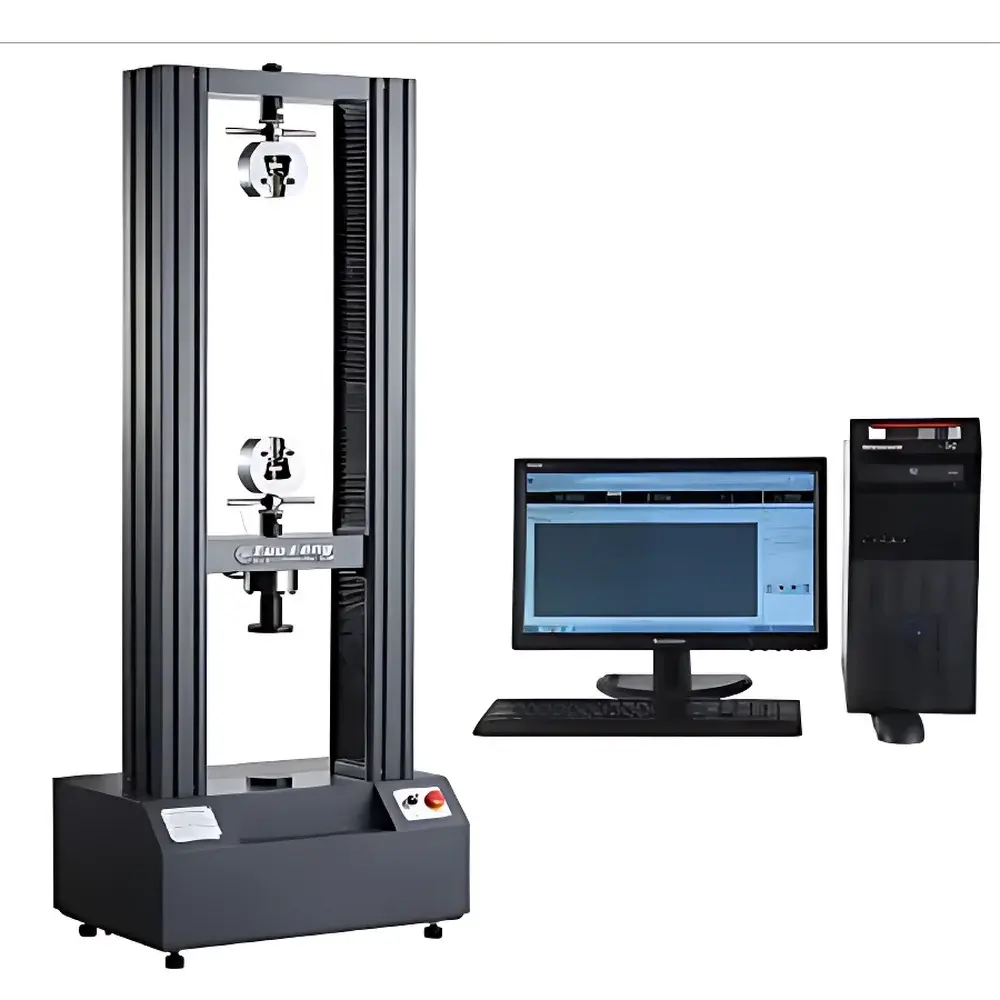
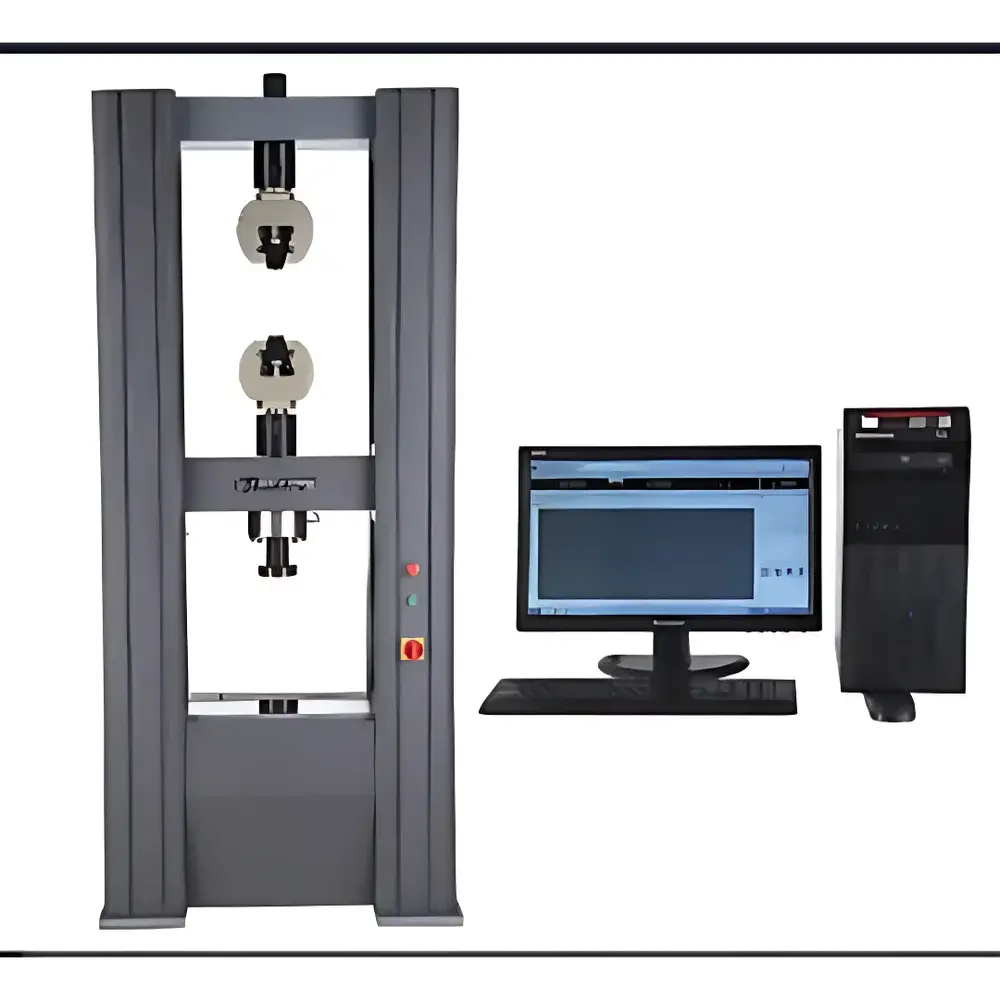
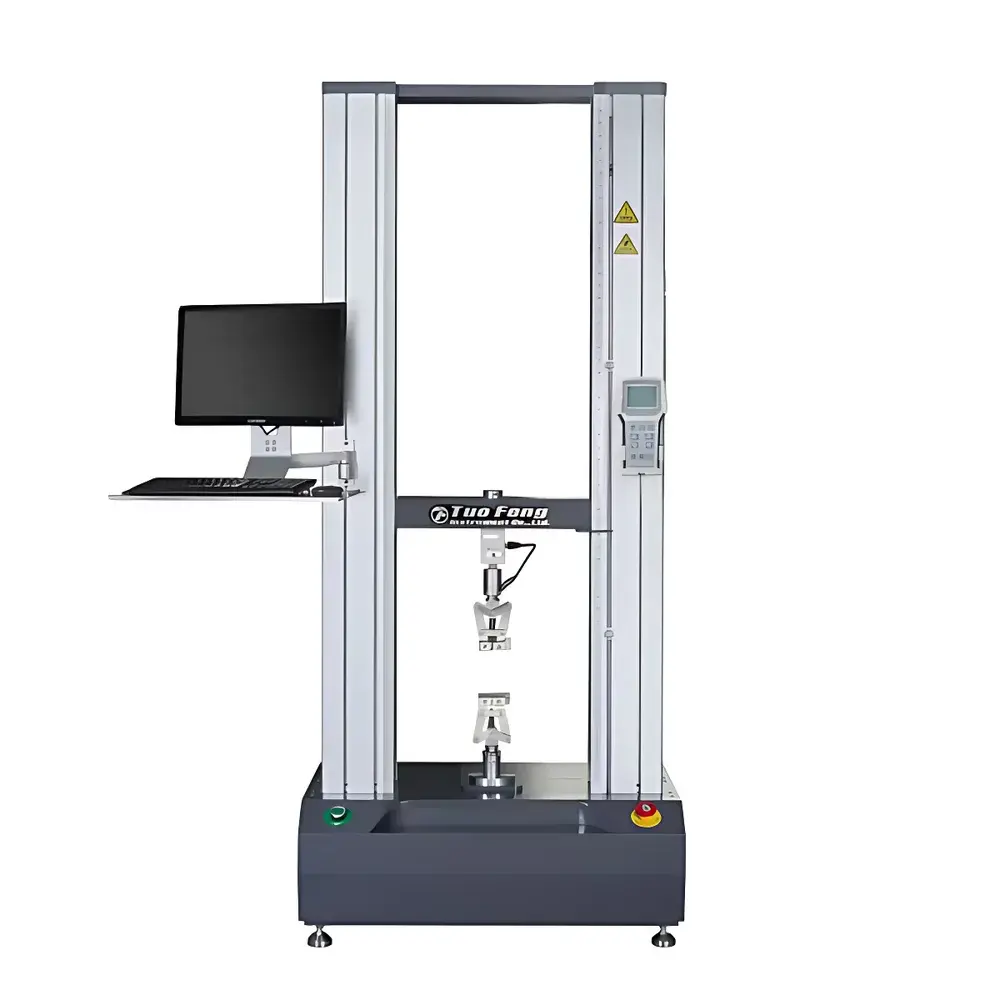
Tuofeng TFW-127 Microcomputer-Controlled Electronic Universal Testing Machine
| Brand | Tuofeng |
|---|---|
| Origin | Shanghai, China |
| Manufacturer Type | Direct Manufacturer |
| Product Category | Domestic |
| Model | TFW-127 |
| Instrument Type | Electronic Tensile Testing Machine |
| Maximum Test Load | 200 kN |
| Force Measurement Range | 0.2%–100% of Full Scale |
| Force Accuracy | ±0.5% of reading |
| Test Stroke | 1000 mm |
| Displacement Resolution | 0.001 mm |
| Control System | PC-based closed-loop servo control |
| Drive System | Imported servo motor with precision worm-gear reducer |
| Transmission | High-accuracy preloaded ball screw |
| Effective Test Width | 400 mm (customizable to 500/600 mm) |
| Crosshead Speed Range | 0.001–500 mm/min (infinitely variable) |
| Displacement Measurement | Optical encoder |
| Displacement Accuracy | ±0.005% of reading |
| Strain Measurement Options | Extensometer or large-deformation transducer (optional) |
| Strain Accuracy | ±0.005% of reading |
| Safety Protection | Dual electronic limit switches, emergency stop button, overload protection (10% above rated capacity) |
| Crosshead Positioning | Dual-speed (fast/slow) motorized adjustment with programmable return function |
| Software | Windows-native testing platform supporting ASTM E4, E8, E9, E21, ISO 6892-1, ISO 178, ISO 148, GB/T 228.1, GB/T 16491, JJG 475, and other international & national standards |
| Compliance | Meets GB/T 16491–2008 (Electronic Universal Testing Machines), JJG 475–2008 (Verification Regulation), and supports 21 CFR Part 11 audit trail configuration (optional) |
Overview
The Tuofeng TFW-127 Microcomputer-Controlled Electronic Universal Testing Machine is a high-precision, dual-column electromechanical system engineered for static mechanical property characterization of metallic, polymeric, ceramic, composite, and elastomeric materials. It operates on the principle of closed-loop servo-controlled force and displacement actuation, enabling accurate application and real-time measurement of axial tensile, compressive, flexural, shear, tear, peel, and puncture loads. The machine integrates a high-rigidity load frame, preloaded ball-screw transmission, and imported servo drive—designed to maintain structural stability and minimize deflection under full-scale loading (up to 200 kN). Its microcomputer-based architecture ensures traceable data acquisition at up to 1 kHz sampling rate, with synchronized force, displacement, and optional strain channels. The system conforms to fundamental metrological requirements defined in ISO 7500-1 (Class 0.5 accuracy), and its mechanical design complies with GB/T 16491–2008 and JJG 475–2008 verification protocols.
Key Features
- Full-scale force measurement range from 0.2% to 100% FS with ±0.5% indication accuracy—achievable without range switching due to 500,000-count internal resolution
- Displacement resolution of 0.001 mm and ±0.005% displacement accuracy, supported by optical rotary encoder feedback
- Infinitely variable crosshead speed (0.001–500 mm/min), programmable via software-defined ramp-hold-step profiles
- Dual-speed motorized crosshead positioning with manual jog capability and automatic return-to-start function post-test
- Integrated safety architecture including electronic upper/lower limit switches, hardware-triggered emergency stop, and automatic overload cutoff at 110% of rated capacity
- Modular fixture interface accommodating standardized grips (e.g., wedge-action, pneumatic, hydraulic) and custom tooling for ASTM D638, ISO 527, ISO 178, and GB/T 1040 test configurations
- Preloaded ball-screw transmission with 10⁶ cycle service life under nominal load conditions
Sample Compatibility & Compliance
The TFW-127 accommodates specimens ranging from thin films (<0.1 mm thickness) to structural steel coupons (up to 50 mm wide × 25 mm thick), with effective test width configurable up to 600 mm and vertical stroke extended to 1000 mm. It supports standard test geometries per ASTM E8/E8M (tension), ASTM C39 (compression), ASTM D790 (flexure), ASTM D624 (tear), ASTM D903 (peel), and ISO 1133 (melt flow index auxiliary fixtures). All mechanical and electrical subsystems are certified to IEC 61000-6-2 (EMC immunity) and IEC 61000-6-4 (EMC emission) standards. Optional GLP/GMP-compliant software modules provide 21 CFR Part 11–ready audit trails, electronic signatures, and role-based user access control—validated for regulated environments in pharmaceutical excipient testing, medical device component qualification, and aerospace material certification.
Software & Data Management
The embedded Windows-based testing software provides multi-mode control—including load-controlled, displacement-controlled, strain-controlled, and hold-step sequencing—with real-time visualization of up to four concurrent plots (e.g., stress–strain, load–time, extension–time, load–extension). Units are freely convertible across SI, imperial, and legacy systems (e.g., N/kN/lbf, mm/in, MPa/psi). Raw data streams are saved in ASCII CSV and proprietary binary formats; all test parameters, calibration logs, and operator annotations are embedded within each file. Batch analysis tools support statistical comparison across up to 99 specimens, calculating mean, standard deviation, min/max, and coefficient of variation for derived properties (UTS, YS, E-modulus, % elongation, % reduction in area, etc.). Reports comply with ISO/IEC 17025 documentation requirements and may be exported as PDF, Excel, or XML for LIMS integration. Firmware and application updates are delivered remotely via secure HTTPS channel with version-controlled changelogs.
Applications
This system serves as a primary mechanical characterization platform in R&D laboratories and QC departments across industries requiring repeatable, standards-aligned material evaluation. In metallurgy, it performs tensile testing of hot-rolled steels per ASTM A370 and aluminum alloys per ISO 6892-1. In polymer science, it quantifies modulus transitions in thermoplastics (ASTM D638), creep compliance in PE pipes (ISO 899-1), and adhesion strength in laminated packaging (ASTM D1876). Automotive suppliers use it for validating brake pad compressibility (SAE J661), while battery manufacturers assess separator tensile integrity under thermal cycling. Academic users leverage its open API for custom algorithm integration—such as digital image correlation (DIC) synchronization or real-time fracture energy computation. Its modular design also supports add-on modules for environmental chambers (−70°C to +300°C), video extensometry, and acoustic emission monitoring.
FAQ
What international standards does the TFW-127 support out of the box?
The base system complies with ASTM E4, E8, E9, E21; ISO 6892-1, 178, 148, 527; GB/T 228.1, 1040, 16491; and JJG 475. Custom test methods can be configured via scriptable test templates.
Is the system compatible with third-party extensometers?
Yes—it features analog and digital inputs (LVDT, strain gauge, and serial RS-422 interfaces) fully configurable in software for analog output scaling and zero offset compensation.
Can test data be integrated into an enterprise LIMS or MES?
Absolutely. The software supports ODBC-compliant database export, HL7 message formatting, and RESTful API endpoints for bidirectional data exchange with validated laboratory informatics platforms.
What is the recommended calibration interval?
Per ISO/IEC 17025, initial calibration is performed pre-shipment; subsequent verification is advised every 12 months—or after 5,000 test cycles, whichever occurs first—using NIST-traceable deadweight or hydraulic calibration standards.
Does the system support multi-axis or biaxial testing?
No—the TFW-127 is a uniaxial testing system. For planar biaxial or torsional characterization, Tuofeng offers complementary systems (e.g., TFW-BX200 series) with orthogonal actuator coupling and synchronized controller firmware.



