
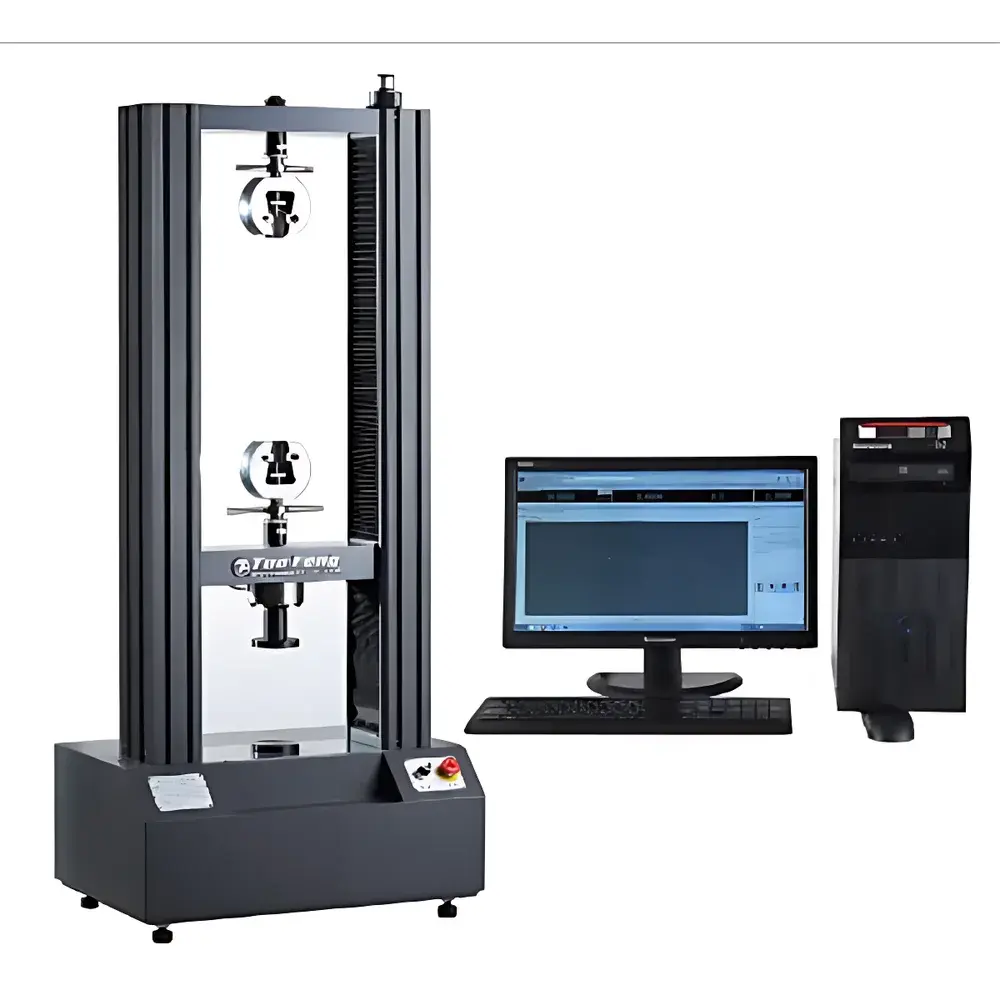
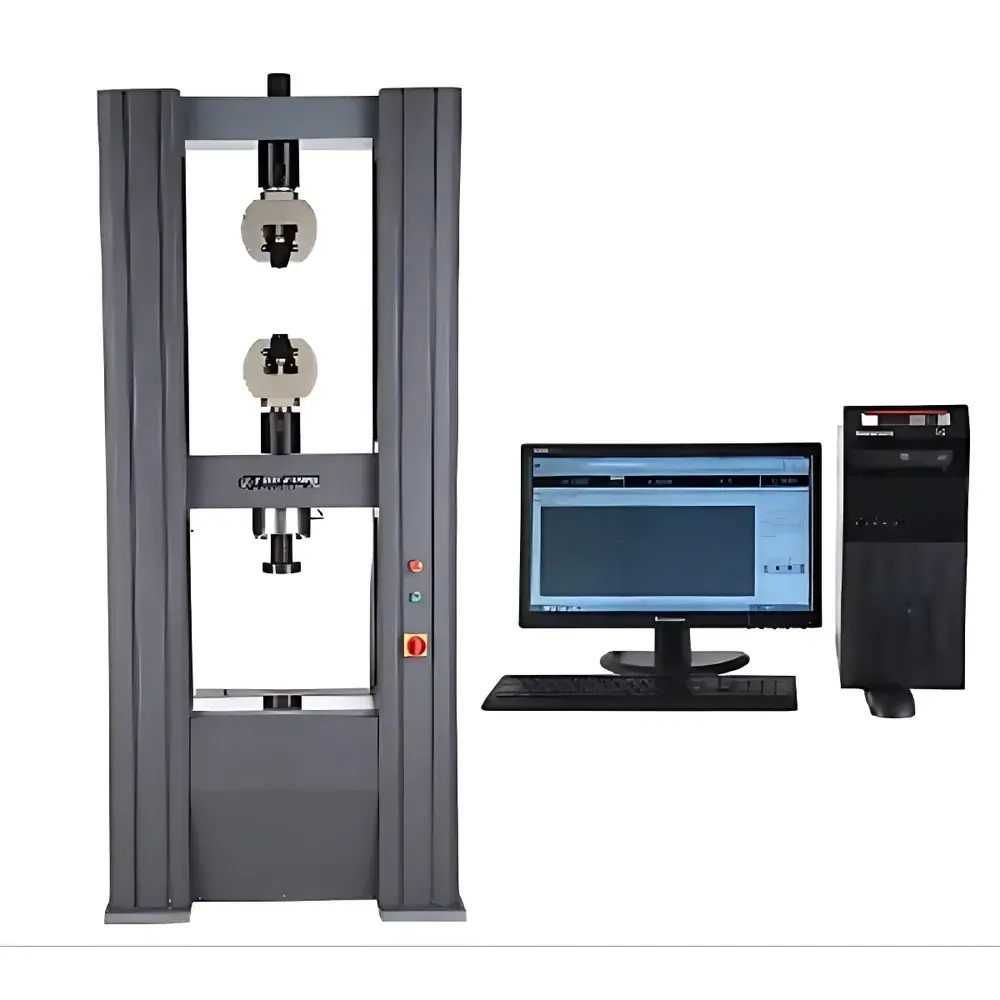
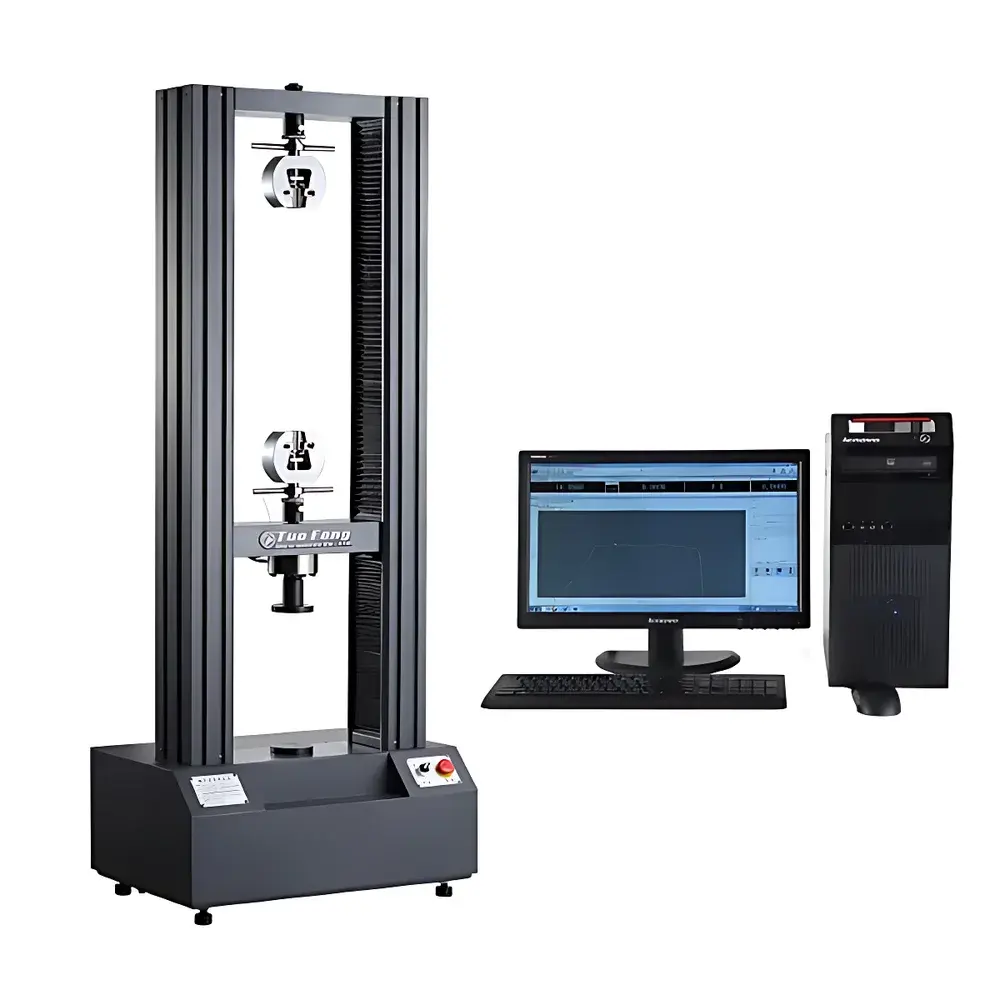
Tuofeng TFW-321 Microcomputer-Controlled Electronic Universal Testing Machine
| Brand | Tuofeng |
|---|---|
| Origin | Shanghai, China |
| Manufacturer Type | Direct Manufacturer |
| Country of Origin | China |
| Model | TFW-321 |
| Price Range | USD 1,400 – 14,000 |
| Instrument Type | Electronic Universal Testing Machine |
| Load Capacity | 0.02 N to 300 kN |
| Load Accuracy | ±0.5% |
| Accuracy Class | 0.5 |
| Effective Force Measurement Range | 0.2%–100% of Full Scale |
| Force Resolution | 1 part in ±500,000 full-scale codes (no range switching, constant resolution) |
| Drive System | Imported servo motor with worm gear reducer |
| Lead Screw | High-precision preloaded ball screw |
| Effective Test Width | 400 mm (customizable up to 600 mm) |
| Maximum Travel | 800 mm (extendable) |
| Speed Range | 0.001–500 mm/min (infinitely variable, programmable) |
| Displacement Measurement | Optical encoder |
| Displacement Accuracy | ±0.005% of reading |
| Strain Measurement | Optional extensometer or large-deformation transducer |
| Strain Accuracy | ±0.005% of reading |
| Safety Protection | Electronic limit switches, emergency stop button, overload protection (auto-shutdown at >110% FS) |
| Crosshead Control | Dual-speed (fast/slow) motorized adjustment with jog function |
| Return Function | Automatic or manual high-speed return to initial position |
| Overload Protection | Activates at >110% of maximum rated load |
| Fixture Customization | Application-specific grips and fixtures available |
| Power Supply | 220 V AC, 750 W to 3.0 kW (model-dependent) |
| Approximate Weight | 280–1500 kg (model-dependent) |
| Compliance | GB/T 16491–2008, JJG 475–2008, ASTM E4, ASTM E8, ASTM D638, ASTM D790, ISO 6892-1, ISO 178, DIN 53455, JIS Z2241, BS EN 10002-1 |
Overview
The Tuofeng TFW-321 Microcomputer-Controlled Electronic Universal Testing Machine is a statically calibrated, force-controlled electromechanical system engineered for high-reproducibility mechanical property characterization of metallic, polymeric, ceramic, composite, and elastomeric materials. It operates on the principle of controlled displacement actuation via a precision ball-screw-driven crosshead, coupled with real-time closed-loop feedback from a high-resolution load cell and optical encoder. The system complies with international metrological standards for static testing machines—including ISO 7500-1 (Class 0.5), ASTM E4 (verification of force-measuring systems), and GB/T 16491–2008—ensuring traceable, auditable performance across laboratory, production QA, and third-party certification environments.
Key Features
- Full-scale load capacity spanning 0.02 N to 300 kN, supported by modular frame configurations (TFW-05S through TFW-200S variants) to match application-specific force and stiffness requirements.
- Constant-resolution force measurement at 1 part in ±500,000 full-scale, eliminating range-switching artifacts and enabling seamless transition from ultra-low-force peel tests to high-load compression of structural composites.
- Dual-speed motorized crosshead control with jog functionality, allowing rapid positioning and fine-tuned alignment prior to test initiation—critical for brittle material testing and multi-specimen batch workflows.
- Integrated safety architecture including electronic travel limits, hardware-based emergency stop circuitry, and programmable overload cutoff (110% FS threshold), fully compliant with IEC 61800-5-2 functional safety guidelines for drive systems.
- Modular extensometry support: compatibility with clip-on axial extensometers (for modulus and yield determination per ASTM E8/E83) and non-contact video extensometers (optional upgrade) for strain mapping without specimen contact.
- Thermally stable mechanical design featuring preloaded ball screws and rigid cast-iron base, minimizing thermal drift and maintaining geometric fidelity over extended test durations and ambient temperature fluctuations (±2°C).
Sample Compatibility & Compliance
The TFW-321 accommodates standardized and custom geometries—from ASTM D638 Type I dog-bone specimens and ISO 527-2 multipurpose bars to cylindrical concrete cores (per ASTM C39), sheet-metal shear coupons (ASTM E2234), and textile laminates (ISO 13934-1). Its open-frame architecture permits integration of environmental chambers (–70°C to +300°C), humidity control enclosures, and in-situ imaging rigs. Regulatory compliance includes full alignment with GLP documentation requirements: audit-trail-enabled software logs all operator actions, parameter changes, and calibration events; raw data files are stored in vendor-neutral ASCII/CSV format with embedded metadata (timestamp, user ID, instrument serial, test standard ID). The system satisfies FDA 21 CFR Part 11 readiness when deployed with optional electronic signature modules and role-based access controls.
Software & Data Management
The Windows-native testing software provides ISO/IEC 17025-aligned test execution and reporting. It supports seven programmable control modes: constant rate of extension (CRE), constant rate of loading (CRL), constant stress, constant strain, hold-to-load, hold-to-strain, and cyclic ramp-hold sequences. Real-time visualization includes synchronized dual-axis plots (e.g., stress–strain + time–displacement), with on-the-fly unit conversion (N/kN/lbf, mm/in, MPa/psi) and automatic calculation of ASTM/ISO-defined parameters—including tensile strength, yield offset (0.2% proof stress), Young’s modulus, fracture toughness (via J-integral approximation), and energy absorption (area under curve). All test data are saved in timestamped, version-controlled folders; batch comparison tools enable statistical overlay of up to 16 curves with confidence interval shading. Export options include PDF reports with digital signatures, Excel-compatible .csv dumps, and XML schemas compatible with LIMS integration (e.g., Thermo Fisher SampleManager, LabVantage).
Applications
This platform serves as a primary mechanical characterization tool across regulated and R&D-intensive sectors. In aerospace, it validates carbon-fiber reinforced polymer (CFRP) interlaminar shear strength (ILSS) per ASTM D2344 and bolt-bearing response under NASM 1312-7. In medical device manufacturing, it verifies tensile integrity of nitinol stent struts (ISO 15626) and suture breaking strength (ISO 10555-1). Automotive suppliers use it for dynamic fatigue simulation of elastomeric bushings (ISO 4664-1) and crash-absorber foam compression (SAE J2116). Within construction materials labs, it executes compressive strength testing of grouts (ASTM C109), flexural modulus of fiber-cement boards (ASTM C1185), and bond strength of tile adhesives (ANSI A118.4). Academic users leverage its open API for custom algorithm development—such as machine-learning–assisted failure prediction from acoustic emission signatures during quasi-static loading.
FAQ
What international standards does the TFW-321 support out-of-the-box?
The system includes preconfigured test methods for ASTM E8/E83 (metals), ASTM D638/D790 (plastics), ISO 6892-1/178 (tensile/flexural), GB/T 228.1 (Chinese metal standard), and JIS Z2241—each with automated parameter validation and report formatting.
Is the software validated for GxP environments?
Yes—the software can be configured to meet 21 CFR Part 11 requirements, including electronic signatures, audit trails, and data integrity safeguards; IQ/OQ documentation packages are available upon request.
Can the system perform cyclic or fatigue testing?
While primarily designed for quasi-static tests, the TFW-321 supports low-cycle fatigue protocols (≤100 cycles) with programmable ramp-hold sequences; for high-cycle applications (>10⁴ cycles), a dedicated servo-hydraulic fatigue system is recommended.
How is calibration traceability maintained?
Each load cell is supplied with NIST-traceable calibration certificate (as per ISO/IEC 17025); annual verification against certified deadweight standards (e.g., Fluke 7000 series) is supported via built-in calibration utility with password-protected admin mode.
What training and technical support options are provided?
Tuofeng offers on-site installation qualification (IQ), operator training (8-hour hands-on course), and remote troubleshooting; firmware and software updates are delivered free of charge for the lifetime of the instrument.



