
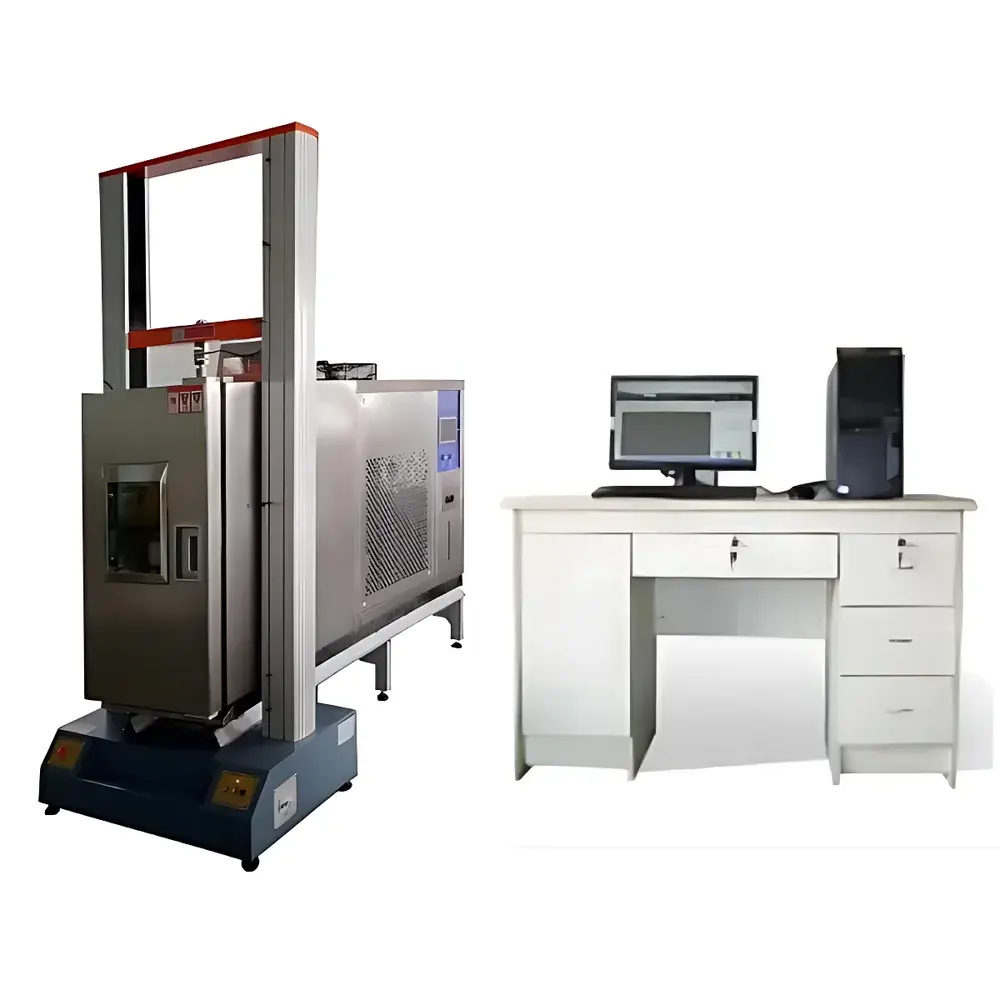
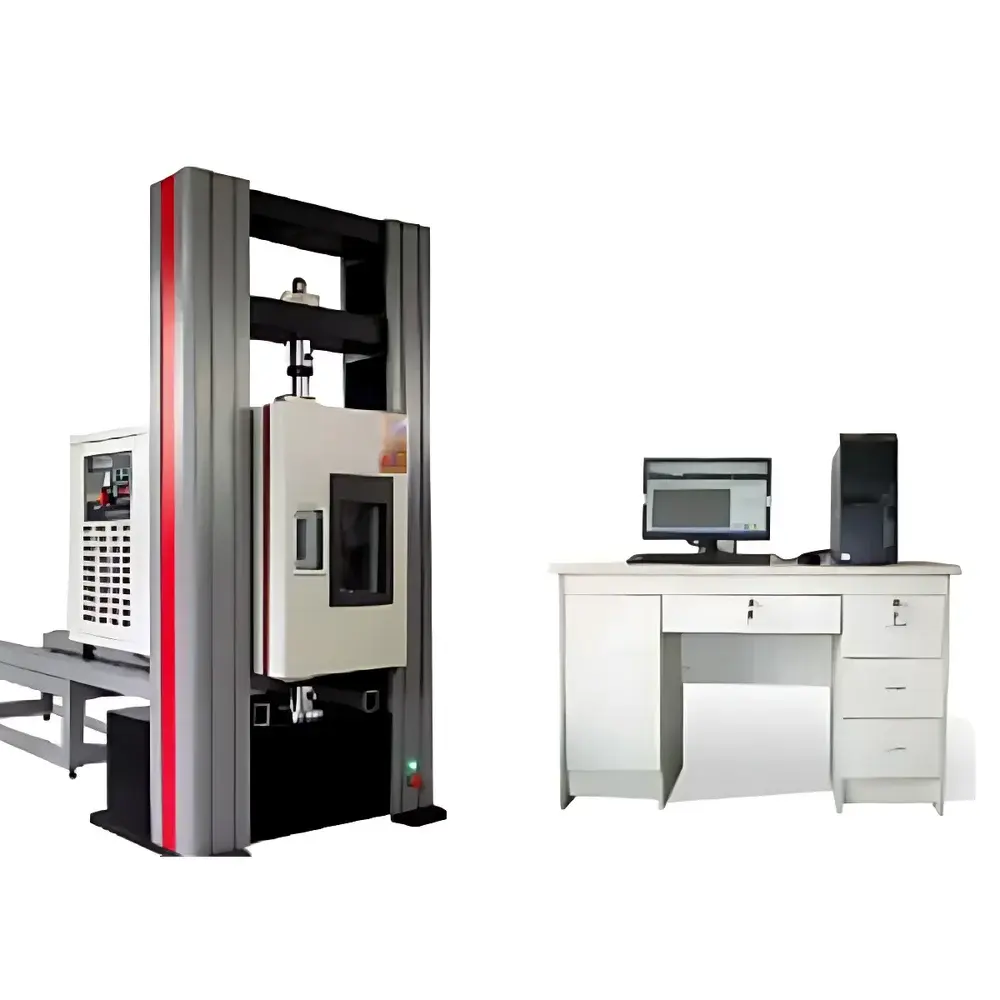
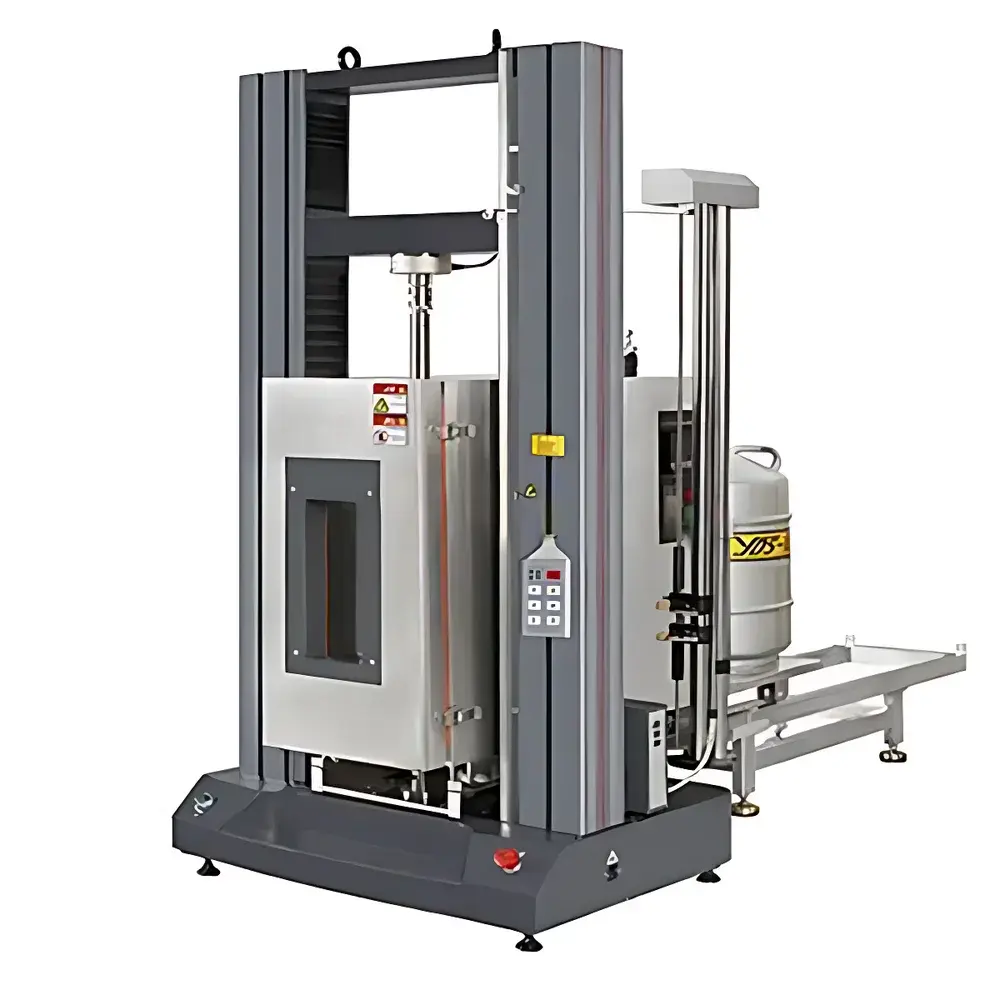
Tuofeng TFW-286 High-Low Temperature Electronic Universal Testing Machine
| Brand | Tuofeng |
|---|---|
| Origin | Shanghai, China |
| Manufacturer Type | Direct Manufacturer |
| Instrument Type | Electronic Universal Testing Machine |
| Model | TFW-286 |
| Load Capacity Range | 0.01 N to 300 kN |
| Load Accuracy | ±0.5% |
| Accuracy Class | Class 0.5 |
| Force Measurement Range | 0.4–100% FS |
| Force Resolution | 1/500,000 of full scale (fixed, no range switching) |
| Deformation Measurement Range | 0.2–100% FS |
| Deformation Accuracy | ±0.5% of reading |
| Deformation Resolution | up to 1/300,000 |
| Displacement Accuracy | ±0.5% of reading |
| Column Spacing (inner) | 840 mm |
| Crosshead Travel | 1000 mm (subject to environmental chamber constraints) |
| Host Dimensions | 1250 × 560 × 2400 mm (W×D×H) |
| Power Supply | AC 220 V / 50 Hz ±10%, 750 W |
| Host Weight | ~380 kg |
| Environmental Chamber Temp Range | −40 °C to +100 °C |
| Chamber Heating Power | 1500 W |
| Chamber Internal Dimensions | ~360 × 300 × 500 mm (W×D×H) |
| Chamber Temp Uniformity | ±2 °C over 100 mm vertical zone |
| Chamber Temp Stabilization Time | ≤5 min (both above and below 0 °C) |
| Chamber Ramp Rate | ≤30 min to reach +100 °C from ambient |
| Chamber Construction | 304 stainless steel exterior, 316 mirror-finish stainless interior, ceramic fiber insulation |
| Control System | Programmable PID controller with LCD digital display, Pt100 sensors, dual-zone thermal management (compressor + NiCr heater), integrated safety circuits (leakage protection, overcurrent cutoff) |
Overview
The Tuofeng TFW-286 High-Low Temperature Electronic Universal Testing Machine is an electromechanical force-testing platform engineered for precise static mechanical characterization of materials across extreme thermal conditions. It integrates a high-stiffness dual-column load frame with a programmable environmental chamber capable of stable operation from −40 °C to +100 °C. The system operates on the principle of controlled displacement or load-controlled actuation using a precision ball-screw-driven crosshead, coupled with closed-loop servo control and high-resolution force/deformation transduction. This architecture enables compliance with standardized quasi-static mechanical test protocols—including tensile, compression, flexural, peel, tear, and shear—under thermally conditioned environments as defined by ISO 6892-1, ASTM E8/E9, ASTM D638/D790/D1876, GB/T 228.1, and JIS Z2241. Its Class 0.5 accuracy rating per ISO 7500-1 ensures traceable metrological performance suitable for R&D validation, quality assurance, and regulatory submission workflows.
Key Features
- Full-range force measurement from 0.01 N to 300 kN with ±0.5% load accuracy and 1/500,000 full-scale resolution—maintained continuously without range switching.
- Dual-mode control architecture supporting both load-controlled and displacement-controlled test profiles with real-time feedback compensation.
- Integrated environmental chamber featuring 316 mirror-finish stainless steel interior, ceramic fiber insulation, and dual-stage thermal regulation (refrigeration compressor + NiCr heating element) for rapid ramping and tight temperature uniformity (±2 °C over 100 mm).
- Programmable temperature profile capability with up to 10 segment ramps/holds, synchronized with mechanical test sequencing via embedded PLC logic.
- High-rigidity load frame with 840 mm column spacing and 1000 mm usable crosshead travel—optimized for large specimens and multi-specimen fixtures.
- Comprehensive safety subsystem including leakage current protection, thermal overload cutoff, emergency stop interlock, and door-open inhibition during active thermal conditioning.
Sample Compatibility & Compliance
The TFW-286 accommodates a broad spectrum of specimen geometries and material classes—including metallic alloys, polymer sheets and films, elastomers, composites, ceramics, adhesives, and biomedical polymers—using standardized grips, bending jigs, peel fixtures, and custom tooling interfaces. All mechanical test routines are fully compatible with international standards governing mechanical property reporting: ISO 527 (plastics), ISO 604 (rigid plastics compression), ISO 178 (flexure), ASTM D882 (thin plastic film tensile), ASTM D3039 (composite tensile), and GB/T 1040 series. The system’s force and displacement metrology is calibrated in accordance with ISO/IEC 17025 requirements, and its environmental chamber validation supports GLP-compliant thermal mapping documentation (IQ/OQ protocols available upon request). For regulated environments, optional 21 CFR Part 11-compliant audit trail logging and electronic signature modules can be implemented within the software framework.
Software & Data Management
Control and analysis are executed via Windows-based TestMaster™ software—a deterministic, multithreaded application designed for laboratory-grade data integrity. The software provides real-time plotting of force–displacement, stress–strain, and time–temperature–load trajectories; automatic calculation of ASTM/ISO-defined parameters (e.g., Young’s modulus, yield strength, elongation at break, compressive modulus, peel adhesion energy); and customizable report generation with embedded metadata (operator ID, calibration certificate IDs, environmental chamber log files). Raw data is stored in vendor-neutral ASCII CSV format with timestamped headers, enabling third-party statistical analysis (Minitab, JMP, Python/Pandas). Optional features include automated batch testing, pass/fail tolerance banding, and integration with LIMS via HL7 or REST API endpoints. All software modules undergo annual regression testing against NIST-traceable reference datasets.
Applications
- Thermal-dependent modulus and strength mapping of aerospace composites under cryogenic and elevated-temperature service conditions.
- Creep and stress-relaxation profiling of thermoplastic elastomers across −30 °C to +80 °C for automotive sealing applications.
- Adhesive bond durability assessment under thermal cycling (−40 °C ↔ +85 °C) per MIL-STD-883 Method 1010.
- Quality conformance testing of medical device polymers (e.g., PEEK, PEKK) per ISO 14801 and USP /.
- Interfacial fracture toughness evaluation of ceramic-metal brazed joints in power electronics packaging.
- Standardized tensile testing of structural steel grades per EN 10002-1 under sub-zero ambient simulation.
FAQ
What temperature uniformity is guaranteed inside the environmental chamber during active testing?
The chamber maintains ±2 °C uniformity over a 100 mm vertical zone at any setpoint between −40 °C and +100 °C, verified per IEC 60068-3-5 thermal mapping procedures.
Can the system perform simultaneous temperature ramping and mechanical loading?
Yes—the controller supports synchronized thermal and mechanical profiles, allowing ramp-hold-load sequences (e.g., heat to +60 °C, hold 10 min, then initiate tensile ramp at 2 mm/min).
Is the force transducer calibrated independently of the environmental chamber?
Force calibration is performed in situ at ambient temperature prior to chamber insertion; thermal drift compensation algorithms are applied during low-temperature testing based on pre-characterized sensor response curves.
Does the software support automated pass/fail evaluation against user-defined specification limits?
Yes—threshold-based logic can be configured for any calculated parameter (e.g., “Yield Strength ≥ 280 MPa AND Elongation ≥ 12%”), with visual alerts and report flagging.
What documentation is provided for regulatory audits?
Standard delivery includes Factory Calibration Certificates (traceable to CNAS-accredited labs), IQ/OQ templates, software validation summary, and mechanical verification reports aligned with ISO/IEC 17025 Annex A.3.
Related Products



