
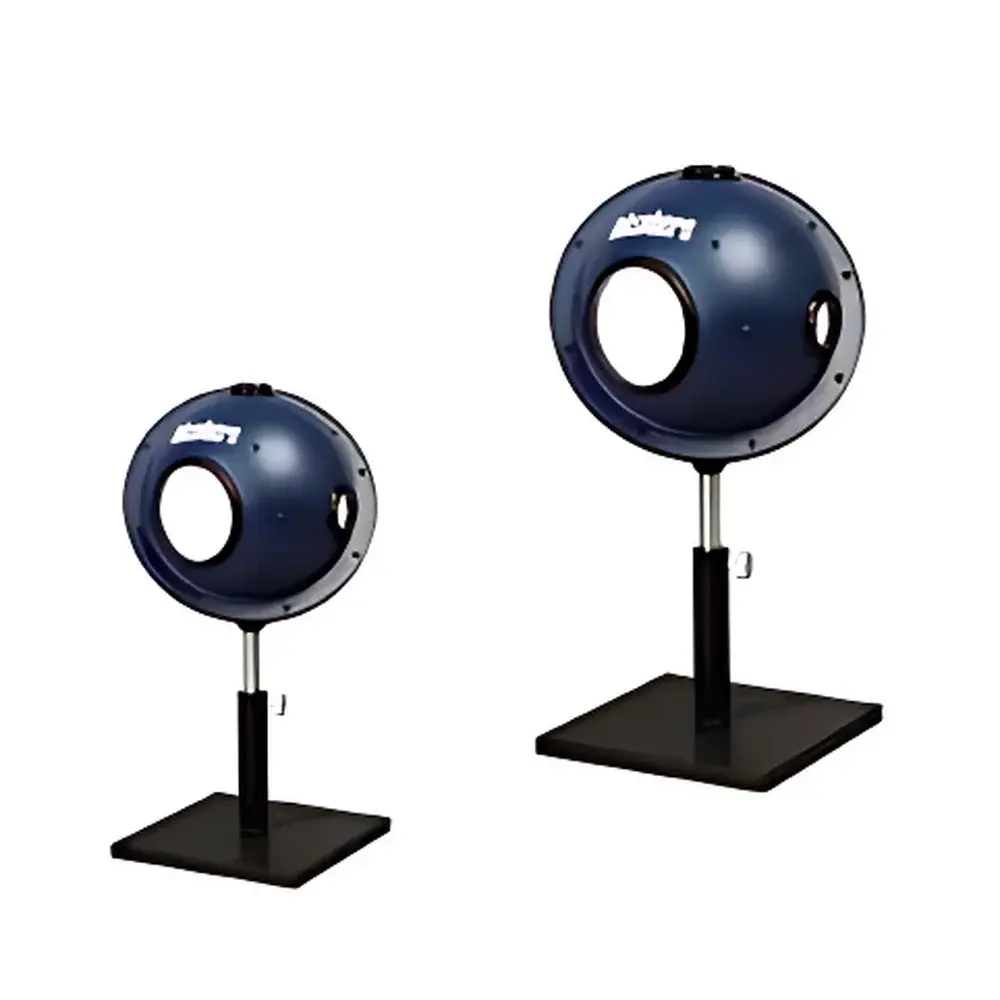
Labsphere 3P-GPS-030-SF Universal Integrating Sphere
| Brand | Labsphere |
|---|---|
| Origin | USA |
| Model | 3P-GPS-030-SF |
| Coating | Spectraflect® |
| Internal Diameter | 3 in (76.2 mm) |
| Port Configuration | 3-Port (Input, Output, 90° Viewing) |
| Coating Type | Barium Sulfate-Based Diffuse Reflectance Coating |
| Compliance | ISO 9001 Certified, NIST-Traceable Manufacturing |
| Component Category | Optical Instrument Component |
Overview
The Labsphere 3P-GPS-030-SF Universal Integrating Sphere is a precision-engineered optical component designed for photometric and radiometric measurement applications requiring high spatial uniformity, diffuse light collection, and spectrally neutral response. Based on the fundamental principle of multiple diffuse reflections within a highly reflective, Lambertian cavity, this integrating sphere homogenizes incident light—whether from LEDs, lasers, lamps, or other broadband or narrowband sources—into a spatially uniform radiance distribution across its inner surface. Its 3-inch internal diameter provides an optimal balance between compact footprint and sufficient surface-area-to-port-area ratio for accurate integration, especially in applications where source size, port geometry, and signal-to-noise requirements must be tightly controlled. The sphere operates on well-established radiometric theory: when the total port area occupies less than 5% of the internal spherical surface area (4πR²), the error introduced by port attenuation remains below 1%, preserving measurement fidelity. This model serves as a foundational building block in calibrated optical systems—including LED flux measurement, luminous intensity distribution analysis, reflectance/transmittance characterization, and spectral irradiance standardization.
Key Features
- Modular universal design enabling rapid reconfiguration for diverse photometric tasks—e.g., source measurement, detector calibration, or sample reflectance testing
- Internally coated with Spectraflect®—a proprietary barium sulfate-based diffuse reflectance material delivering >98% average reflectance from 250 nm to 2500 nm and near-perfect Lambertian scattering behavior
- Precision-machined aluminum housing with black-anodized exterior for thermal stability and stray-light suppression
- Standard three-port configuration: input port (1.0 in), output/detector port (1.0 in), and orthogonal 90° viewing port (1.0 in)—all threaded (8-32 UNC) and gasket-sealed for repeatable alignment
- ISO 9001–certified manufacturing process with full NIST-traceable documentation; each unit supplied with individual serial-numbered calibration record
- Compatible with interchangeable accessories including collimators, baffle assemblies, source mounts, fiber-optic couplers, and shutter mechanisms
Sample Compatibility & Compliance
The 3P-GPS-030-SF accommodates light sources up to 1.5 inches in effective emission area while maintaining <5% port-area-to-sphere-surface-area ratio—ensuring compliance with CIE Publication 84, ASTM E1331, and ISO/CIE 19476 standards for integrating sphere performance. It supports both broadband (e.g., white LEDs, halogen lamps) and quasi-monochromatic sources (e.g., laser diodes, filtered arc lamps). When used with calibrated reference detectors or transfer standards, the sphere meets requirements for GLP-compliant photometric validation per FDA 21 CFR Part 11 data integrity guidelines. Optional Spectralon® (for UV-VIS-NIR) or Infragold® (for IR-dominant applications) coatings are available to extend spectral coverage and optimize reflectance stability under specific irradiance conditions.
Software & Data Management
While the 3P-GPS-030-SF is a passive optical component, it integrates seamlessly into Labsphere’s suite of radiometric software platforms—including SphereOptics™ and SpectraSuite™—enabling automated system configuration, correction factor application (e.g., port loss, coating non-uniformity), and uncertainty propagation per GUM (Guide to the Expression of Uncertainty in Measurement). All calibration certificates include wavelength-dependent reflectance curves and spatial uniformity maps traceable to NIST SRM 2065 and 2066. Audit trails, user access logs, and electronic signature support are embedded in compliant lab environments operating under ISO/IEC 17025 or ICH Q2(R2) frameworks.
Applications
- Luminous flux and efficacy measurement of single-die and multi-chip LEDs per LM-79 and IES LM-80 protocols
- Photometric characterization of automotive lighting modules (headlamps, DRLs, taillights) per SAE J1383 and ECE R149
- Reflectance and transmittance quantification of optical filters, diffusers, and display materials
- Calibration of spectroradiometers, photometers, and imaging colorimeters
- Uniform illumination generation for camera sensor testing and flat-field correction
- Architectural lighting validation—including spatial color uniformity assessment for tunable-white and human-centric lighting systems
FAQ
What is the maximum recommended port area relative to the sphere’s internal surface area?
For photometric accuracy, total port area should not exceed 5% of the internal surface area (4πR²). For the 3P-GPS-030-SF (R = 1.5 in), this corresponds to ≤1.41 in² aggregate port area.
Can this sphere be used for both reflectance and transmittance measurements?
Yes—when configured with appropriate baffling and port assignments, it supports both absolute reflectance (using reference standard) and total transmittance modes per ASTM E903 and ISO 9050.
Is Spectraflect® coating suitable for UV applications below 350 nm?
Spectraflect® maintains >95% reflectance down to 250 nm; however, for extended UV durability (<250 nm), Spectralon® is recommended.
Does Labsphere provide NIST-traceable calibration for this model?
Yes—each unit ships with a certificate of conformance and optional NIST-traceable spectral reflectance calibration (SRM-matched) performed in our A2LA-accredited laboratory.
How is mechanical alignment ensured during system integration?
All ports feature precision-ground, concentric threading (8-32 UNC) with ±0.002 in runout tolerance and integrated O-ring sealing surfaces to guarantee repeatable, vibration-resistant mounting.




