
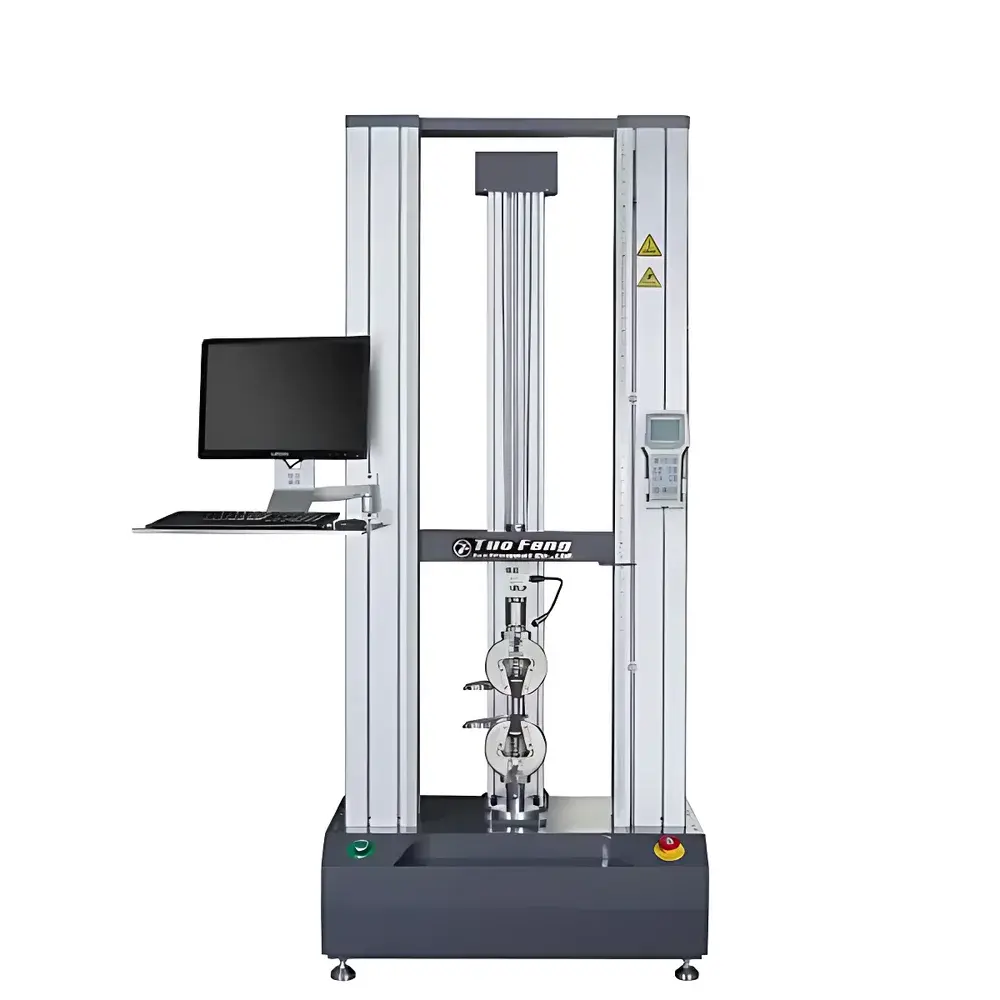
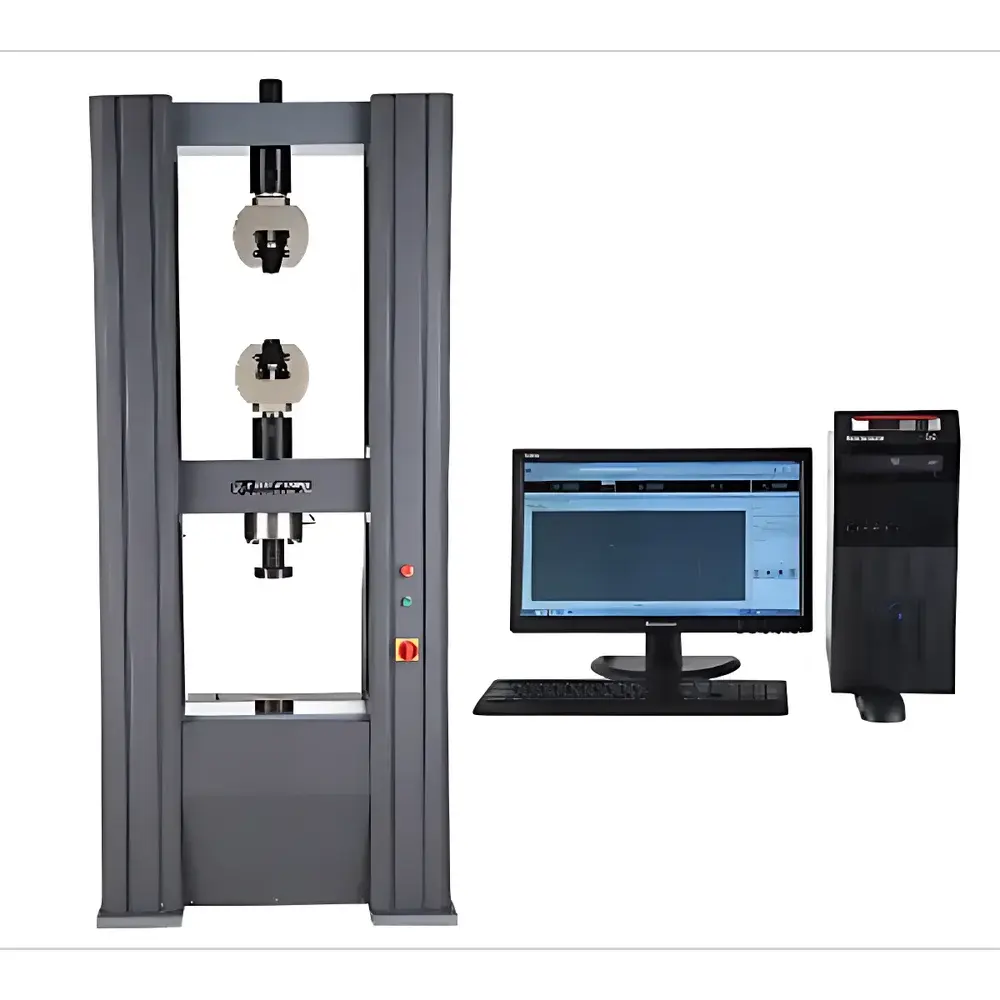
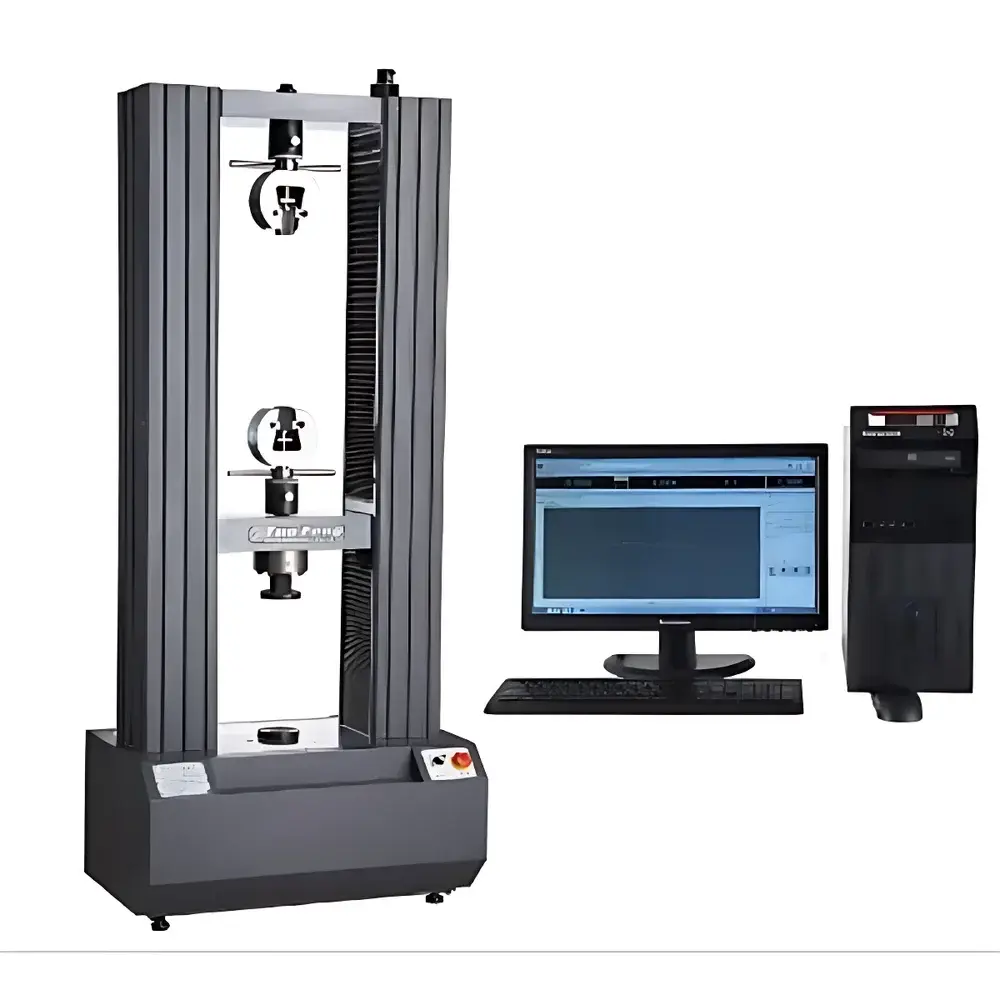
Tuofeng TFW-238 Microcomputer-Controlled Universal Testing Machine
| Brand | Tuofeng |
|---|---|
| Origin | Shanghai, China |
| Manufacturer Type | Direct Manufacturer |
| Product Category | Domestic |
| Model | TFW-238 |
| Instrument Type | Electromechanical Universal Testing Machine |
| Maximum Test Load | 20 kN |
| Accuracy Class | 0.5 |
| Effective Force Measurement Range | 0.2–100% of full scale |
| Force Measurement Accuracy | ±0.005% of reading |
| Force Resolution | 1 part in ±500,000 full-scale load (no range switching, constant resolution) |
| Drive System | Imported servo motor with worm gear reducer |
| Lead Screw | High-precision ball screw |
| Effective Test Width | 600 mm (customizable) |
| Tensile Stroke | 800 mm (extendable) |
| Test Speed Range | 0.001–500 mm/min (infinitely variable) |
| Displacement Measurement | Optical encoder |
| Displacement Accuracy | ±0.005% of reading |
| Strain Measurement | Optional electronic extensometer or large-deformation extensometer |
| Strain Accuracy | ±0.005% of reading |
| Safety Protection | Electronic limit switches, emergency stop button, overload protection (10% above capacity) |
| Crosshead Adjustment | Dual-speed (fast/slow) motorized control with jog function |
| Return Function | Automatic or manual high-speed return to initial position |
| Overload Protection | Automatic shutdown at >110% of rated load |
| Fixture Customization | Application-specific grips and fixtures available |
| Power Supply | 220 V, 1.0 kW |
| Dimensions (W×D×H) | 1000 × 700 × 2000 mm |
| Approx. Weight | 450 kg |
Overview
The Tuofeng TFW-238 Microcomputer-Controlled Universal Testing Machine is an electromechanical static testing system engineered for precision mechanical property characterization of metallic, polymeric, composite, and ceramic materials. Based on closed-loop servo-controlled force and displacement actuation, the system operates under the fundamental principles of uniaxial quasi-static loading—compliant with ISO 7500-1, ASTM E4, and GB/T 16491-2008 standards for verification of force measurement systems. Its modular architecture supports standardized tensile, compression, bending, shear, tear, peel, and puncture tests per ASTM D638, ISO 527, ASTM C39, ISO 178, ASTM D1876, and GB/T 2792. Designed for laboratory-grade repeatability and long-term stability, the TFW-238 integrates high-resolution transduction, thermal-stable mechanical alignment, and real-time digital feedback control to ensure traceable, auditable test data suitable for GLP, GMP, and ISO/IEC 17025 environments.
Key Features
- 0.5-class accuracy certified per GB/T 16491-2008 and JJG 475–2008, with force resolution of 1 part in ±500,000 full-scale load—maintained across the entire dynamic range without range switching
- High-precision ball screw drive system coupled with imported servo motor and worm gear reducer, delivering smooth, low-noise motion and minimal backlash (<0.02 mm)
- Dual-speed crosshead control (fast/slow modes) with jog functionality and programmable return-to-start sequence after test completion
- Comprehensive safety architecture: electronic travel limits, hardware-based emergency stop circuitry, mechanical overload cutoff (>110% FS), and software-enforced operational boundaries
- Modular fixture interface supporting ASTM-compliant wedge-action grips, compression platens, bend fixtures, peel jigs, and custom-designed tooling for specialized geometries
- Integrated optical encoder for displacement measurement with ±0.005% reading accuracy and sub-micron positional resolution
Sample Compatibility & Compliance
The TFW-238 accommodates specimens ranging from thin polymer films (≥0.05 mm thickness) to structural steel coupons (up to 40 mm thick), including wire, rod, sheet, tube, and molded components. It complies with international standard test methods including ASTM E8/E8M (tension), ASTM D695 (compression), ASTM D790 (flexure), ASTM D624 (tear), ISO 1133 (melt flow index correlation), and GB/T 1040 series. All mechanical and metrological performance parameters are validated against national verification规程 JJG 475–2008 and certified by provincial-level metrology institutes. The system meets requirements for regulatory submission under FDA 21 CFR Part 11 when configured with audit-trail-enabled software and user-access controls.
Software & Data Management
The Windows-based testing software provides multi-mode control—including constant-rate loading, constant-strain-rate, load-hold, displacement-hold, and cyclic protocols—with real-time graphical display of up to four synchronized curves (e.g., stress–strain, load–time, extension–time). Units are freely convertible between SI, imperial, and legacy metric systems. Raw data files (.csv, .txt) include timestamped metadata (operator ID, sample ID, environmental conditions), and all test parameters are digitally signed and version-locked. Software supports automated report generation per ISO/IEC 17025 Annex A, with configurable templates for internal QA, third-party certification, or regulatory filing. Audit trail functionality logs every parameter change, user login/logout, and result modification event—fully compliant with FDA 21 CFR Part 11 and EU Annex 11 requirements.
Applications
This system serves as a core mechanical testing platform across R&D, quality assurance, and production validation workflows. In aerospace, it characterizes titanium alloy fasteners and carbon-fiber laminates under tensile and interlaminar shear loading. In medical device manufacturing, it validates suture tensile strength (ISO 10993-12) and catheter shaft stiffness (ASTM F2606). Automotive suppliers use it for rubber bushing compression set analysis (ASTM D395) and battery cell stack compressive yield behavior. In construction materials testing, it determines compressive strength of concrete cores (ASTM C39) and flexural modulus of fiber-reinforced cement boards (ASTM C78). Academic labs employ it for fundamental viscoelastic modeling of hydrogels and thermoplastic elastomers via multi-step creep/recovery protocols.
FAQ
What standards does the TFW-238 comply with for calibration and verification?
It conforms to GB/T 16491–2008 (Chinese national standard for electronic UTM), JJG 475–2008 (verification regulation), ISO 7500–1 (static force calibration), and ASTM E4 (force verification procedures). Calibration certificates are traceable to NIM (National Institute of Metrology, China) or equivalent national metrology institutes.
Can the system perform cyclic or fatigue testing?
The base configuration supports quasi-static cyclic loading (e.g., tension–compression hysteresis) up to 5 Hz; high-frequency fatigue testing requires optional hydraulic or electromagnetic actuator modules not included in the TFW-238 standard package.
Is strain measurement integrated or optional?
Axial strain measurement is optional: electronic extensometers (for rigid materials) and large-deformation clip-on or video-based extensometers (for elastomers, foams) are available as field-installable accessories with calibrated output signals.
Does the software support LIMS integration?
Yes—the software includes OPC UA and TCP/IP interfaces for bidirectional communication with laboratory information management systems (LIMS), enabling automatic sample ID ingestion, result push, and instrument status monitoring.
What maintenance intervals are recommended?
Preventive maintenance is advised every 12 months or 2,000 operating hours, including lead screw lubrication, encoder alignment check, load cell zero drift verification, and firmware/software update validation per manufacturer release notes.



