
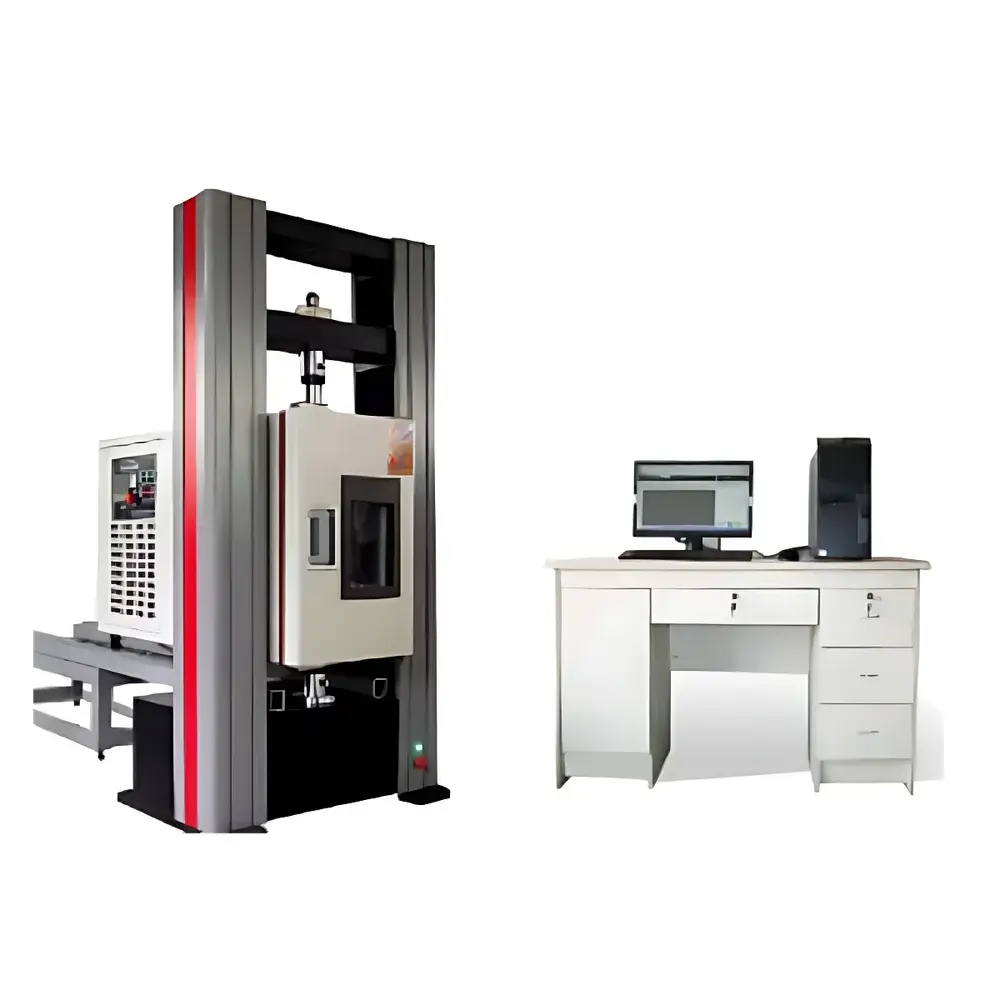
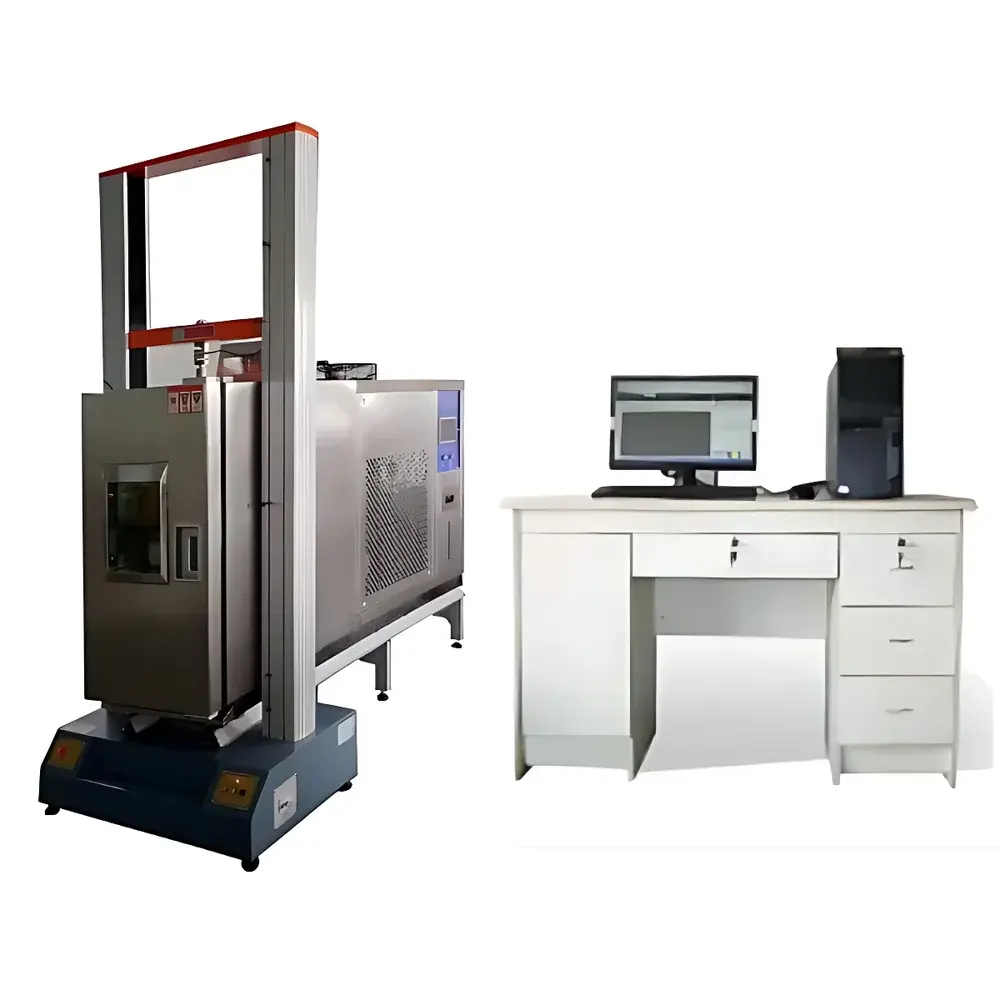
Tuofeng TFW-247 High-Low Temperature Electronic Universal Testing Machine
| Brand | Tuofeng |
|---|---|
| Model | TFW-247 |
| Type | Electromechanical Universal Testing Machine |
| Max Test Load | 5–300 kN (configurable) |
| Accuracy Class | 0.5 |
| Force Measurement Range | 0.4–100% FS |
| Force Resolution | 1/500,000 of Full Scale |
| Deformation Measurement Range | 0.2–100% FS |
| Deformation Resolution | up to 1/300,000 |
| Displacement Error | ±0.5% of reading |
| Column Inner Width | 840 mm |
| Crosshead Travel (standard) | 1000 mm |
| Host Dimensions (L×W×H) | 1250 × 560 × 2400 mm |
| Weight | ~380 kg |
| Power Supply | AC 220 V / 50 Hz ±10%, 750 W |
| Environmental Operating Range | +5 °C to +35 °C |
| Integrated Environmental Chamber | Temp. Range –40 °C to +100 °C |
| Chamber Internal Dimensions | 360 × 300 × 500 mm (W×D×H) |
| Heating Power | 1.5 kW |
| Cooling Method | Compressor-assisted |
| Temperature Uniformity | ±2 °C over 100 mm vertical zone |
| Temperature Stabilization Time | ≤5 min (both above and below 0 °C) |
| Chamber Control | Programmable PID with Pt100 sensors |
| Safety Systems | Leakage current protection, overcurrent circuit breaker |
| Compliance | Designed to support GB/T, ISO 6892, ASTM E8/E21, ASTM D638/D790/D143, JIS Z2241, DIN 50125 |
Overview
The Tuofeng TFW-247 High-Low Temperature Electronic Universal Testing Machine is an electromechanical force-testing platform engineered for precision mechanical characterization of metallic and non-metallic materials across a broad thermal spectrum—from –40 °C to +100 °C. It integrates a high-stiffness dual-column load frame with a fully programmable environmental chamber, enabling controlled uniaxial tensile, compression, flexural, peel, tear, and shear testing under thermally regulated conditions. The system operates on servo-controlled electromechanical actuation, delivering high reproducibility in force application and displacement control without hydraulic fluid dependency. Its architecture conforms to the fundamental principles of Hookean mechanics and quasi-static loading protocols defined in ISO 7500-1 and ASTM E4, ensuring traceable calibration and metrological integrity. Unlike ambient-only testers, the TFW-247 supports true thermomechanical coupling—allowing users to quantify temperature-dependent yield strength, modulus transition, ductility loss at cryogenic temperatures, or creep onset near glass transition points—critical for qualification in aerospace composites, polymer processing, and advanced alloy development.
Key Features
- Modular high-precision load frame with 840 mm column spacing and 1000 mm standard crosshead travel—optimized for large specimens and multi-sensor integration.
- 0.5-class accuracy per ISO 7500-1: force measurement uncertainty ≤ ±0.5% of reading across 0.4–100% full scale; resolution maintained at 1/500,000 FS, fully digitized and auto-ranging.
- Dual-channel high-resolution extensometry: strain measurement range 0.2–100% FS with ≤ ±0.5% error and up to 1/300,000 resolution—compatible with clip-on, video, and non-contact extensometers.
- Integrated environmental chamber fabricated from 304 stainless steel exterior and 316 mirror-finish interior, insulated with high-density alumina-silica fiber; includes dual-zone Pt100 sensing, compressor-assisted cooling, and NiCr heating elements.
- Programmable thermal profile capability: ramp rates, dwell times, and step cycles configurable via embedded controller; temperature uniformity validated at ±2 °C over 100 mm axial zone.
- Comprehensive safety architecture: leakage current protection, thermal cutoffs, emergency stop interlock, and mechanical overload limit switches compliant with IEC 61000-6-2/6-4 EMC standards.
Sample Compatibility & Compliance
The TFW-247 accommodates standardized test specimens per ASTM E8 (metals), ASTM D638 (plastics), ISO 527 (polymer tensile), ISO 178 (flexure), and ISO 1133 (melt flow index correlation). Its chamber aperture (50 mm diameter top/bottom ports) permits uninterrupted load train alignment during thermal cycling, minimizing parasitic bending moments. Specimen fixtures—including wedge-action grips, pneumatic clamps, and custom four-point bend tooling—are interchangeable and calibrated to ISO 14577 Annex B. The system meets functional requirements for GLP-compliant laboratories: audit-trail-enabled software, electronic signature support per FDA 21 CFR Part 11, and raw data immutability. It supports full traceability to national metrology institutes via factory calibration certificates (NIST-traceable load cells and displacement transducers) and is routinely deployed in ISO/IEC 17025-accredited testing labs for third-party certification.
Software & Data Management
The Windows-based Tuofeng TestMaster™ software provides real-time synchronized acquisition of force, displacement, strain, and chamber temperature at up to 1 kHz sampling rate. It features automated parameter calculation per ISO 6892-1 (e.g., Rp0.2, Rm, A50mm, E-modulus), customizable report templates (PDF/Excel/XML), and curve overlay functionality for comparative thermal-series analysis. All test sequences are stored with metadata including operator ID, calibration status, environmental logs, and version-controlled firmware identifiers. Raw binary data (.tdf) is archived with checksum validation and supports post-hoc reprocessing using user-defined algorithms. The software architecture complies with ICH M7 and USP guidelines for analytical instrument qualification (AIQ), covering design qualification (DQ), installation qualification (IQ), operational qualification (OQ), and performance qualification (PQ) documentation modules.
Applications
- Aerospace: Tensile strength degradation of carbon-fiber-reinforced polymers (CFRPs) at –40 °C; compressive yield behavior of Ti-6Al-4V under thermal soak.
- Automotive: Peel adhesion testing of structural adhesives at elevated temperatures (85 °C/85% RH simulated); low-temperature impact resistance of polypropylene bumpers.
- Biomedical: Mechanical fatigue of PEEK spinal cages under physiological temperature cycling (37 °C ↔ –10 °C); suture pull-out strength in hydrated collagen matrices.
- Electronics: Coefficient of thermal expansion (CTE) estimation via constrained thermal strain in solder joint analogs; die-attach bond strength evaluation at reflow profiles.
- Academic Research: Strain-rate sensitivity mapping of shape-memory alloys across martensite/austenite transition zones; viscoelastic master curve generation for thermoplastic elastomers.
FAQ
What temperature ranges does the integrated chamber support, and how is thermal stability verified?
The chamber operates from –40 °C to +100 °C with ≤5 min stabilization time and ±2 °C uniformity across the 100 mm active test zone, validated using NIST-traceable Pt100 probes and documented in IQ/OQ reports.
Is the system compliant with FDA 21 CFR Part 11 for regulated environments?
Yes—TestMaster™ software includes role-based access control, electronic signatures, immutable audit trails, and data backup protocols aligned with Part 11 Subpart B requirements.
Can custom test methods be programmed, and are they exportable between instruments?
All test sequences are saved as XML-based method files and can be imported/exported across TFW-series systems without vendor lock-in or proprietary encryption.
What maintenance intervals are recommended for the environmental chamber and load frame?
Chamber compressor oil and desiccant are inspected quarterly; load cell verification is recommended annually or after 10,000 cycles, per ISO 7500-1 Annex C.
Does the system support third-party extensometers or digital image correlation (DIC)?
Yes—the controller provides TTL-sync outputs and analog voltage inputs compatible with industry-standard DIC systems (e.g., Correlated Solutions VIC-2D) and LVDT/video extensometers.



