
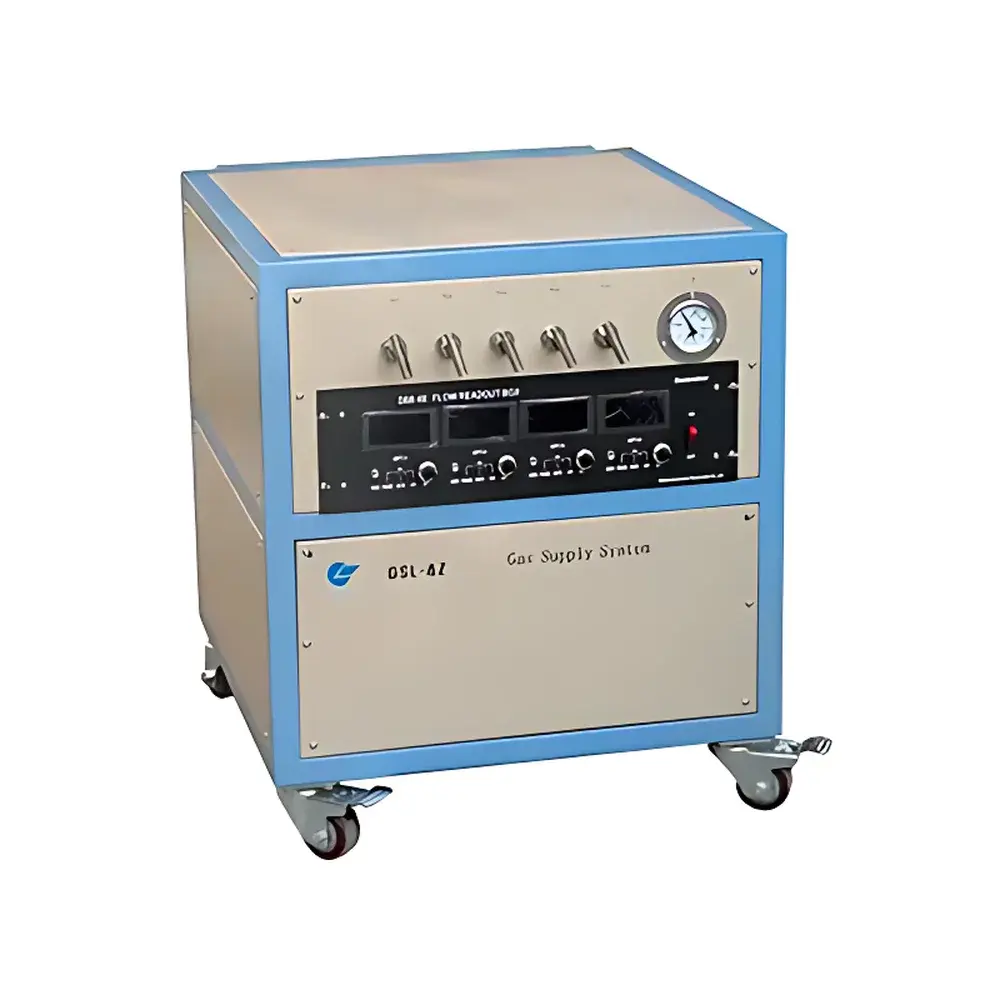
Kejing GSL-4Z Multi-Channel Mass Flow Control System
| Brand | Kejing |
|---|---|
| Model | GSL-4Z |
| Origin | Anhui, China |
| Channel Configuration | 4 independent mass flow controllers (MFCs) |
| Standard Flow Ranges | 100 sccm, 200 sccm, 200 sccm, 500 sccm |
| Accuracy | ±1% FS |
| Repeatability | ±0.2% FS |
| Linearity | ±0.5–1.5% FS |
| Response Time (Gas) | 1–4 s |
| Operating Pressure Range | 0.1–0.5 MPa differential |
| Max Inlet Pressure | 3 MPa |
| Operating Temperature | 5–45 °C |
| Power Supply | 185–245 VAC, 50 Hz |
| Max Power Consumption | 18 W |
| Gas Mixing Chamber | Φ80 × 120 mm stainless steel |
| Manifold & Tubing | 316 stainless steel 1/4″ fittings, nylon tubing (ID 1/4″, L=12″) |
| Mechanical Pressure Gauge Range | −0.1 to +0.15 MPa (0.01 MPa/division) |
| Enclosure Dimensions | 600 × 600 × 650 mm (W×D×H) |
Overview
The Kejing GSL-4Z Multi-Channel Mass Flow Control System is an engineered solution for precise, independent regulation and real-time monitoring of gas mass flow rates across four discrete channels. Based on thermal mass flow measurement principles—utilizing constant-temperature anemometry—the system delivers high reproducibility and stability under varying inlet pressure, temperature, and gas composition conditions. Designed for integration with high-temperature synthesis platforms—including tube furnaces, CVD reactors, and annealing systems—the GSL-4Z enables controlled atmospheric environments critical for thin-film deposition, dopant diffusion, oxide growth, and post-processing treatments in materials science and semiconductor research. Its modular architecture supports both standalone operation and synchronized control via external PLC or PC-based automation interfaces, making it suitable for ISO/IEC 17025-accredited laboratories and GMP-compliant pilot-scale process development.
Key Features
- Four independently calibrated thermal mass flow controllers (MFCs), each with user-selectable full-scale ranges (100, 200, or 500 sccm) to accommodate diverse gas species and stoichiometric ratios.
- High-accuracy control with ±1% full-scale (FS) accuracy, ±0.2% FS repeatability, and linearity within ±0.5–1.5% FS—validated per ISO 6358 and ASTM D7504 standards for gas flow instrumentation.
- Robust mechanical design featuring 316 stainless steel needle valves, pressure-rated manifold blocks, and a welded stainless steel mixing chamber (Φ80 × 120 mm) resistant to corrosion and thermal cycling.
- Wide operational pressure window: functional from vacuum-compatible differential pressures (0.1 MPa) up to 3 MPa absolute inlet pressure—enabling compatibility with high-pressure CVD precursors and inert carrier gases.
- Integrated analog (0–5 V / 4–20 mA) and digital (RS-485 Modbus RTU) output interfaces for seamless integration into SCADA, LabVIEW, or custom process control software stacks.
- Front-panel mechanical pressure gauge (−0.1 to +0.15 MPa, 0.01 MPa resolution) and precision-adjustable stainless steel needle valves provide manual override and local verification capability without reliance on electronic feedback.
Sample Compatibility & Compliance
The GSL-4Z is compatible with non-corrosive, non-condensable gases including N2, Ar, O2, H2, He, NH3, and diluted silane or phosphine mixtures when used with appropriate gas-handling protocols. All wetted components meet ASTM A269/A270 specifications for sanitary-grade 316 stainless steel. The system complies with ISO 14001 environmental management requirements and OHSAS 18001 (now ISO 45001) occupational health and safety criteria. Electrical design conforms to IEC 61000-6-3 (EMC emission limits) and IEC 61000-6-2 (immunity). No hazardous substances are used in construction per RoHS Directive 2011/65/EU. Documentation includes factory calibration certificates traceable to NIM (National Institute of Metrology, China) standards.
Software & Data Management
While the GSL-4Z operates autonomously via front-panel controls, optional Kejing MFC-Link software (Windows-based) provides real-time flow visualization, multi-channel setpoint programming, data logging at configurable intervals (100 ms–10 s), and CSV export for post-analysis. Audit trails include timestamped setpoint changes, alarm events (e.g., overpressure, zero-drift alert), and controller status flags—supporting GLP and FDA 21 CFR Part 11 compliance when deployed with validated user access controls and electronic signature modules. Raw analog outputs can be interfaced with third-party DAQ systems (e.g., National Instruments USB-6009) for closed-loop furnace atmosphere control in accordance with ASTM F1526 and SEMI F20 standards.
Applications
- Chemical vapor deposition (CVD) and atomic layer deposition (ALD) precursor delivery with stoichiometric ratio control across multiple reactant lines.
- Inert or reducing atmosphere annealing of metal oxides, perovskites, and 2D materials in horizontal or vertical tube furnaces.
- Controlled oxidation kinetics studies requiring dynamic O2/N2 blending under elevated temperature and pressure.
- Gas-phase doping of silicon wafers and compound semiconductors during diffusion and epitaxial growth.
- Calibration reference for secondary flow sensors in cleanroom HVAC and exhaust scrubber monitoring systems.
- Research-scale plasma-enhanced CVD (PECVD) where precise gas residence time and partial pressure management are essential.
FAQ
Can the GSL-4Z be used with reactive or corrosive gases such as Cl2 or HF?
No—standard GSL-4Z units are configured for non-corrosive gases only. For aggressive chemistries, optional Hastelloy-C276 sensor elements and fluoropolymer-sealed valves must be specified at time of order.
Is individual channel calibration certified and traceable?
Yes—each MFC undergoes factory calibration using NIST-traceable primary standards; calibration certificates (including as-found/as-left data) are supplied with shipment.
What is the minimum detectable flow rate for the 100 sccm channel?
The lower limit of control is 0.5% FS (0.5 sccm), with measurable signal down to 0.1% FS under stable thermal conditions.
Does the system support automatic leak-check routines?
Not natively—but when integrated with a programmable pressure decay module (e.g., Kejing PDM-2000), automated zero-flow integrity tests can be executed via Modbus command sequences.
Can flow setpoints be modulated via analog voltage input from an external PID controller?
Yes—each channel accepts 0–5 VDC analog setpoint input with 12-bit resolution; voltage-to-flow mapping is linear and user-configurable via DIP switches or software.



