
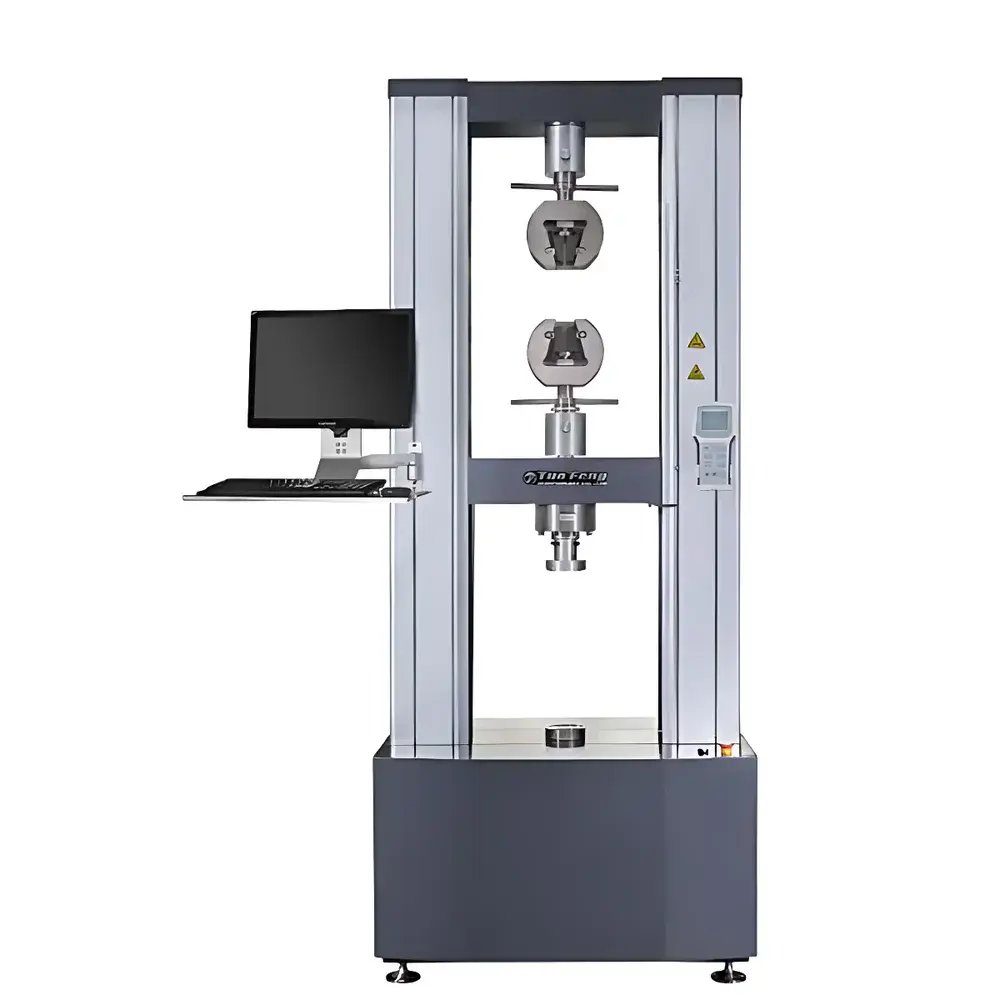
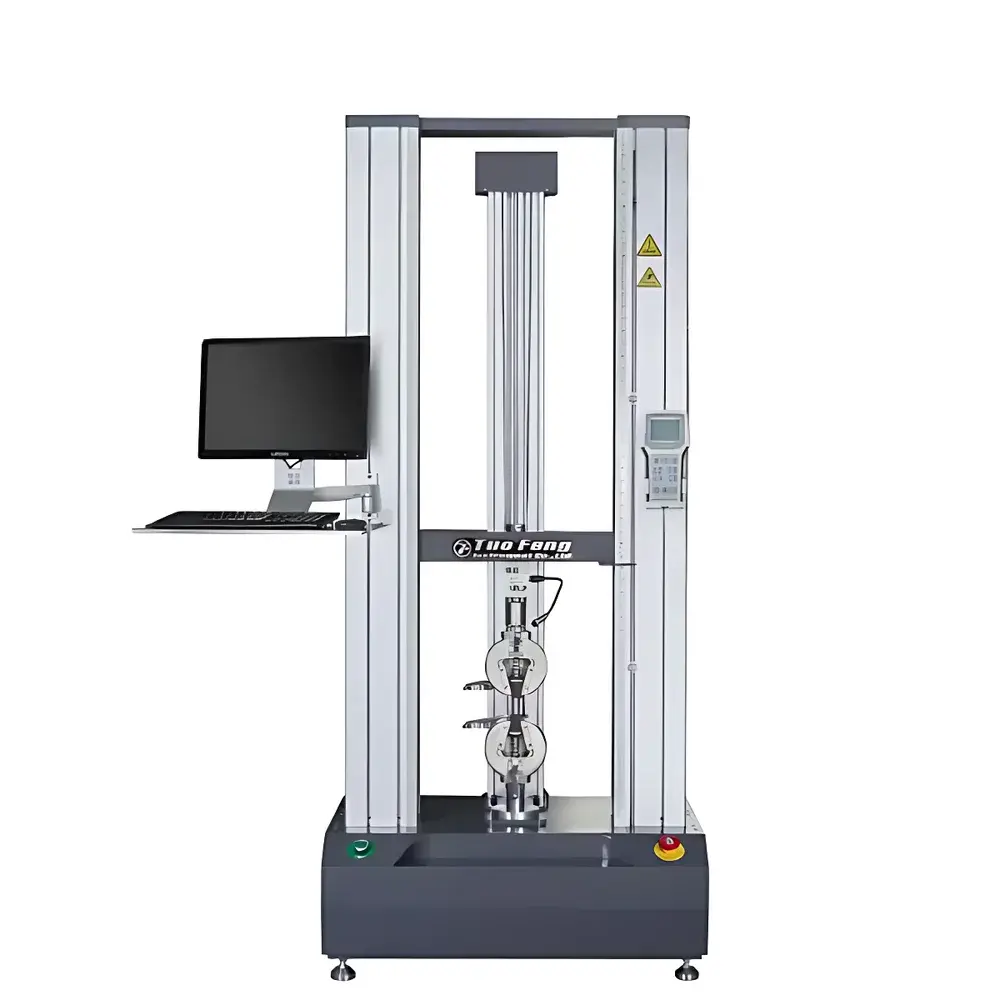
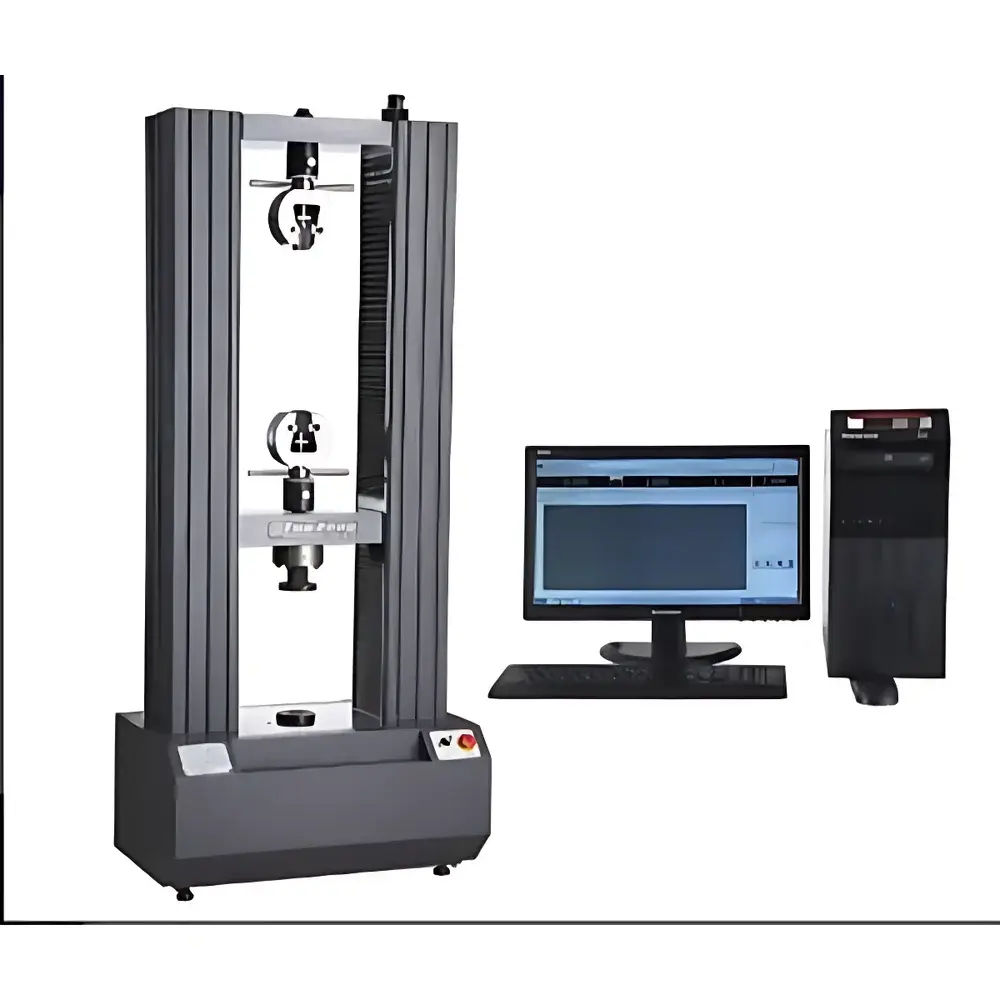
Tuofeng TFW-197 Microcomputer-Controlled Electronic Universal Testing Machine
| Brand | Tuofeng |
|---|---|
| Origin | Shanghai, China |
| Manufacturer Type | Direct Manufacturer |
| Instrument Type | Electromechanical Universal Testing Machine |
| Model | TFW-197 |
| Max Test Load | 100 kN |
| Accuracy Class | 0.5 |
| Effective Force Range | 0.2–100% of Full Scale |
| Force Measurement Accuracy | ±0.005% of Reading |
| Force Resolution | 1 part in ±500,000 full-scale codes (no range switching, constant resolution) |
| Drive System | Imported Servo Motor + Worm Gear Reducer |
| Lead Screw | High-Precision Ball Screw |
| Effective Test Width | 600 mm (customizable) |
| Stroke | 800 mm (extendable) |
| Speed Range | 0.001–500 mm/min (infinitely variable) |
| Displacement Measurement | Optical Encoder |
| Displacement Accuracy | ±0.005% of Reading |
| Strain Measurement | Optional Extensometer or Large-Deformation Clip-on Gauge |
| Strain Accuracy | ±0.005% of Reading |
| Safety Protection | Electronic Limit Switches, Emergency Stop Button, Overload Protection (10% above rated capacity) |
| Crosshead Control | Dual-speed (fast/slow) motorized up/down with jog function |
| Return Function | Automatic or manual high-speed return to initial position |
| Fixture Customization | Application-specific grips and fixtures available |
| Dimensions (W×D×H) | 1000×700×2000 mm |
| Power Supply | 220 V, 1.5 kW |
| Net Weight | ~800 kg |
| Compliance | GB/T 16491–2008, JJG 475–2008, ASTM E4, ASTM E8, ASTM D638, ASTM D790, ISO 6892-1, ISO 178, ISO 527, DIN 53455, JIS Z2241, BS EN 10002-1 |
Overview
The Tuofeng TFW-197 is a microcomputer-controlled electromechanical universal testing machine engineered for high-precision static mechanical property evaluation of metallic, polymeric, ceramic, and fiber-reinforced composite materials. Based on servo-driven force application and closed-loop displacement control, it operates under the fundamental principles of uniaxial quasi-static loading—applying controlled tensile, compressive, flexural, shear, tear, peel, and puncture forces to standardized specimens per internationally recognized test protocols. Its rigid frame architecture, high-resolution load cell (1/±500,000 internal resolution), and zero-drift displacement feedback system ensure repeatable, traceable, and metrologically sound measurements across the full force range—from 0.2% to 100% of its 100 kN capacity. Designed for laboratory and quality assurance environments requiring GLP-compliant data integrity, the TFW-197 meets national and international manufacturing and verification standards including GB/T 16491–2008 and JJG 475–2008, while supporting method execution aligned with ASTM E4 (load verification), ASTM E8/E21 (tension/compression of metals), ASTM D638/D790 (plastics), and ISO 6892-1 (metallic tensile testing).
Key Features
- 0.5-class accuracy certified mechanical system with dual-circuit overload protection (electronic limit switches, emergency stop, and automatic cut-off at 110% full scale)
- High-stiffness cast-iron frame integrated with precision-ground ball screws and low-backlash worm gear reduction for minimal axial deflection and thermal drift
- Imported servo motor drive delivering smooth, noise-free operation across the full speed range (0.001–500 mm/min) with programmable ramp-hold-step profiles
- Constant-resolution force measurement without range switching—enabling seamless transition from low-force composites testing to high-load structural component validation
- Modular extensometry support: compatible with both clip-on electronic extensometers (for modulus and yield determination) and large-deformation video or mechanical gauges (for elastomers and soft composites)
- Motorized crosshead with dual-speed control (jog/fast return), enabling rapid specimen setup and post-test recovery without manual intervention
- Integrated safety interlocks—including hardware-based emergency stop circuitry and software-enforced operational limits—meeting IEC 61508 functional safety prerequisites for industrial lab deployment
Sample Compatibility & Compliance
The TFW-197 accommodates a broad spectrum of specimen geometries and material classes through customizable fixture sets: pneumatic wedge grips for high-strength fibers, compression platens with self-aligning spherical seats, three/four-point bend fixtures conforming to ASTM D790, peel test jigs per ASTM D1876, and puncture fixtures compliant with ISO 3344. It supports standard specimen widths up to 600 mm and stroke lengths up to 800 mm (extendable), making it suitable for laminated CFRP panels, honeycomb cores, thermoplastic matrix composites, and hybrid metal-polymer assemblies. All test methods are executable within a documented, audit-ready framework—supporting 21 CFR Part 11–compliant user access controls, electronic signatures, and immutable audit trails when paired with validated software configurations. Calibration certificates are traceable to NIM (National Institute of Metrology, China) and optionally to NIST or UKAS-accredited laboratories upon request.
Software & Data Management
The Windows-based Tuofeng TestSuite v4.2 provides ISO/IEC 17025-aligned test method configuration, real-time multi-curve visualization (force–time, stress–strain, displacement–time, force–extension), and automated parameter derivation—including ultimate tensile strength (UTS), yield strength (0.2% offset), Young’s modulus, elongation at break, compressive yield stress, flexural modulus, tear strength, and peel adhesion energy. The software supports multilingual UI (English, Simplified/Traditional Chinese), unit system switching (N/kN/lbf, MPa/psi, mm/in), batch report generation with embedded statistical summaries (max/min/mean/stdev), and overlay comparison of up to 12 curves with differential deviation highlighting. Raw data exports to CSV, XML, and PDF formats include metadata tags (operator ID, timestamp, calibration ID, environmental conditions). Firmware and software updates are delivered remotely via secure HTTPS channel, with version-controlled release notes and backward-compatible data file handling ensuring long-term archive integrity.
Applications
- Mechanical qualification of carbon-fiber/epoxy laminates per ASTM D3039 and ISO 527-4 in aerospace OEM supply chains
- Interlaminar shear strength (ILSS) assessment of prepreg systems using short-beam shear fixtures (ASTM D2344)
- Tensile fatigue pre-screening of glass-fiber reinforced polymers under controlled load cycling protocols
- Compression-after-impact (CAI) residual strength evaluation of sandwich structures following ASTM D7136
- Adhesive bond line characterization—lap shear (ASTM D1002), peel (ASTM D903), and cleavage (ASTM D1876)
- Quality control of thermoplastic composite tapes during automated fiber placement (AFP) process validation
- Research-grade constitutive modeling input generation for finite element analysis (FEA) of hybrid joints and bolted connections
FAQ
Does the TFW-197 comply with ASTM and ISO test standards?
Yes—it is fully configurable to execute ASTM D638, D790, D3039, D2344, D7136, and ISO 527, 178, 6892-1, 3344, with method templates preloaded in the software.
Can the system perform cyclic or fatigue testing?
The base configuration supports quasi-static loading only; optional servo-hydraulic upgrade modules enable low-cycle fatigue testing up to 10 Hz with dedicated waveform generators and strain-controlled closed-loop operation.
Is the software 21 CFR Part 11 compliant?
Out-of-the-box functionality includes role-based access, electronic signatures, and audit trail logging; full Part 11 compliance requires site-specific validation documentation and IT infrastructure alignment per FDA guidance.
What calibration documentation is provided?
Each unit ships with a factory calibration certificate traceable to NIM; third-party NIST-traceable calibration reports are available as an add-on service.
Are custom fixtures included in the standard package?
Standard delivery includes one pair of universal wedge grips and flat compression platens; application-specific fixtures (e.g., peel jigs, bend supports) are quoted separately based on dimensional and load requirements.



