
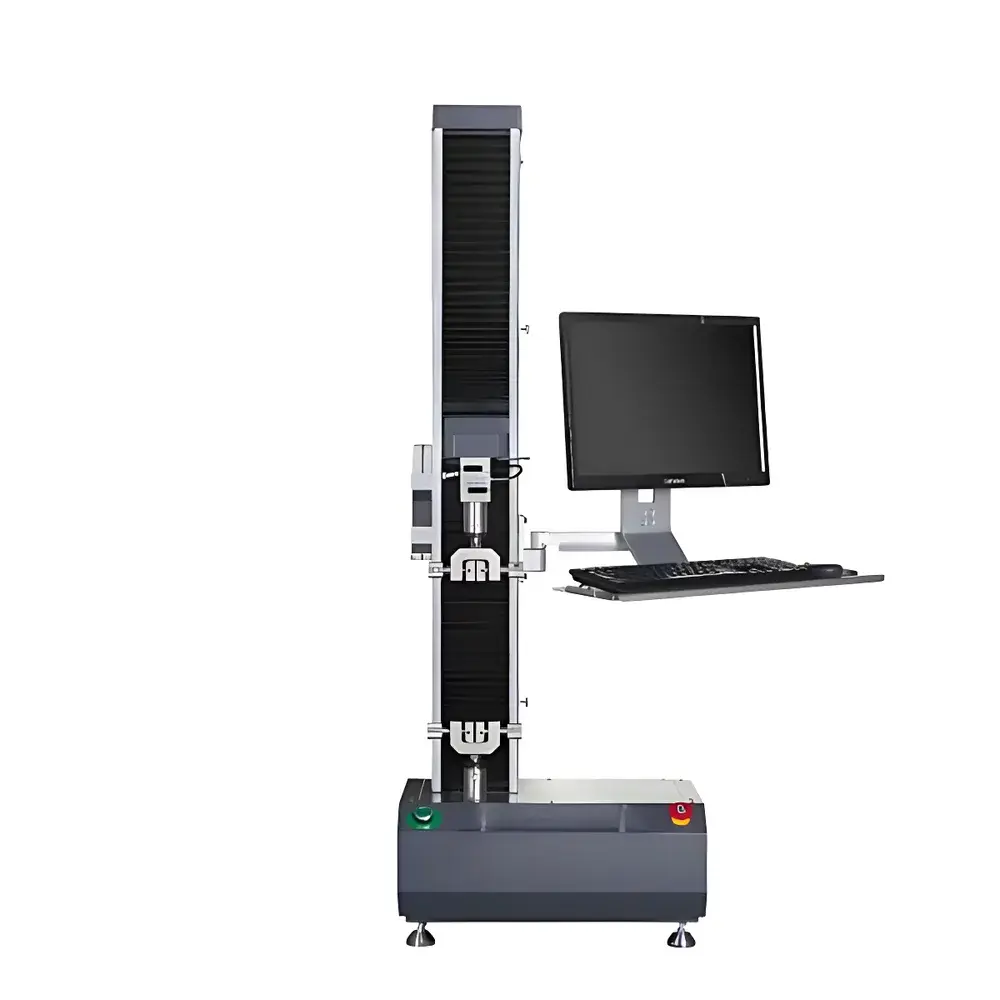
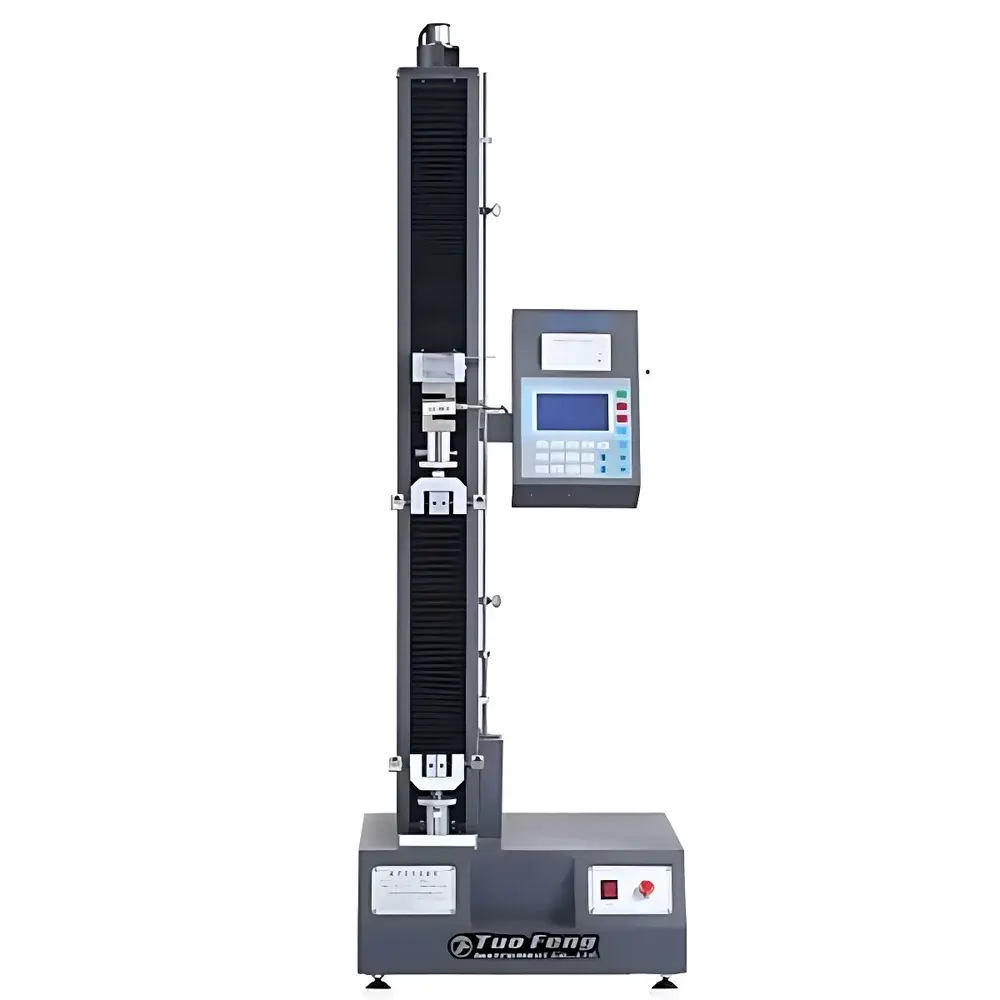
TOFENG TFW-244 Electronic Tensile Testing Machine for Hydrogel Characterization
| [Brand | TOFENG |
|---|---|
| Origin | Shanghai, China |
| Manufacturer Type | Direct Manufacturer |
| Instrument Type | Electronic Tensile Testing Machine |
| Model | TFW-244 |
| Max Test Force | 5 kN |
| Force Measurement Range | 0.4%–100% FS |
| Force Accuracy | ±0.5% of reading |
| Crosshead Travel | 700 mm |
| Displacement Resolution | ±0.5% of reading |
| Compliance | ASTM D638, ISO 527, GB/T 1040, ISO 1184, USP <1209> (for hydrogel adhesion and cohesion assessment)] |
Overview
The TOFENG TFW-244 Electronic Tensile Testing Machine is an engineered platform designed specifically for the mechanical characterization of soft, viscoelastic biomaterials—including hydrogels, hydrocolloid films, tissue-engineered scaffolds, and pharmaceutical dosage forms. Unlike general-purpose tensile testers optimized for metals or rigid polymers, the TFW-244 integrates low-force sensitivity, high-resolution displacement tracking, and programmable strain-rate control to meet the stringent demands of hydrogel testing protocols. It operates on the principle of uniaxial quasi-static tensile loading under controlled displacement or load control, enabling precise quantification of stress–strain behavior, fracture toughness, elastic modulus (E), yield point, elongation at break, and adhesive/cohesive strength in hydrated or partially dehydrated states. Its modular architecture supports standardized test configurations per ISO 1184 (tensile properties of rubber-like materials), ASTM D638 (plastics), and USP (mechanical performance of hydrogel-based wound dressings and transdermal patches).
Key Features
- High-fidelity force measurement system with ±0.5% accuracy across 0.4–100% full scale (5 kN), ensuring traceable data for regulatory submissions.
- Optimized crosshead travel of 700 mm—extendable upon request—to accommodate large-format hydrogel sheets, multi-layer laminates, or swelling-integrated fixtures.
- Motor-driven dual-speed actuation (0.01–500 mm/min, infinitely variable) with real-time feedback control, enabling creep, stress-relaxation, and cyclic loading sequences critical for viscoelastic analysis.
- Integrated optical encoder-based displacement sensing with ±0.5% linearity, supporting accurate calculation of true strain even during large deformations (>300% elongation).
- Dual-limit safety architecture: electronic software limits + hardware emergency stop + overload cutoff (>110% FS) to protect both operator and delicate specimens.
- Modular fixture interface compatible with pneumatic grips, custom hydrogel clamping jaws, peel-adhesion fixtures (180°/90°), and environmental chamber mounts (optional).
Sample Compatibility & Compliance
The TFW-244 accommodates a broad spectrum of hydrogel morphologies: cast films (thickness 0.2–5 mm), injectable pre-gel solutions (via compression-to-fracture mode), electrospun nanofiber-reinforced hydrogels, and composite wound matrices. Specimen geometries include dog-bone, rectangular strips, circular discs, and custom die-cut shapes. The system complies with internationally recognized standards for mechanical testing of soft biomaterials—including ISO 527-2 (plastics – tensile properties), ASTM F2100 (performance of medical face mask materials), ISO 10993-10 (biological evaluation of medical devices – irritation and sensitization), and USP (hydrogel physical integrity and adhesion). All test methods are fully configurable to support GLP-compliant workflows, including audit-trail-enabled user authentication and electronic signature capability (when paired with validated software version).
Software & Data Management
The proprietary Windows-based TensilePro™ software (v4.2+) provides ISO/IEC 17025-aligned data acquisition and reporting. It supports multi-mode control: constant rate of extension (CRE), constant load, ramp-to-failure, and hold-at-load protocols. Real-time plotting includes stress–strain, force–time, displacement–time, and derivative modulus curves. Software modules automatically compute and report Young’s modulus (initial slope), ultimate tensile strength (UTS), breaking elongation, toughness (area under curve), and post-yield energy absorption. Data export is native to CSV, XML, and PDF formats; raw ASCII files include timestamped force/displacement/strain channels at ≥100 Hz sampling. The system supports 21 CFR Part 11 compliance packages (optional), featuring role-based access control, electronic signatures, and immutable audit logs for QA/QC departments operating under GMP or ISO 13485 frameworks.
Applications
- Mechanical validation of synthetic and natural hydrogels (e.g., alginate, chitosan, PEGDA, gelatin-methacryloyl) during formulation development.
- Quality control of commercial hydrogel products—wound dressings, contact lenses, drug-eluting matrices, and bioadhesive patches—against batch-to-batch consistency metrics.
- Swelling–mechanics coupling studies: integration with environmental chambers to quantify modulus decay under controlled humidity or immersion conditions.
- Adhesion strength testing of hydrogel–skin, hydrogel–tissue, or hydrogel–polymer interfaces using modified peel or lap-shear fixtures.
- Regulatory dossier preparation for FDA 510(k), CE Marking, or NMPA registration, where tensile parameters serve as critical quality attributes (CQAs).
FAQ
Can the TFW-244 measure very low-force responses typical of ultra-soft hydrogels (<100 mN)?
Yes—the system’s high-resolution load cell and noise-suppressed signal conditioning enable stable acquisition down to 0.4% of 5 kN (20 N), with optional calibration kits available for sub-Newton verification.
Is it possible to perform hydration-dependent testing?
Absolutely. The machine features standardized mounting points for third-party environmental chambers (temperature/humidity control) and custom liquid submersion stages, enabling in-situ tensile testing under physiological or accelerated aging conditions.
Does the software support automated pass/fail criteria based on specification limits?
Yes. TensilePro™ allows users to define upper/lower specification limits per parameter (e.g., UTS ≥ 120 kPa, elongation ≥ 250%). Results are color-coded and flagged in reports for immediate QC decision-making.
What documentation is provided for regulatory audits?
Factory calibration certificates (traceable to NIM, China), IQ/OQ protocol templates, and 21 CFR Part 11 validation support packages are included with each instrument shipment.
Are custom fixtures for irregular hydrogel geometries available?
TOFENG offers engineering consultation and rapid-prototyped fixture design services—typically delivered within 10 business days—based on client-provided CAD models or dimensional specifications.



