
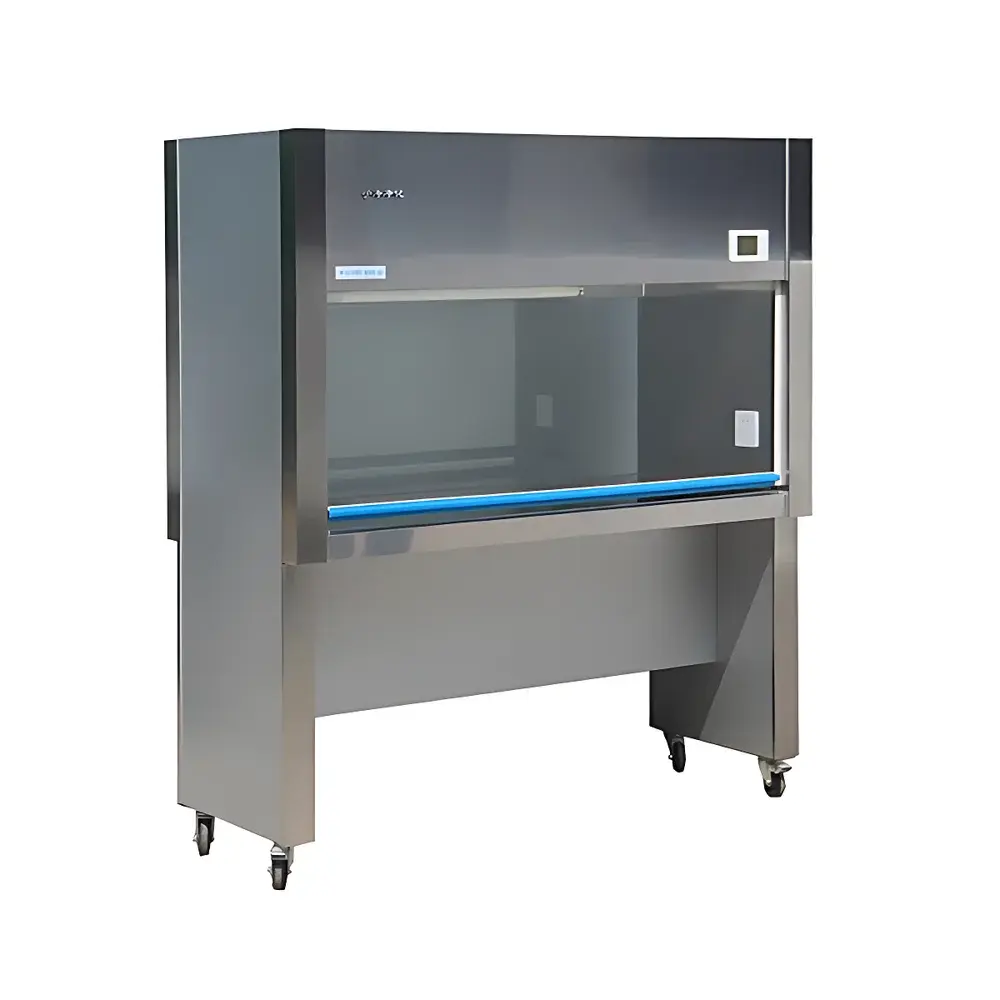
HJ SW-CJ-3FD Triple-User Vertical Laminar Flow Clean Bench
| Brand | HJ |
|---|---|
| Origin | Shanghai, China |
| Manufacturer Type | Direct Manufacturer |
| Instrument Category | Vertical Laminar Flow Clean Bench |
| Model | SW-CJ-3FD |
| Cleanliness Class | ISO Class 5 (equivalent to Fed. Std. 209E Class 100 @ ≥0.5 µm) |
| Airflow Pattern | Vertical Downflow |
| Noise Level | ≤62 dB(A) |
| Operating Personnel Capacity | 3 users |
| Average Air Velocity | 0.25–0.45 m/s (dual-speed control) |
| Illumination | ≥300 lx |
| Power Supply | AC 220 V / 50 Hz |
| Max. Power Consumption | 1000 W |
| Net Weight | 250 kg |
| Work Area Dimensions (W×D×H) | 1800 × 580 × 515 mm |
| Overall Dimensions (W×D×H) | 1960 × 645 × 1625 mm |
| HEPA Filter Specification | 1795 × 555 × 38 mm (single unit) |
| Pre-filter | Integrated coarse particulate pre-filter |
| UV Lamp | 50 W (interlocked with lighting) |
| Fluorescent Lamp | 50 W |
| Vibration Amplitude | ≤5 µm (peak-to-peak, XYZ axes) |
Overview
The HJ SW-CJ-3FD Triple-User Vertical Laminar Flow Clean Bench is an ISO Class 5-certified (Fed. Std. 209E Class 100) personnel-protective and product-protective work environment engineered for routine aseptic operations in microbiology, cell culture, pharmaceutical quality control, and academic research laboratories. It employs a vertical laminar airflow principle: ambient air is drawn through a pre-filter to capture coarse particulates, then forced downward through a certified HEPA filter (≥99.99% efficiency at 0.3 µm) at a controlled, uniform velocity (0.25–0.45 m/s). This unidirectional, low-turbulence airflow creates a sterile working zone by continuously sweeping airborne contaminants—including viable microorganisms and non-viable particles ≥0.5 µm—away from the work surface and out through the front grille. Unlike biosafety cabinets, this clean bench provides product protection only; it does not protect operators from hazardous aerosols or vapors. Its design complies with core principles outlined in ISO 14644-1 for cleanroom performance verification and supports GLP-aligned documentation practices for routine environmental monitoring.
Key Features
- Triple-user configuration with single-face vertical downflow architecture optimized for collaborative yet segregated workflow in shared lab spaces.
- High-efficiency, energy-optimized blower system mounted overhead, delivering stable laminar flow across the full 1800 mm work surface without turbulence hotspots.
- Dual-speed electronic control (via infrared remote) enables real-time adjustment of face velocity to match procedural requirements—e.g., slower flow for delicate tissue handling, faster flow for high-risk inoculation steps.
- Integrated interlock circuitry ensures simultaneous activation of UV germicidal lamp (50 W) and deactivation of fluorescent lighting (50 W), preventing accidental UV exposure during operation.
- Robust steel-and-laminate structural frame with full-color pre-painted steel panels—corrosion-resistant, non-porous, and compliant with laboratory furniture hygiene standards (ISO 15195).
- Multi-layer electrical safety architecture including thermal overload protection, grounded chassis, and GFCI-compatible input—meeting IEC 61000-6-3 EMC emission limits and IEC 61010-1 safety requirements for laboratory equipment.
- Frontal ergonomic access with consistent sash height (515 mm work area depth) and integrated handrest ledge to minimize operator fatigue during extended use.
Sample Compatibility & Compliance
The SW-CJ-3FD accommodates standard Petri dishes (Φ90 mm), multi-well plates, flasks, pipette racks, and small-scale bioreactors within its 1800 × 580 mm work envelope. Its validated performance delivers ≤0.5 CFU/plate·hour under continuous operation—meeting USP environmental monitoring benchmarks for low-risk compounding and ISO 13408-1 sterility assurance thresholds. While not classified as medical device under FDA 21 CFR Part 820, the unit supports audit-ready workflows aligned with ISO/IEC 17025 clause 5.5.2 (equipment verification) and EU GMP Annex 1 (2022) recommendations for grade A environments when used as a supporting workstation adjacent to isolators or RABS. All materials comply with RoHS Directive 2011/65/EU and are free of halogenated flame retardants.
Software & Data Management
This clean bench operates as a standalone mechanical-electrical system with no embedded firmware or network connectivity. However, its dual-speed controller outputs analog voltage signals (0–10 V DC) corresponding to fan speed state—enabling integration into third-party building management systems (BMS) or lab-wide HVAC monitoring platforms via optional analog-to-digital gateways. For compliance-driven labs, periodic verification data (air velocity mapping, particle count, UV intensity decay) may be recorded manually or using calibrated handheld instruments (e.g., TSI 9565-P, Met One HHPC-6) and archived per internal SOPs referencing ISO 14644-3 Annex B and ASTM E29-23 documentation guidelines. Audit trails for maintenance logs—including HEPA filter replacement dates and pre-filter cleaning intervals—are maintained externally in accordance with GLP Principle 5 (record retention).
Applications
- Aseptic preparation of microbial culture media and inoculation of agar plates in clinical microbiology and food testing labs.
- Handling of primary cell lines and stem cells during passaging and transfection protocols where chemical or biological hazard exposure is absent.
- Assembly and quality inspection of sterile medical devices prior to packaging (non-invasive procedures only).
- Pharmaceutical QC tasks including visual inspection of clear parenteral vials and preparation of reference standards under controlled particulate conditions.
- Electronics manufacturing support for dust-sensitive component handling (e.g., optical sensors, MEMS devices) requiring ISO Class 5 background conditions.
FAQ
Does this unit provide operator protection against biohazards or toxic chemicals?
No. The SW-CJ-3FD is a product-protective clean bench only. It must not be used for work involving infectious agents, volatile solvents, or cytotoxic compounds. Use a Class II biological safety cabinet for such applications.
What is the recommended HEPA filter replacement interval?
Under typical usage (8 hrs/day, 5 days/week), replace the HEPA filter every 18–24 months—or sooner if manometer differential pressure exceeds 250 Pa or particle counts exceed ISO Class 5 limits during routine monitoring.
Can the UV lamp be operated while personnel are present?
No. The UV lamp is electrically interlocked with the main lighting circuit and cannot activate unless the fluorescent lamp is off and the sash is fully closed—a hardware-enforced safety requirement per IEC 62471 photobiological safety classification.
Is calibration required before first use?
Yes. Initial commissioning must include air velocity profiling (minimum 3-point grid per ISO 14644-3), illumination measurement, and noise level verification using NIST-traceable instruments. A signed commissioning report is required for GLP/GMP traceability.
Does the unit meet CE marking requirements for export to the European Union?
It complies with essential health and safety requirements of the Machinery Directive 2006/42/EC and EMC Directive 2014/30/EU. CE self-declaration is available upon request; however, end-user responsibility includes verifying conformity with national installation codes (e.g., DIN VDE 0100-510).



